Showing posts with label Instructional. Show all posts

Thursday, September 01, 2011

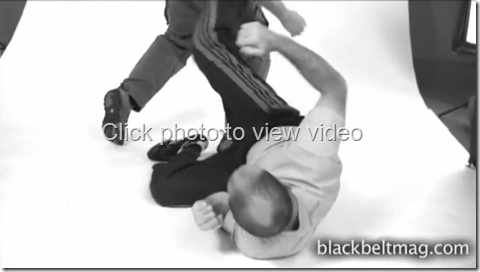
Defend Yourself From Kicks while on the Ground (video)

It's Technique of the Week Day - Krav Maga
(Click the picture to go the video page if you cannot play the video below.)

In the event of an attack, there is a high likelihood that members of one or both parties WILL go to the ground, for whatever reason-slip and fall, takedown, throw, or as a result of a strike.

Black Belt Magazine’s Facebook page has posted this video as their technique of the day . Their description: “In this vid. clip, Yanilov demonstrates a series of krav maga defenses against variations of the front kick.” Video after the jump.

Tuesday, August 30, 2011

How to Improve Your Kicking Skill - Part 1

Just how do you improve your kicks in the martial arts?

I received a question on Twitter reference improving kicks, and thought I'd post the answer to share with all of you. Cause I'm nice like that!

About developing kicks:
  1. They are unnatural: An example of a "natural" kicking motion is, walking along a road and seeing a can, then kicking it down the road. Natural. Learning to knock someone out with a 540-degree roundhouse kick. Not natural. Most of the kicks in the martial arts (and all martial arts) are "unnatural," in that the motion has to be learned - they are not the types of mechanics that are used in everyday life, so they have to be taught, and we have to build muscle memory. That takes time.
  2. You're not born ready: Along with mechanics (technique), you need conditioning and attributes, like muscle endurance, strength, and flexibility to be an awesome kicker. That takes time.
  3. Even if you can do them, can you use them? Kicks are not a static exercise for most of us; they have a purpose, namely to impart some accelerated mass at a particular point in time and space-meaning to blast someone, and do some damage! So you need to learn the distance required to throw a particular kick in your arsenal, and then you need to learn the timing required to hit at the point of maximum power. For example, a baseball bat is weakest at the beginning end of the swing. We need to learn to time our swing to hit the ball at the point of maximum power. Kicks are the same. That takes time.

Wednesday, March 16, 2011

The Basics of Self-Defense Training

[This was built from one of my first serious attempts at passing along practical information from this site, rather than using it as a training diary in 2004. It was originally posted as Practicality in Training. It still encompasses much of my outlook on martial arts training. Comments are appreciated.-Nathan]

I've always looked at martial arts, in general, as an equalizer, much like the Colt 45 in the old west. I believe that you can improve your chances of survival in all self-defense situations if you have some training. For that training to be effective, though, you have to train as if you're in the situation.

This brings to mind something saw last winter at the skating rink near our home. As we were waiting for one of our kids' lessons to begin, I watched as the figure skaters were warming up in the main lobby area. Some of the competitors were just stretching and moving around, but a couple of them were practicing their jumps and spins in the air, then landing on the floor in tennis shoes. I realized that they were not only practicing some of the mechanics of the technique or jump, but from the focus, they were visualizing being on the ice.

That's how we should utilize the components of our training - everything can, and should, have a practical component. How often will we use a technique? Hopefully, never. If we need to, I don't think it's as important as being prepared to usewhatever we have ready. By this, I mean that if I have very heavy boots, restrictive clothing such as jeans and a winter coat on, I probably won't be kicking very high, if at all. But, I should have full use of my hands, and can count on some protection from my clothing as well. If you've ever worn bag gloves, you can attest to the fact that you can hit a lot harder with them on than with them off.

What's more important than what I wear is that I have mental preparation and confidence that I can avoid or handle something. So how can we prepare?

How can you make your self-defense training more practical.

  1. Train with self-defense in mind - How can I actually use this block, kick, punch, or grappling technique to save my life? Every technique, once learned properly, should be filled with intensity and purpose. Take nothing for granted. It could save your life.

  2. Drill scenarios like being attacked as you get in or out of your car; pushed from behind; grabbed from behind; tackled and pinned; in very light or dark conditions. Have you ever started out a grappling or groundfighting session on the ground, lights out or blindfolded? Drill being at an ATM and getting approached from behind. Practice in the parking lot. Read the crime blotter in your local paper and build scenarios from it.

  3. Train outdoors in street clothes. Make your training environment more realistic by wearing what you normally do. If it isn't appropriate, wear something close. As Bob mentioned recently, and I have many times, training wearing footwear is completely different than barefoot. Why on earth would you think that you can pivot, slide, or move the same with street clothes as you do in near-pajamas? Why do you think the military trains combatives in body armor, helmets, etc? Take a lesson and get it in gear!

  4. Train in confined spaces. Use a parking lot area marked off and surrounded (against a car), simulate an elevator or office area (or really use one if you make sure it's OK).

  5. Mentally rehearse. Inconspicuously look someone over so that you could identify them. Go from head to toe: height, build, skin color, facial hair or other distinguishing characteristics, clothing, footwear. Listen to his voice. Accent or anything else that stands out? Could he have a weapon? Think about what you would do versus an initial move or attack by that person.

  6. Think of escape routes. Never a good idea to turn your back, but, can you get away without being exposed to potential danger? One of your first moves when going in to a location is thinking of how you would get out. Much like defensive driving, knowing an escape route is key to being able to avoid dangerous situations.

  7. Practice the dynamics of fighting, not sparring. There is a very big difference between fighting and sparring. As you may know, sparring can be pretty, rhythmic, clean (technique-wise), and can take a while. Sometimes in sparring, you need to pace yourself. Fighting is all-out, vicious, and messy. It doesn't have a discernable rhythm, and there is no referee, or clock, so you don't have rules, and sometimes pacing yourself is going to mean you give your opponent more chances. Fight like you're in a toughman contest with only sixty seconds to win the whole bout. Sparring has it's place, but reserve time for serious fighting drills as well. Contact is critical to training to survive. If you aren't used to getting hit pretty hard, you're probably not going to make it outside the training hall.

  8. Train to survive fighting more than one person. Try to spar, at first, with more than one person until you get pretty competent at it. Then try to fight against a pair of partners that are working together to try to tackle or pin you. If you're really brave, try this against 3. Escalate the intensity and difficulty just a little past what the "defender" is ready for occasionally. Afterward, sit down and discuss what worked, what didn't and why. Learn from your losses and wins. Open up with different objectives, like the attackers are really pissed, or only want your wallet, or are just out to hurt you.

  9. Train to defend and survive an armed attack. Introduce weapons into your training as early as you can. There should be clubs, edged weapons, and handguns in your training. Add them into your skill set, then learn to defend against and use them. Add a club into the mix, or a blade, when sparring. Have someone pull a training pistol or squirt gun during drills and see how you handle it. It will, more than anything else, open up your mind to how your current skills need improvement. Who cares how many guys you can tap if someone else can double-tap you in the chest with a pistol because you aren't looking for it.

  10. Use your environment to survive. Dr. Jerry Beasley said that one of the first things he looks for in every self-defense situation is for something to throw. He wants to make sure he can blind, stun, or injure an attacker so that he can get away. A great approach. Also use objects in your environment to put between yourself and danger, anything that can give you a millisecond more to react if there's a threat. I think it was Hock Hochheim that wrote about some of the subtle things that officers do to maximize reaction time, like standing behind a fire hydrant or up on a curb. Are there any objects in your vicinity that your could improvise with? A broom could make good use of your bo skills. Similarly, I love having a short umbrella in my hand because I know that my Arnis training will let me make short work of most attackers, even a knife-wielding one.

In short, most of us start training with the idea that what we learn will help us in self defense. In many cases, it won't. Unless you train like your life depends on it.

Photo source: Wikipedia Commons

Monday, August 16, 2010

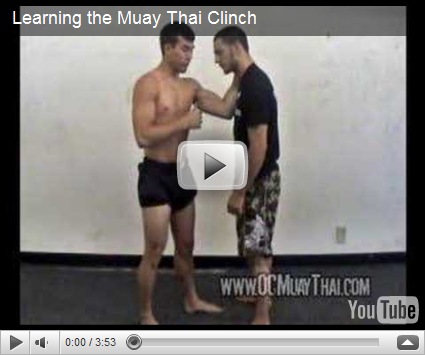
How to perform the Clinch in Muay Thai

Our post, Defend the Thai Clinch, elicited a response in the comments of “They are actually doing it wrong,” with a link to this video:

Couple of points:

  1. There is a lot of merit to clinching high, on the head. This is a good habit, and I agree with, and recommend this video. There are many benefits to doing it.
  2. I always found it easier to escape a higher clinch like this. Not to say that it isn’t better. Learn it. Learn to defend it. Learn why it works and how to counter it.

Friday, August 13, 2010

When Does a Circular Technique Trump a Straight?

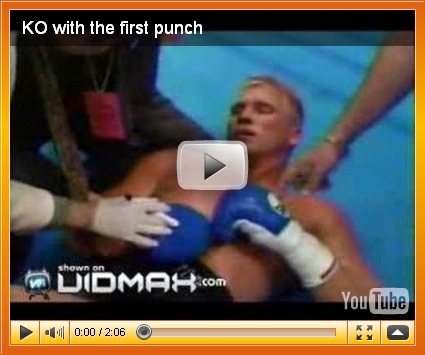
Check this out:

In this case a counter overhand worked because the lead-off fighter did not connect with his jab. It could also be argued that he overcommitted and walked into the counter overhand right. A more conservative approach, hindsight being 20/20, would be to pump the jab while circling away from James Thunder’s power hand (his right), and not commit until the opponent made a mistake. Thunder (the counter fighter) slipped the jab well, and threw the right over the committed jab.

In my experience in fighting and sparring, the easiest thing to handle is a committed lead technique. In striking, “committed” can be defined as a technique thrown with the distance and penetration to not only connect, but to drive through the target. You usually see this behavior from those with little training, or much. In other words, am untrained, aggressive fighter, or a highly trained fighter who is confident he has little to fear.

In most cases, I’d hazard that that type of commitment is a mistake, which can cost you dearly, as in the example of the KO above, but it can also lead to a quick knockout delivered by the committed lead-off fighter, as we’ve all seen many times.

My advice is to not be lulled into the idea that you can take anyone out with your first technique. A scientific fighter, one who uses high-percentage techniques, tactics, and strategies, will usually employ a true lead to:

  1. Gauge the reaction time and habits of one’s opponent,
  2. Close safely, cover the distance with a barrage of fire while moving close enough to make contact – that prevents a committed counter and puts the opponent back on his heels and unable to transfer his weight to attack or counter (rendering his nearly powerless) and
  3. Set up techniques based on the above.

A good example is the 1-2-3 tactic. It’s a lead jab (1), usually eliciting a step back or a parry by the counterfighter, then a straight right (2), which if the opponent moves straight back will set up the range perfectly, and, whether the opponent covers up or rolls the rear hand straight, his inside line will be occupied, and the outside open for the hook (3).

Have any other good examples? They are there is all styles, from boxing to Taekwondo, grappling,  to fencing, to the battlefield.

For more information:

TDA Tip: Always Use Combinations
Creating Combinations
High-Low combination: Jab-Side Kick
Taekwondo Fighting Strategy - Broken Rhythm
Nut Kicking and Ball Busting Girls?
Why Do We Get Hit?

Wednesday, April 28, 2010

Violent Handshake Response – Kelly McCann

Has this ever happened to you? Someone turns a handshake into an attack? How can you respond?

What do you think?

Saturday, March 06, 2010

Ground self-defense options

This was posted on Striking Thoughts most recent Martial Arts News post.


My take on women's self defense changed quite a bit about 15 years, ago, and the physical instruction actually starts on the ground first, then we work our way up to a sitting, then standing position (where most start).

Any technique you teach for self-defense which do not work on someone much larger and stronger than you should be secondary. Check out more at Jiu-Jitsu Sensei's site here.

Like this post? Subscribe to our feed, or follow us via Twitter

Tuesday, February 23, 2010

Thursday, November 13, 2008

Todays TDA Tip: Protect your centerline


Why did the guy on the left (Sam) get hit? Direct route in. Notice the lead-off fighter throws a weapon between the two. The counter-fighter attempts to use the side-kick counter, but it's too slow compared to the jab. The reason this worked is that the counter-fighter's lead was low, and aimed at the floor. Remember to keep a weapon between yourself and the opponent. In this case, if the counter-fighter had his lead up and aimed (covering the centerline), the opening wouldn't have been there in the first place.

Note: originally posted here.

Wednesday, October 15, 2008

The King of Combinations for MMA, Boxing, and Self-Defense

image Also known as the Jab-Cross, or Jab-Straight Right, I believe that the 1-2 is the best single punching combination in the known universe for humans. Delivering maximum power at the optimum long punching range, it is the simplest setup and finish in orthodox Western Boxing. It's also common to almost everyone, even untrained fighters, and thus every fighter or martial artist should drill against it, even if it's not "traditional."
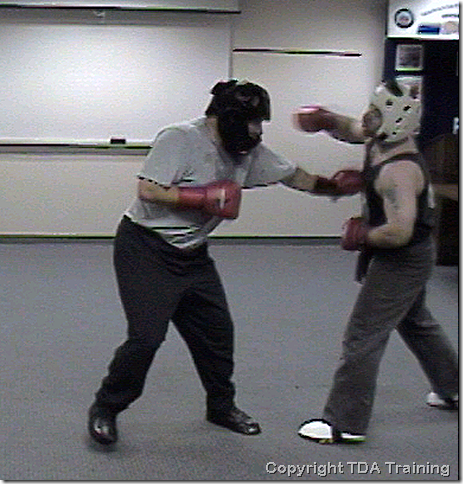
The best targets (with a fist):

Chin: There are probably more knockouts in boxing and MMA with a straight or cross to the point of the chin than almost all others combined. That's why one of the first lessons in Muay Thai, Boxing, or MMA, is to protect your chin by lowering it into your torso and keeping your hands up, and in the way.

Nose: It have less effect on a trained fighter, especially if he's had a broken nose before, but for self-defense, one of the easiest and best targets is the nose. Using the straight right, cross, or palm heel at the same angle, the nose being struck results in plenty of blood, mucus, and tears from the victim. It prevents him from seeing well, and invokes a nice feeling of nausea and dizziness in the best of us. My first boxing smoker was stopped because of getting hit in the nose, though I was giving my victim a beating (I also had a kickboxing match later that weekend). I've also been stunned by my kids jumping up to me as I reached down to give them hugs. I had to sit down and just suffer. Very effective.

Temple: Many a quick knockout has resulted from this punch. Often a glancing blow with a cross to the side of the head results in a KO.

Brachial Plexus: A collection of nerves on the side of the neck make this a great target for a stunning punch. Not for any situation but life-threatening self-defense situations, this target will take down almost everyone.

A few examples of the 1-2:


  1. In this first example, it's easy to see how critical distance is when delivering the 1-2, and how easy it may be to hit too hard in sparring. If the opponent tries to duck and his weight is going forward (all of a sudden), he can get knocked out. If the opponent is too close, it reduces the power of the punch, and sometimes the aim, plus the right can leave you vulnerable for a left hook.

  2. This is in the context of the MCMAP Program's Tan Belt curriculum. Watch the Jab, then Straight, then the 1-2.

  3. Back in the day, Mike Tyson was actually a very good fighter. Watch the first two KOs are of the 1-2 variety.

Tips for making the 1-2 effective:

  • Punch through the target (with the 2) - see below
  • Use the jab as a feeler slash range-finder. If you are making real good contact on a jab, you're too close, and your jab will probably knock your opponent out of range for a good straight. Instead, try to be at a range where you're barely making contact with the jab or just missing, then when your step in the right, full extension will be a few inches past the target for maximum damage.
  • Don't always do the same thing. If you habitually throw a 2 (cross or straight) after a 1 (jab), you're going to get countered in a bad way. Mix it up! Throw 1-1, 1-1-2. and sometimes lead with a 2. Use many of the other combination that work well. Use kicking and takedowns, too.
  • Use the 1-2 to set up the takedown as he shifts his weight back to defend.
  • Use the body punch, too. 1 high, then 2 low, and visa versa.

For more information:

TDA Proper form on a 1-2 combination
TDA Reliable boxing combinations
TDA Boxing Punch Numbering System
TDA One-One-Two Combination
National Geographic Fight Science Martial Artists' Moves Revealed in "Fight Science" Lab

Photo Credit: National Geographic Fight Science

Saturday, October 11, 2008

Repost: Timing Counter

[Nathan- Originally posted in July of '04, the timing counter is one of my favorite types. It can only be used if you're already certain of how the opponent throws a strike. That knowledge will enable you to beat them to the punch (stop-hit), or make them miss, thus getting out of position. Try it, you'll like it!]

Timing Counter
TIMING Counter: Dropping a right hand over a lazy lead. This will work if the lead-off fighter throws an uncommitted jab, or drops it on the way out (when retracting the punch). Remember, the best defense really is a good offense. If you commit fully to an offensive technique, and your tactic is sound, the counter-fighter will be forced to defend the technique-creating openings-rather than counter. This will only work with commitment. In this case, the counter fighter also has used a draw by keeping the lead hand low to leave the head vulnerable-drawing the lazy jab. Nice.

Monday, September 29, 2008

Boxing with the Dojo Rat

Dojo Rat on Boxing

No, not me - I'm too smart for that! It's interesting that DR has started a series of good video on boxing technique. Check out his current posts, Jab-Cross-Hook Drill, and Jab-Hook Combo, with the promise of more to come. It's interesting to watch the perspective of guys who I know have studied "hard styles," but seem to have more of an internal martial arts perspective post and talk about boxing, one of the more well-known Western hard styles.

Check them out on Dojo Rat's site, but take some time to head over to YouTube and check out the Dojo Rat channel where you can see lots of great instructional video. Then head back to TDA Training, of course!

For more information:

TDA Boxing Category
TDA Instructional Category

Friday, July 04, 2008

A good big man...

It is a maxim of unarmed combat that even a very skilled smaller man is always at a disadvantage versus a skilled bigger man. In other words, size matters - a lot. This, by the way, is one of the reasons I've always advocated weapons as an "equalizer." I don't care how many martial arts classes a small woman or elderly person takes, they may never beat a large vicious male, or more than one attacker. A weapon changes that dynamic completely.

Back to the subject at hand, let's use the match-up of a good big man and a good little man here to illustrate the point. Watch Joe Frazier versus the big George Foreman. Some of you may not know this, but at one time George wasn't just a grill salesman on TV. Watch.

What do you take from this? I'll give you my impressions, and ask for yours in the comments below.

  1. George Foreman outweighed and outreached his opponent. Joe Frazier was 5'11" to George's 6'3", but their disparity in weight and reach was certainly greater, with Foreman probably weighing close to 225, and Frazier no more than 205 (he would be a very small heavyweight today).
  2. Frazier was the certainly a skilled "little man." He was the undefeated heavyweight champion of the world at the time, and had earned the belt by first winning a "tournament" of bouts to fill the vacated throne of Muhammad Ali (who was stripped of his belt by refusing induction into the military during the Vietnam conflict), and then legitimizing his reign by convincingly beating Ali in a 15-round decision. Prior to Ali and Foreman, Joe Frazier had defeated a who's who of top heavyweights of the day: Jerry Quarry, Jimmy Ellis, Oscar Bonavena, and Georges Chuvalo. He was 29-0, with 25 KOs, and was on top of the world. Was the big Foreman a match?
  3. Frazier was never in this fight. Foreman took a few glancing blows by Frazier early in round one, but from that point on, it was a systematic and inevitable destruction of the smaller man. After three knockdowns of Frazier in round one, Foreman finished the fight in the second round after the Joe Frazier's sixth trip to the canvas.
  4. I am glad that there is a three knockdown rule today, as it spares fighters undue punishment and reduces the likelihood, in my opinion, of permanent brain damage due to concussion. Frazier and the fighters of his day had no such protections.
  5. Frazier was like meat served on a platter for Foreman. To fight a larger man, one should use angles of attack, and stay inside (closer). Foreman witnessed a small man who attacked straight ahead with indirect attacks (hooks), and couldn't stay inside because he was able to parry him aside or push him back to keep him at his ideal range. A smaller fighter needs to be behind or beside a larger fighter and force him to have to turn to bring his weapons to bear.
  6. As mentioned in the previous point, closing the gap should be done with a proper lead, or any weapon that forces a defense, thereby creating an opening.
  7. While Frazier's punching power was tremendous, it relied on the accuracy of his only real weapon, the left hook. He couldn't get close enough to George Foreman to land it. On the other hand, Foreman's power was based on his weight and uncanny strength. Any part of the body that Foreman hit was a good target - it hurt! He did a good job of mixing body shots with straight punches, then almost literally took Joe Frazier off his feet, seemingly without effort.

While this was a fight that, stylistically, George Foreman would win 99 times out of 100, it's worth studying to develop your own tactics.

For more information:

TDA What is an effective lead?
TDA The Three Cs of Sparring: Offense and Defense - repost

Tuesday, May 20, 2008

Repost: Snap-Back to Counter

This is a repost of a nice counter technique, the snap-back. When slipping a punch in boxing or kickboxing, there are several options: slip inside or outside (see example versus the jab) the attacking arm, bob (dip straight down by bending the knees, or, the little-used SNAP-BACK. Check out how you can use it. - Nathan

Drawing the lead

Snap back and prepare to push off

Drive off the rear foot

Counter with the straight right

Follow throw with the straight right

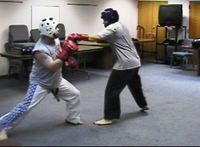
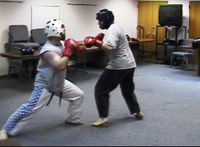
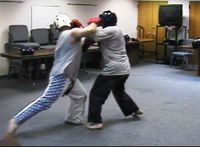
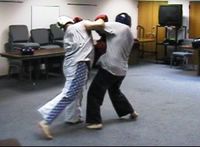
Snap-back and counter right: The lead-off fighter, on the right, leads, but only singles. Also notice the lead is dropped as it is retracted. The snap-back of the counter-fighter shifts the weight to the rear foot, and protects the head by moving it out of range. Quickly pushing off the read with the counter is accomplished by not leaning back, just shifting the weight.

NOTE: The key to this technique is to keep the weight forward! This is accomplished by taking a step back with the rear foot that is just enough to make your opponent miss, and reach. Make sure you keep the weight on the front foot and plant and push off with the ball of the rear foot. The over-extension of an expected scoring shot will over-extend the lead-off fighter's technique and create an opening for your counter. - Nathan

Thursday, May 15, 2008

Breakdown of the High Thai Kick

I like this video analysis of the Thai kick to the head.

The only thing I'd quibble with is that the counter-rotation of the upper body by swinging the lead arm counter to the direction of the kick is more for balance than torque. My opinion only, but the torque is created by the lead foot stepping out, toes angled out at 45-degrees from the target, and the rotation of the hips into the target.

One other safety point: make sure you pivot on the ball of the supporting foot. If you plant it your knee will blow out a la Jason on the Human Weapon. One of my students did the same thing during a test and it was ugly.

Via: Fight Geek: High Round Kick

Thursday, May 08, 2008

Repost: Close to Roundhouse Knee

I thought this 2006 oldie was worth reposting, Close to Roundhouse Knee. I've been so busy the past few days I haven't even had a chance to stay caught up on email, much less create posts (I've got about 75-100 drafts, but none ready). So to tie you over, a good blast from the past, the offensive check with a round knee attack. This has utility in sport MA (MMA or Muay Thai), self-defense, Combatives, or defensive tactics (DT).

A few points: the lead technique doesn't always have to do damage, it just has to create or exploit an opening. The lead-off check is a great use of that tactic. It can transition to a trap, pressing to remove the threat of a viable counter (the opponent is off-balanced), and keeps the attention on the upper body, setting up the knee opening. Enjoy. Comments are encouraged!

Offensive (not counter) use of the knee:
1. Instead of closing the gap with a jab, the lead-off fighter uses a check of the right hand of the counter-fighter.

2. Inside the guard, and on the flank, the right hand latches behind the neck.

3. The knee to the face is delivered. The important thing to remember is that as long as you close the gap properly, any technique can be used - even a "counter". Why wait for your opponent to lead-he might hit you! Maxim: "It's always faster to act than to react."

For more information:

TDA Check, step-around, and counter
TDA Video: Checking your way to surviving multiple opponents
TDA How Long Do You Press the Attack?
TDA Checking

Tuesday, April 29, 2008

Send this to Anderson Silvas future opponents

This is a post I've been wanting to make for a long time - a prescription for someone to defeat Anderson Silva. Will it work? Probably not. But, from my vantage point, where Silva excels is in the clinch. Too many MMA fighters fall prey to knees after being tied up in the Thai clinch, so I am doing my part to help preserve the looks and brains of the past and future victims of Silva's knee! Watch his match with Rich Franklin:

Then watch the aftermath in this video (language warning) which details some of the damage that Franklin took by his inability to handle that clinch.

What defeated him? The inability to handle the Thai clinch and knee. All of the other openings were created by the Thai clinch inside position that Silva took, then the subsequent knees to the face that set up his defeat.

For help, check out this post at some site called TDA Training (never heard of it, but this post is OK):

Defend the Thai Clinch

Thursday, April 24, 2008

Video: Arnis options

A nice demonstration of the options available in Arnis. I'm not familiar with the master instructing here, but his skill and knowledge are evident. Enjoy.


Thursday, April 17, 2008

Video: Setting up the Hook Punch

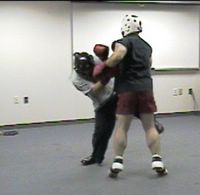
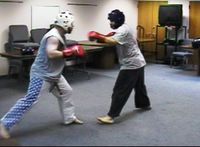
Unfortunately, this clip is short, and you may have to watch it a couple of times because there's no slo-mo option. It actually illustrates a couple of things:

  1. Using the 1-2 to set up the hook (3). The 1-2 closed up the guard of the fighter with the black headgear, and brought his hands up...
  2. The hands being brought up set up a body hook.

As was stated in this short post on building combinations: use the high-low, and inside-outside to develop your openings with combinations. If I use 1-2 (inside, straight punches) high a couple of times, my opponent will guard against it when he next sees it coming. Then, a low, outside punch (body hook) will probably succeed. The key is to throw the opening moves with conviction so that they elicit a mandatory defense. Also, this could easily be reversed, for example, I like to use a close-in body shot (hook) to set up a straight right against someone who retreats straight back when hit. If you want to learn to set up combinations, just hit someone and see what they do [Author: not to be construed as recommending the reader hit just anyone - only sparring partners with whom one has a previous relationship and history of such violence.]

For more information:

TDA Boxing Punch Numbering System
TDA Creating Combinations
TDA Reliable boxing combinations
Today's TDA Tip: Creative combinations
TDA High-Low combination: Jab-Side Kick
TDA Boxing Combinations: Jab-Lead Hook Combination
Today's TDA Tip: Always Use Combinations
Today's TDA Tip: Become a Touch Typist
TDA How to Create an Opening: 101

Technorati Tags: