Bunkai Jutsu posts What's The Difference Between Karate & Tae Kwon Do? Huh? Are they different?
Sunday, April 10, 2011
The Difference Between Karate & Tae Kwon Do
Wednesday, March 30, 2011
Blogs You Should Read: Martial Arts Spectrum and The Dragons Orb
Two such sites are Martial Arts Spectrum and The Dragon’s Orb.
Martial Arts Spectrum is a relatively new blog (started in January of this year), but is off to a great start. I’ve been burned before by featuring and linking new sites, but have a feeling that this one will be with us for a long time. Author Craig Willits runs a school in Fredericksburg, Virginia that features formal instruction in ATA Taekwondo, with an adult program that includes techniques from TKD, Krav Maga, vee arnis jitsu, and defensive tactics. A nice mix.
Mr. Willits writing interests me because his focus is on the practical or self-defense aspects of technique and tactics, while not ignoring the strategies necessary to employ them. He is also not afraid to express his opinions in a blunt manner, and, more importantly, give the reasons for those thoughts.
Some good recent examples of MAS posts are:
Kata Evolution: A Video Comparison
Refractions 3/28/2011: Sumo, McGruff, and Daniel-San – a great weekly collection of links. I hope he adds labels so that we can review or reference past posts that way.
Taekwondo for Self Defense
The Jumping Jack Brain Scramble
Check out Martial Arts Spectrum whenever you can, and look for his latest post the sidebar under “What I Read” for a link.
Another recent discovery is The Dragon’s Orb, written by the mysterious Sensei Strange, whose moniker should give you an idea of the flavor of the content: irreverent, fun, but insightful. Strange’s self description is “Martial Magi. Exploring the path through exploration, introspection, a deep love of people and sense of awe.” Love it! I have to admit that I didn’t really discover this site, it was actually there all along, and I saw it linked several times on Pat Parker’s Mokuren Dojo site, and had to check it out.
From what I can see, there is a heavy emphasis on Aikido content and much is filtered through that context, though
I am only beginning to explore The Dragon’s Orb, but to give you an idea of why you should do the same, here are a few posts to whet your appetite:
Training Montage a post which immediate gave me pangs of envy ‘cause I don’t have a montage myself, and as Strange says, “What you don't have a montage? ...And you call yourself a martial artist. Sheesh.”
Interesting Ashi Waza – Sapu contrasting the footwork of a silat instructor’s ideas with ashi waza.
The Definitive Shomen Ate which does what Sensei Strange seems to do best, expound on concepts and ideas using words and video exposition.
A heavy and satisfying dose of instruction is what you’ll get with every post at The Dragon’s Orb. So head over and check it out, or look on the sidebar under “What I Read” for a link to the latest post.
____
Like this post? Subscribe to our feed or by email and you won’t miss a thing.
Please interact with us at our TDA Training Facebook page!
All original material is copyright of their respective authors.
All rights reserved. Permission must be obtained before use. Copyright 2011
Friday, March 11, 2011
Taekwondo Competition Rules and Self Defense
Photo credit: Aminoacid91
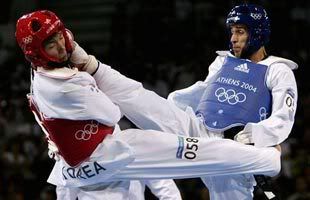
A nice post by Self Defense Source on the difference between ITF (International Tae Kwon-Do Federation) and WTF (World Taekwondo Federation) rules for sparring in competition. Why post about specific federation rules? Well, it relates to the discussion started by John Zimmer at My Self Defense Blog on what I called Competitive Distortion in Martial Arts Competition, meaning how tweaks to the rules emphasize (or de-emphasize the practicality of certain techniques. Zimmer’s post focused on open tournament rules, and then it started a healthy discussion on MMA in his comments. The Self Defense Source post is a pretty fair comparison of the difference, pros and cons of the two federations’ rules, with the admonition that, “Although both organizations have admirable characteristics and traits, receiving training in WTF vs ITF Tae Kwon Do, can lead the student down different paths.” What are those paths?
The gist of it is that, “Individuals who want to compete in tournaments that may lead to Olympic try-outs will be most interested in the WTF sanctioned schools. When self-defense or the art of movement is the goal, the ITF sanctioned schools will be most appropriate” Absolutely correct. Or is it?
Full disclosure: I hold black belt ranks in both styles of TKD, but favor the ITF. I do recognize, however, that there are distinct advantages to the WTF approach, at least as I understand it (not having taught pure TKD of any flavor since 1996). The two biggest advantages for the self-defense oriented martial artist is that WTF competitive sparring is very physical – heavy contact is the only way to score; in some traditional (ITF) competition, power is de-emphasized over clean technique and control (reducing power while retaining speed and technique). There are other differences, and to make it easy for even someone like me to understand, here is a handy comparison chart:
| Comparison Point | WTF | ITF |
| Knockouts? | Allowed (wins) | Not allowed (Disqualification) |
| Power Level | Heavy (to score at all) | Controlled (or point deductions) |
| Body Protection Equipment | Yes | No |
| Head Punching | Illegal | Allowed |
| # of rounds | Three with 1-minute rest periods | One 2-minute round |
| Continuous Action? | No | Yes |
| Point Scoring | Body (punch or kick)=1 Turning during score+1 Head kick=3 | Punch to head or body=1 Kick to body=2 Kick to head=3 |
Can you pick out the distinct advantages for self-defense oriented practitioner? No? Well, it’s not that clear. Here’s my humble opinion, and I’ll invite our TKD oriented readers to correct and interject as to whatever I may have missed.
To sum up, I think both are unrealistic enough due to the emphasis mentioned in John’s post about open rules: more points for head kicks. That leads to a distortion in that what is being used in competition is one of the last things you want to use in self defense. Sensei Matt Klein’s comment in the Zimmer post was right on: for a sport that can also apply well in self defense, pick MMA.
For more information:
Read the original post at Self Defense Source
Traditional Taekwondo Techniques
____
Like this post? Subscribe to our feed or by email and you won’t miss a thing.
Please interact with us at our TDA Training Facebook page!
All original material is copyright of their respective authors.
All rights reserved. Permission must be obtained before use. Copyright 2011
Friday, January 09, 2009
Taekwondo versus wildlife
This was sent to my by my old muay Thai and boxing buddy Brian, and I just had to post it. Enjoy!
What do you think. Is it realistic? I’m wondering how other styles would fare? There goes that old style vs. style argument again…
Thursday, November 27, 2008
Impressions, Aikido, Karate, and attacking first
Ever thought provoking, Colin's Traditional Taekwondo Techniques (an excellent blog sharing the techniques, training methods, and philosophy of one who teaches an older, and yes, more traditional form of TKD than you usually see), responded to our post, Impressions, impressions... with his own, which I will quote and to which I will respond below:
There is no first attack in Karate ... by Colin Wee
This is a response to Nat's post Impressions, impressions ... on the TDA Training Blog.
In a deadly environment where ruthlessness was the norm, it would be the wise instructor to promote peace and harmony whilst equipping the student with the tools to defend or de-escalate the situation if it got out of hand. Funakoshi, father of modern karate, called for 'no first attack' in Karate. Ueshiba, the founder of Aikido, focused on defensiveness and spiritual oneness, rather than on the lethality of his techniques.
In Nat's post, impressions are enough for you to judge the fighting prowess of the people around you. Yet there is still a lot of dumbness that get people into road rage, bar fights, and other brawls ... especially when the evening wears on. Dare I say these guys should be at the dojo practicing?
Indeed, the philosophy of Funakoshi and Ueshiba, as well as Judo's founder, Jigoro Kano, was to avoid or de-escalate any situation in which violence may result, and their teachings clearly reflect those ideals. Morihei Ueshiba and Kano created their styles from the ancient battlefield art we know as traditional jiu-jitsu (as opposed to BJJ), which contained the footwork, postures, locks, throws, chokes, and falls of both arts, but also incorporated many more offensive techniques. Jiu-jitsu has every element of an offensive combatives (military application) system of unarmed combat, including open and closed hand strikes, kicks, strangles, weapon defenses, and deadly finishing moves with the explicit intent to maim or kill. Funakoshi's Shotokan Karate, on the other hand, is a direct descendant of Okinawan "kara-te" (China hand), which was a civilian art with a primary emphasis on striking. Indeed, it was he who changed the meaning of "kara-te" to "empty hand," denoting those devoid of offensive weapons.
My opinion is that all three, Funakoshi's karate (as opposed to other styles of karate), Uyeshiba's Aikido (the "Way of harmonious spirit), and Kano's Judo (the Gentle Way"), are a product of their environment, and do not represent the entirety of their respective antecedents. All were formed or matured in the shadow of World War II's militaristic expansion of the Japanese Empire, with all of the barbaric acts committed therein. My reading of history is that the post-war years were characterized by large elements of pacifism, with rejection of arms, violence, and weapons resulting from occupation and national shame. In all three cases, those arts were perfectly positioned to grow and expand in the years when anything that seemed military (or too reminiscent of what had become associated with the Bushi or samurai class was either forbidden or strongly discouraged). Judo was promoted as fitness and safe competition, Aikido was a spiritually rich alternative to violence, and that laid the groundwork for a politically correct Karate (Shotokan) to eventually become popular.
I am not saying that the origins of these arts are all post-war, just that they probably survived and thrived because of their seeming rejection of the aggressive nature of their parent arts. All three still contain the seeds and even techniques of their more violent forebears, but are all restrained by the moderating principles of their founders. Indeed, those philosophies are the ideals to which the faithful aspire: non-violence, non-aggressive, or, at least, not "attacking first."
A careful reading of the original post to which Colin is responding is one in which I actually express skepticism of the idea of judging a book by it's cover, or, an opponent by his appearance, not agreement with the concept. But re-reading it after reading Colin's response got me thinking that Colin may actually be advocating the opposite, passive-aggression through stealth!
[Is this man causing conflict?]
One of the core things in our system is that we shouldn't engage the opponent in any way. The posture we sometimes favour is called 'please don't hurt me' ... head hung a little lower, hands up with palms outward, and standing straight ahead. We take some of our drills in this manner, and we dish out some strikes from this starting point.
On the surface, Colin's preferred posture might be interpreted submissive, and invite attack. It's non-aggressive, but I've learned over the years that someone who appears submissive may not attract good will, but aggression or bullying behavior; in other words, bring on, or invite aggression. Knowing a little about what Colin probably teaches (based on his writing, videos, and my black belts in TKD), I'd bet that his students are anything but wimpy, and he's actually promoting a good defensive posture, not really "please don't hurt little ol' me" body language. On the other hand, though, if he is advocating that posture, but teaching powerful striking techniques based on out of a posture that invites attack, then he's actually starting fights! Wow! I'm not going to pick on anyone who seems wimpy anymore, 'cause they might actually be getting ready to ambush me after reading Traditional Taekwondo on the Web!
I'm betting that I've offended a lot of people, started some arguments in Australia, and made Colin regret revealing his hyper-aggressive stealth world takeover tactics to me, the decoder of ancient and modern secrets! The Illuminati have to be worried!
Heh.
Have a great Thanksgiving.
Wednesday, October 22, 2008
Side Kick Striking Surface
I was preparing another side kick post, when I happened on Colin Wee's excellent, Won-hyo: The Taekwondo Side Kick, and this nugget, "Blade or heel of the foot? ...Typically I kick with the blade of the foot - but lately, with suspected joint inflammation/arthritis developing in one of my hip joints, I've opted to reduce as much torque on the hips as possible. So I've been experimenting with focusing power into the heel and adding a little more 'snap' in the leg extension - so the lower leg travels faster. This seems to increase power and keep my joints happy."
Great post there, please head over and read it all. Couple of points:
- Side kicking with the "blade" of the foot is a technical skill, and is only useful for aesthetics, and only possible when barefoot, or wearing very flexible footwear. It has no place in the arsenal of someone who's engaged in combat with boots, hard shoes, or similar footwear. As Colin mentions the last sentence of his quote, kicking with the heel is more powerful. A bladed side kick striking surface should be used in a side snap kick, not a thrust kick, even when barefoot.
- You should never drive and lock a joint. Always snap. Always. Nothing seems to wear out joints more than continual locking during striking techniques. It wears on the elbows, hips, and knees. So if you want to be kicking into your golden years, try snapping, not locking your kicks.
Sunday, August 03, 2008
Colin Wee on Traditional TKD
A very nice interview of Colin Wee at Traditional Taekwondo Technique Workshop, one of my must-read blog buddies. Of note to me, he discusses the origins and recent history of TKD.
From what has been told to me by A-KaTo GM Keith Yates, A-KaTo’s Taekwondo was brought over from Korea in 1955 via the auspices of Tang Soo Do practitioner GM Jhoon Rhee. Note and compare this time period with the military martial arts demonstration for South Korean President Syngman Rhee in 1952, historically significant for Taekwondo as President Rhee who would then ask for all troops to be trained in that martial art, and the subsequent accepting of Taekwondo as the official name of that style in 1955. GM Jhoon Rhee’s early Taekwondo export, still used by A-KaTo, continued to be practiced in the Southwest USA separate from the Taekwondo further refined by the ITF and WTF organisations.
So where global Taekwondo embarked on rapid fire expansion, A-KaTo black belts continued early Taekwondo’s close ties with Karate, often cross training with Karate instructors and practicing Shotokan forms for their black belt gradings. In fact, you would be hard pressed to tell apart an A-KaTo Taekwondo practitioner from a Karate-ka, all of whom are clothed in traditional fold-over white Karate gis and whom practice ‘Taekwondo’ basics in a manner that Funakoshi Sensei, Father of Modern Karate, would be proud of.
This is of particular interest to me, as I trained in TKD for a number of years, and actively taught it until the mid-90's. Whereas I have mostly eschewed that particular style in recent years, preferring what are now called "reality-based" systems and ideas, Colin, a contemporary of mine (based on the interview's references to Bruce Lee) has stayed with it, developing and teaching.
Of particular interest is his mention of GM Jhoon Rhee, whom I have met. I came of age in the Washington, DC area, and for many years would see his TV commercials and hear the familiar closing words, "Nobody bothers me!" An honorable man, and a great ambassador for the best values and traditions of our community.
Check out the interview for more about Colin!
Thursday, August 09, 2007
Why Taekwondo differs from Karate
Let me start by saying "thanks" to Nathan for inviting me to Guest post on his blog!My name is Gordon White. I live in Burlington VT and Teach Taekwondo at The Blue Wave Taekwondo school. I have been a Taekwondo practitioner since 1983.
A couple of things I would like to point out:
1. I make no claims of being a martial arts Historian.
2. The Taekwondo I speak of is that of the Kukkiwon and WTF. General Choi Hong Hi, while crucial to the development of Taekwondo in its infancy, for (insert reason here) was ousted from Korea and relocated to Canada, where he continued to promote and develop his style of Taekwon-do. ITF practitioners are likely take a different approach to the material discussed here.
Taekwondo is being practiced in 30,000 U.S. based dojangs. The curriculum varies so greatly however, that "Taekwondo, Tae Kwon Do, TaeKwon-Do" has become another generic term for Martial arts. The essay that I reference takes a step towards explaining why this is. If you find the topic interesting, I highly recommend following the link and reading the entire essay.
----
My favorite article about the history and development of Taekwondo is by Steven Capener called "Problems in the Identity and Philosophy of Taekwondo and Their Historical Causes" The paper discusses the confused personalities of Taekwondo; Martial Art, Sport, Fitness program, etc. Mr. Capener discusses this from a historical, and philosophical view point. (Eastern Culture and Western Culture).
One section of the paper identifies the deliberate design qualities the Taekwondo pioneers implemented. In an effort to create a uniquely Korean martial art, they literally took the opposite view of many Karate philosophies. (note: Taekwondo Pioneers are mostly students of the men that opened the first martial arts schools (kwans) in Korea after Japanese occupation ended, eventually coming together as a group to develop Taekwondo as single martial art)
The most visible difference was the intent to develop Taekwondo as a sport. This was something many Karate instructors were not willing to do as quoted in Mr. Capeners Essay:
Many karate instructors in Japan, however, did not understand the significance of this process and by insisting that karate must maintain its lethality, actually hindered its development.
Because of the decision to do this, it led to some other changes as well (Quoted from Mr. Capeners Essay):
The aspects of the competition system which generated the development of the original techniques by which Taekwondo became clearly distinguished from karate and in which new, more modern training values were posited are as follows:
A. The prohibition of attacking the face with hand techniques.
B. The prohibition of attacking below the waist.
C. The prohibition of grabbing the opponent.
D. The use of body protection making full-contact possible.
E. A scoring system which awarded points only for accurate blows of substantial power (full-contact). F. The regulations which allow continuous fighting without interference from the referee (except in cases where the flow of the match must be re-established or a warning given).
Its important to note that not all aspects of Karate training was challenged. Forms, 1 & 3 Steps sparring, self defense applications are all still practiced today and are Taekwondo Versions of these Karate drills.
I really like this essay because it makes no comments about Taekwondo being better then Karate, it simply states that Taekwondo took a different evolutionary path, what those differences are, and why they were chosen.
Taekwondo today is largely governed by 2 global organizations. The Kukkiwon, handles Dan certification, Basics, Forms and the Martial Art Curriculum development of Taekwondo. The World Taekwondo Federation ( WTF ) is an international Sport organization promoting and governing the international and Olympic Sport of Taekwondo.
I hope you enjoyed the post and I didnt bore you to tears.
Gordon
Wednesday, July 25, 2007
The Value of Tradition
This past weekend, my wife, kids and I went to a Fuddruckers last Saturday to get a bite to eat. While waiting for our food, I was wandering around the restaurant looking at the various Elvis, Beatles, and Rolling Stones memorabilia, and someone asked me, "Excuse me, but did you used to teach Tae Kwon Do?" Surprised, I studied the young man's face and answered, cautiously, "yes. Have we met?" He answered, "You used to be my teacher."
As I looked at him, recognition dawned on me, and I remembered him, and his two brothers being students of mine. The young man, Khalil, and his brothers, Jamil and Niko, were students of mine at the ages of (approximately) 14, 12, and 7. Khalil was there, wearing a suit and tie, accompanied by his wife and young (3-year old) son, and looked to be about in his late twenties. I verified it by finding out that Niko just turned 21! How's that for making me feel old? It made me realize that I've been teaching the martial arts now for twenty-four years! [Reader please visualize the shell-shocked look in my eyes]
We talked excitedly for a few minutes, and then parted company after I introduced my 11 year-old son and wife to him, then I spent a few minutes thinking about how much of an impact I may have had on him, his brothers, and their upbringing. I hope it was a good impact, and think it was.
We often underestimate how we affect the lives of those around us, or at least I do, but when I reflect on what many of the parents of my students told me, I realize how powerful an impression we can make. How do you act around the kids? Their parents? No matter how they acted, I almost always addressed the parents of my students with a "Mr. or Mrs. (or Ms)" before their last name. I said "sir and ma'am" to almost everyone, whether they deserved that respect or not, and demanded the same of the instructors under me. I believed in setting an example, and still do.
We hold the lives and safety of our students in our hands with our policies and teachings, good or bad. But we also hold a part of their futures as well. Many of my faithful readers will already know that I've long abandoned or lowered the priority of many of the traditions and methods of the arts that I've studied and taught (such as forms, light or no-contact sparring, bowing, traditional uniforms, and removing one's shoes), but some things are indispensable in transforming young people into good citizens, all of which are integral to teaching the traditional martial arts (TMA):
- Courtesy toward others
- Respect for elders, superiors, and one's parents
- Self-control, both physical and mental
- Goal-setting through understanding the belt-earning process
- Integrity, or adherence to a moral code
- Pride, or or self-respect - not an empty self-esteem, but a sense of worth built by overcoming obstacles and challenges
Can we learn the same things in other ways? Sure. There are civic organizations like Scouting, social and religious groups, like churches, and many other ways. However few others do it like TMA!
Now that I've focused, for several years on only teaching adults, women's self-defense, and public safety courses, my perspective has changed a lot, but that "chance" meeting on Saturday reminded me of something for which I can be proud, and TMA instructors, so can you. Thanks Khalil!
Good DR Post on Joint-Locking on YouTube
Check out this post and comments on Dojo Rat's blog for a confluence of Taekwondo history, UFC/MMA, Hapkido, and Count Dante thrown in for good measure, you'll check it out! Enjoy
Saturday, May 05, 2007
Excellent TKD training material
If you are a Taekwondo practitioner, or just play one on TV, you'll appreciate the Blue Wave Taekwondo School site. It's a blog for the students and instructors of the school, but they have taken the time and energy (and I know how much that takes) to detail techniques and drills on video, then share them with us. Most instructors would charge a pretty penny for information like this, but instructor Gordon White allows you to view it for free. For Olympic-style (WTF) TKD, I don't know of a better site. Also, the school's environment seems top-notch, from the outside looking in.Kudos to Blue Wave! Check it out!
Monday, April 09, 2007
When Arts Become Sports
"Last night I’m perusing Half Price Books and come a across ChungI'm probably going to get in trouble for this with my TKD brethren (I hold a 3rd Dan in ITF, and a 2nd in WTF-style), but oh well! Many TKD practitioners may not know that:
Do Kwan: The Power of Taekwondo by Simpkins. The taekwondo that this book
presents IS traditional Chung Do Kwan as practiced in the late 40s and 50s.
After perusing the book and the internet it appears that there as still schools
out there that teach taekwondo like this. Comparing it to the style that I am
learning was very interesting. The first thing I noticed is a greater emphasis
on hand techiques. The second thing was the fact that there are far fewer kicks
and they are not as complex; same for the footowork. I’m pretty sure that the
forms (aka katas) presented in the book are slight variations on Shotokan
katas."
- The original Kwans (schools or styles) of Korean arts were heavily influenced by Japanese and Okinawan Karate. Korea was occupied for more than a generation (1910-1945) by Japan, and many (most?) of the Kwan founders were students of, or heavily influenced by the Japanese arts. In fact, early on, they used the same forms!
- As the post acknowledged, the TKD stances, punches, and even kicks were performed more or less the same as their Japanese/Okinawan counterparts.
- Obviously, the color-belt system is Japanese in origin (Judo), but has been adopted by almost everyone.
The point of all of this is not to denigrate the Korean arts, but to make another point:
At some point, everything changed. Why? Why did the stances get higher? Why did the emphasis on kicks change? Why was there an introduction of full-power contact sparring, as opposed to the no-contact type still emphasized in some styles?
The answer is that TKD (at least the Olympic/WTF variant), became a sport. Gone was the emphasis on the deep stances and punching, which didn't distinguish TKD from Karate, and in comes the "trembling shock" scoring and spectacular high kicks of TKD competition that eventually helped make it an Olympic sport.
What happens is that when a "martial" art becomes a sport, it loses something. TKD (WTF) is no longer the well-rounded, practical art that it once was. To see that, look to ITF or Tang Soo Do, which refused to jump on the TKD bandwagon. There you will still see the complex forms, deep stances, powerful punches, and low kicks.
Something similar took place with Judo many years ago. At one point, Judo was considered lethal self-defense, and included many aspects that are only preserved in their kata today - striking, knife defense, and self-defense. After it became a sport, it lost much of its effectiveness because the practitioners (now tellingly called "players") specialized in what could help them win in competition, and only within those rules. Take a look at old articles or video of Judo, and you'll see something that looks similar to traditional Japanese Ju-Jitsu.
A final point is that all martial sports can be effective for self-defense, it just takes the determination of the practitioner to concentrate on that aspect.
See also:
The Martial Art vs Sport Debate
Why Are Martial Sports Superior?
Boxing for Self-Defense and MMA
What is the relationship of sport judo to unarmed combat?
Fighting in the Clinch
American Wrestling vs. Jujitsu
Training for Sport vs Training for Combat
If it's against the rules, then it must work!
Comments welcomed, threats discouraged!
Saturday, February 10, 2007
New Link - Planet Dojang

Wednesday, January 10, 2007
Devastating TKD K-1 Fighter
Monday, June 05, 2006
Tae Kwon-Do vs Muay Thai
This is fascinating: A Thai fighter versus a TKD (ITF) fighter with no hands to the head, no elbows, and no knees. I don't want to spoil it, so just go here to watch.
Comments are encouraged for this one.
Hat tip to the California Savate Association Blog (I just added it to Links).
UPDATE: Disclosure I am a 3rd Dan ITF, and have been doing Muay Thai since the late 1980s, so I can attest that this is realistic.