Showing posts with label Crime Prevention. Show all posts

Wednesday, June 19, 2013

How to Be A Good Victim

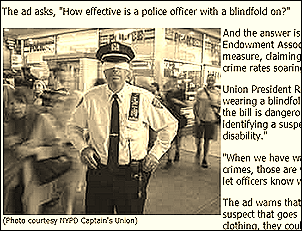
How effective is a police officer with a blindfold Finishing up some reading that I will be posting on soon, but I came across this in my work feed:

NYPD unions say bill would blindfold officers, "It will ban cops from identifying a suspect's age, gender, color or disability" — or risk being sued for profiling"

I have to say that this is disappointing on many levels, even the idea that someone should withhold information that could lead to the arrest of an assailant or criminal due to accusations of racism or, when that charge is leveled at law enforcement, "profiling."

My take:

Every victim or witness should make every effort to give as complete and accurate a description as possible of everything that was involved in the commission of a crime. If it's early evening, and you see three guys in light blue shirts and faded jeans breaking into a business across the street with a white Ford F-150 parked out back, describe exactly what you saw. Those are the facts! If you happen to notice that all three are Hispanic males wearing light blue shirts with faded jeans, one is approximately 5-foot, four inches, the other two about average height, and one had a red bandana in his back pocket, and there was a white F-150 running with NJ plate XXXXXX, then that's what you should report.

In a previous life, I did some part-time police dispatching (rather amateurishly, in fact), and was trained to get from victims, then provide to my officers all descriptors that could identify a perpetrator, so I did. If you don't the chances of them getting the wrong guy (whoops, I just profiled!) go way up, and it could be you that becomes a victim, and the real criminal may never get caught.

So how do you be a good victim?
What should you provide if you witness, or are the victim of a crime? Everything. Some suggestions:

First of all, when you call 9-1-1 (in the US), make sure you give you number, in case you get disconnected, and your location. Not every dispatch center can obtain that information all of the time - systems fail, and can be inaccurate.

Of the subject (as accurate as you can, and tell the authorities if it's a guess or estimate):

  • Sex
  • Race/ethnicity
  • Age
  • Height
  • Weight
  • Build
  • Hair color (or baldness)
  • Facial hair
  • Any distinguishing scars, marks, or tattoos
  • Head covering/hat
  • Shirt type and color
  • Pants type and color
  • Shoes
  • Anything else that could narrow it down, like missing teeth/eyes, limps, language, etc.
Of the situation and environment:
  • Where did the crime occur? 
  • What happened? Be succinct, but complete.
  • Is the danger still present? Is there a person there with a knife/gun or other weapon? Is the fight still going on?
  • How many people are involved?
  • What time did it happen?
  • Which way did they go?
  • What kind of vehicle were they driving? Did you get a plate number?
Please don't think I am making light of, or minimizing racial profiling. I am not. All factors must be included in reporting a crime, both to protect the innocent, and to catch criminals.

Disagree? Agree? Please tell me what you think, and why in the comments.


____
Like this post? Subscribe to our feed or by email and you won’t miss a thing.
All original material is copyright of their respective authors.
All rights reserved. Permission must be obtained before use. Copyright 2013

Tuesday, June 18, 2013

Must read: How to Protect Yourself from Date Rape Drugs

Defend University has a great post on protecting yourself from date rape drugs.

They are odorless, tasteless and they are intended to incapacitate you while producing enough amnesia that you’ll never remember him attacking you.
They are called “date rape drugs” and can be put into drinks or food. And they can kill you.
cocktails for date rape drugsBefore you think this can never happen to you, read about this real case of one of our friends being date rape drugged. Leslie in this story still does not know specifically what she was drugged with, but a few of the most common ones are Rohypnol, GHB and Ketamine. There are a number of different street names they are known by, but all three have similar effects — they impair you to the point that you are unable to refuse sex or defend yourself.
Read the rest, including practical steps here.
____
Like this post? Subscribe to our feed or by email and you won’t miss a thing.
All original material is copyright of their respective authors.
All rights reserved. Permission must be obtained before use. Copyright 2013

Wednesday, October 26, 2011

Personal Information May Put You at Risk - Serial Rapist Knew Details

An interesting story this morning, "Serial Rapist May Be Targeting Texas Sorority Alumnae, Police Say"
Police are looking for a serial rapist who may be targeting sorority alumnae in at least three North Texas cities, where at least four women have been attacked in their homes by a man who reportedly claimed he knew personal details about his victims. 
The victims, all members of the predominantly black Delta Sigma Theta sorority, were in their mid-50s to mid-60s and all were attacked late at night in their homes, according to police. It is unclear if the women knew each other.
Salient details:
  • All victims were members of the same sorority
  • All victims are in the same age range
  • During the attacks, "the assailant revealed that he knew personal information about his victims"
Ok, maybe it's just me, but do any of you see a commonality here? To me, it looks like this piece of scum has access to the sorority's membership list. What do you think?

As we give some thought to this, is it possible that too many people have access to our home addresses, phone numbers, etc? The story does mention "avoid being alone or posting information about their day-to-day activities on social networking sites." But why? It could be a factor, for example, people who have wide open profiles on social media (Facebook, Foursquare, Twitter, Google+) sometimes use the "check-in" feature and let the world know that they are away from their homes, or even when they are home - not smart. However, in this case, the rapist knews where they all live, and, likely, that they are home alone.

Monday, March 07, 2011

Home Invasion Survival

John Vesia has a post on Surviving a Home Invasion prompted by receiving information from an alarm company. He’s asking for comments as to what readers have done to prepare for the possibility, and how to survive.

Has anyone taken measures to ward off the possibility of a home invasion? Certainly, the very thought of one should be horrifying. But what to do? Keep a bat or some other handy weapon in the closet or drawer? Is owning a gun and keeping it at home a good idea if you have young children?

We’ve posted before on it, and thought it might be helpful to remind our readers.

In our post, Anecdotal Information on Home Invasion - Use of Deadly Force we cover the following:

During my recent time with a retired police officer (see Real-life Pit Bull Encounter) was home invasion, which is defined as, "burglary of a dwelling while the residents are at home." I've had several posts on what type of response you should have, or how you should prepare for the possibility of home invasion.

As we compared notes on burglary (I don't remember why the subject came up), the gist of our conversation was that true home invasion is actually pretty rare. Most are accidental - burglaries where someone isn't supposed to be home. For example, a home is usually burglarized when the residents are known to be away, or during the day. During those times, if someone is at home, it's likely that the burglar will attempt to flee, because he's after your property, not you, and wants to get away, not hang around.

The most frequent cases of intentional home invasion may be where the invader is an acquaintance (or relative) or former partner ( or spouse) of the resident, and intends harm to said resident, usually murder, rape, or robbery. In other words, someone breaks into your home because they know you are there, and want to harm or harass you while you are present.

In any case, depending on the original intention of the home invader (burglary of an unoccupied residence, robbery of the residents, or worse), your response should be appropriate. You don’t know what the intentions are, and can’t trust that it’s not to rape, rob, or murder you and your entire family. You don’t know. Will you risk it?

Our response in the same post was:

"weapons should always be your first resort, not the last. My reasoning is that, if faced with an unknown threat, especially an intruder that is so bold as to invade an occupied home, you should assume a deadly threatto your family." My position, after assuming that all other steps are taken to make the home a hard target, and assuming the invaders probably know that you are home and are coming in anyway, you are justified in using a weapon. The commenter is correct that use of deadly force may constitute a crime if not justified. I will clarify my opinion:

  1. If you have a chance (or a choice), make sure that everyone in the home is BEHIND you and in as safe a place as possible. There are many cases in the news of inner-city shootouts that kill residents in their homes because bullets keep going until they stop. That means that you want everyone you care about behind you, if possible.
  2. Call the cops - let them know where you are, meaning your full address and WHERE YOU ARE IN THE HOUSE. Make sure you let the dispatcher know that you are armed, and give a description of your appearance. For example, "My family and I are in the second-floor bedroom furthest back. I am a five foot, nine-inch white male with a beard, and wearing a blue t-shirt and boxer shorts. I am armed with a small semi-automatic pistol." For a good example of why you want to do this, go here.
  3. Let the intruder know that you are there, armed, and that law enforcement has been called. Do this while staying on the phone so that it's recorded by the dispatcher (almost all 911 calls are recorded). Do this in a loud, clear voice.
  4. If you believe the lives of you or your family are in danger, do what you have to do.

Consult with legal authorities in your state. Is that clear enough?

There is more good information linked from Weapons first or last?, a post on whether to use weapons or empty-hand self defense skills in a home invasion. Can you guess where we come down on that?

UPDATE: Wim weighs in on the subject here.

For more information:

Be sure to read Martial Views
Crime Doctor's Home Invasion page
Equalizer saves the day
The Armed Citizen

Thursday, June 10, 2010

Why You Don’t Accept Rides From Strangers

I’m guessing this girl didn’t get that safety talk from her parents…
John William Sinnett 
Photo: NBC Washington

Man, 85, charged with abducting teen (Fredericksburg.com)

June 10, 2010 12:35 am
BY KEITH EPPS 
A Fredericksburg teenager said she saw no reason to be alarmed March 29 when she accepted a ride home from an 85-year-old stranger. 
Before the 11/2-mile ride was over, the young woman testified yesterday in Fredericksburg Juvenile and Domestic Relations Court, she was "freaking out." 
She said the elderly driver touched her breast and made numerous sexually suggestive comments during the short ride. 
John William Sinnett, 85, of Spotsylvania is charged with abduction with the intent to defile. The charge, which carries a possible life sentence, was sent to a city grand jury following a preliminary hearing yesterday. 
According to the evidence presented by Commonwealth's Attorney LaBravia Jenkins, the girl was walking home from James Monroe High School about 11:30 a.m. when Sinnett pulled up on Fall Hill Avenue. 
Sinnett had been in the Rappahannock Regional Jail's electronic incarceration program since July, when he got a 12-month jail sentence for sexually assaulting a 21-year-old woman in Spotsylvania.
I’d suggest you read the whole thing for more context.


What should you teach your children about “stranger danger?”

Lessons that everyone should teach children (and this young lady seems to have the naiveté of a child, despite her legal age) include:
  1. Never, ever, ever accept rides from someone, unless it’s cleared with your parents FIRST. In cases where a victim is transported, the chances of survival are reduced. In other words, don’t accept rides from strangers.
  2. Make sure they have a cell phone or some means to call for help. Dialing 9-1-1 should be a rehearsed action.
  3. As a parent or guardian, cover this information, then drill it by asking “What would you do if ____ happens?” Do it at random times. Ask questions like, “Would this be normal?” or, “Would it be OK if…” Read the newspaper or follow the news and use examples of attempted abductions to as teaching moments. Discuss what the “victim” did right, and could have done better. Ask them to be aware of the potential of these things happening, and to not deny it – accept what’s happening is real, and ACT!
  4. Teach that it’s OK to resist and talk back to adults. We ingrain in our children to be polite and proper, but not to scream and run, or be firm and forceful. Teach it!
  5. Teach your child that it’s critical to always know where he is. That his or safety is the most important thing. Drill and enforce daily schedules.
  6. Explain the safety of groups – the predator wants to avoid one thing: attention. A target is isolated and/or unaware. The sheer numbers of a group makes avoiding attention impossible for a child predator, so use that tactic.
There are many more excellent safety tips and information available on the Web. A great tip sheet can be found on the Elmira Police Department’s site here (good job). More resources:

National Center for Missing & Exploited Children
FBI Publications - A Parent's Guide to Internet Safety

If you have other resources or tips, please comment. Thanks!

Saturday, November 22, 2008

Making a Difference

Hell in a Handbasket

My brother asked me a couple of years ago why I did this, the blog thing. He knows why I do the martial arts - I love it. I enjoy hitting and being hit, the clash, impact, and wheezing as you attempt to break a grip on your neck. That's easy to understand, right? But this blog thing?? A little harder to explain.

I've been at this since 2004, and, though TDA Training seems to be one of the more popular sites of it's type, haven't made nearly anything doing it. I do it because I love writing, sharing ideas, but a bigger benefit has been the community.

Getting to know George, Pat, DR, Colin, and too many others to name has been a great pleasure. I've recently had the honor of getting to know Mr. James Rummel of Hell in a Handbasket a little bit, and I have to say that I'm impressed.

James has been helping victims of violence put their lives back together and regain some emotional sanity by gaining some control. James teaches those "victims" tactics and techniques for avoiding becoming a victim again, and how to safely and effectively use firearms in self-defense.

By his own estimation Mr. Rummel has taught over 700 people to look forward and not back, and to open, instead of close, their eyes when confronted, facing their fears with steely determination.

I just want to salute him for making a difference. Go over to his site and do the same.

Wednesday, October 08, 2008

Anecdotal Information on Home Invasion - Use of Deadly Force

Home invasion victim

I just got a comment on a post from earlier this year, Weapons first or last?, which brought up the subject of use of deadly force in home invasions. Specifically, whether you should use that force in response to the invasion. The comment:

Although I appreciate your focus on prevention in the latter part of the post. I have to disagree with your shoot to kill advice. There are laws that govern use of force, when it is appropriate to escalate etc. Your readers should be warned that escalating force without LEGAL justification can result in charges leading to conviction. If you were to fatally injure an unarmed intruder in your home, you would find yourself being charged with far worse a crime than your aggressor.I believe there is even a major motion picture about a situation similar to this titled "Felon".

During my recent time with a retired police officer (see Real-life Pit Bull Encounter) was home invasion, which is defined as, "burglary of a dwelling while the residents are at home." I've had several posts on what type of response you should have, or how you should prepare for the possibility of home invasion.

As we compared notes on burglary (I don't remember why the subject came up), the gist of our conversation was that true home invasion is actually pretty rare. Most are accidental - burglaries where someone isn't supposed to be home. For example, a home is usually burglarized when the residents are known to be away, or during the day. During those times, if someone is at home, it's likely that the burglar will attempt to flee, because he's after your property, not you, and wants to get away, not hang around.

The most frequent cases of intentional home invasion may be where the invader is an acquaintance (or relative) or former partner ( or spouse) of the resident, and intends harm to said resident, usually murder, rape, or robbery. In other words, someone breaks into your home because they know you are there, and want to harm or harass you while you are present.

Take the Sean Taylor case. The NFL star was known by the invaders (one was formerly employed at the home), were not supposed to be in the home (it was during the NFL season), and they were armed, though didn't plan to harm the family. This was a situation where Taylor's presence in his own home precipitated a crime going from a property crime (burglary), to a violent crime (murder).

The point of this post is to make the distinction between the types of crime, and how serious it is if someone actually breaks in while you are there. If that happens, the invaders probably mean you harm, and protecting you and your family is your responsibility.

In context, the original post (Weapons first or last?) was addressing whether one should use firearms against a home intruder. My point was that, "weapons should always be your first resort, not the last. My reasoning is that, if faced with an unknown threat, especially an intruder that is so bold as to invade an occupied home, you should assume a deadly threat to your family." My position, after assuming that all other steps are taken to make the home a hard target, and assuming the invaders probably know that you are home and are coming in anyway, you are justified in using a weapon. The commenter is correct that use of deadly force may constitute a crime if not justified. I will clarify my opinion:

  1. If you have a chance (or a choice), make sure that everyone in the home is BEHIND you and in as safe a place as possible. There are many cases in the news of inner-city shootouts that kill residents in their homes because bullets keep going until they stop. That means that you want everyone you care about behind you, if possible.
  2. Call the cops - let them know where you are, meaning your full address and WHERE YOU ARE IN THE HOUSE. Make sure you let the dispatcher know that you are armed, and give a description of your appearance. For example, "My family and I are in the second-floor bedroom furthest back. I am a five foot, nine-inch white male with a beard, and wearing a blue t-shirt and boxer shorts. I am armed with a small semi-automatic pistol." For a good example of why you want to do this, go here.
  3. Let the intruder know that you are there, armed, and that law enforcement has been called. Do this while staying on the phone so that it's recorded by the dispatcher (almost all 911 calls are recorded). Do this in a loud, clear voice.
  4. If you believe the lives of you or your family are in danger, do what you have to do.

Consult with legal authorities in your state. Is that clear enough? Comments are welcomed.

For more information:

Crime Doctor (for great tips and information)
TDA Weapons first or last?
TDA Equalizer saves the day
TDA "...he was just standing there with a gun pointed at my face"
TDA Bringing a gun to a knife fight?
FBI Uniform Crime Reports
Civilian Gun Self-Defense Blog (for examples of use of force situations)
Google News (news stories)
Wikipedia

Thursday, August 21, 2008

Georgia and the Nature of Man

I think Georgia was a wake-up call for many of us, for whom the sight of raw aggression has been limited to parts south and east of that small country. I often ponder, as I read the news, how many can still hold the viewpoint that man is essentially good. The sight of the Russian army rolling through the streets of Gori, expelling ethnic Georgians from their homes in South Ossetia, and stories of murder and pillage remind us of the dangers we face in the world today, and how thin a line there is between civilization and savagery. A governing principle in my understanding of mankind's dealing with one another is that there is evil in our hearts, evil which must be restrained. Were this not so, there would be no need for police, prisons, armies, or even governments, much less weapons and martial arts.

This should serve as a reminder to equip yourself to resist evil in all it's forms. Support and participate in civic activities like local and national elections. Arm yourself with education and information needed to make wise choices. Support the armed forces, law enforcement, and public safety by, at a minimum, reporting crime. Finally, learn to protect yourself, and if possible, put yourself in the way of those who would prey on the weak.

Nations and individuals seems to have an unlimited capacity to prey upon those weaker in strength or resolve. Be prepared.


Technorati Tags: ,

Friday, March 07, 2008

Property crime turns into murder

I just read this USA Today news article, Man fatally hurt trying to stop Starbucks thieves, and reflected on the tragedy that it became.

CRESTWOOD, Mo. — Surveillance video from a Starbucks in a St. Louis suburb captures the moments before Roger Kreutz went from hero to tragic victim.

He stands in line behind a young man and woman at the coffee shop, where he's a regular customer. The young man fiddles with items on the counter while she orders a coffee, pays and heads out the door. The young man swipes the tip jar, and Kreutz, in the spur of the moment, gives chase.

ON THE WEB: KSDK-TV shows shop's surveillance video

What happened next is not caught on tape. Police say the two suspects, with the young man behind the wheel of a 1990s white Ford Taurus, ran over the Good Samaritan in the parking lot.

Kreutz, 54, died Wednesday at a hospital, two days after he was struck.

"I don't claim to understand it," police Chief Mike Paillou said at a news conference. He said detectives are following up on leads but asked for the public's help in identifying the suspects. He did not know what provoked them — "fear, confusion, being young?"

It's believed there was about $5 in the tip jar.

First of all, pray for the family of the victim. The lesson here, to me, is that crimes against property are not worth your life. If someone's committing a crime, and it isn't against a person, call the cops. Unless you're an officer, you shouldn't put your life at risk for anything short of protecting the safety of yourself or others. From read the rest of the article to learn about what a good guy this fellow was, making his death for a tip jar all the more tragic.

The first step in avoiding crime is to prepare for it, and protect against it, but I've often mentally rehearsed advised handing over a wallet rather than attempting to destroy a would-be mugger. If someone has "the drop" on you, there's no telling what they'll do, or how desperate they are. Make the decision now to fight for your life, but nothing short of that.

Friday, February 22, 2008

Protecting Karate Kids From Sexual Abuse

From About.com's Diana Davila, an article on Protecting Our Children From Sexual Abuse that goes further than mine. My intent was to create a guide for martial arts school best-practices. Davila goes further:

The facts:

The National Foundation to Prevent Child Sexual Abuse estimates that one out of every three girls and one out of every six boys will be abused in some way by their late teens. The majority of cases will never be reported, or may be reported years later.

To parents, check out the instructors.

Do a search on the various online state databases to see if the instructor, assistant instructors or any staff member at the martial arts school you are selecting is listed as a sex offender. You can also check with your local police department to see if there have been any reports or complaints of abuse of any kind, as well as to check on any other pertinent criminal complaints or charges.

Red flags to detect abuse:

Pay Attention to Your Child Observe your child's behavior. Any drastic changes to behavior, habits or appearance should be red flags that something is wrong, whether or not you suspect abuse. Some behavioral signs to watch out for include

  • withdrawing from friends and family
  • depression
  • hostility or unusual aggression
  • nightmares
  • suddenly having an extreme aversion to a particular person or place
  • soiling or wetting the bed after being fully potty trained.

Followed by "what to do if you suspect abuse." There's a lot more. Read it all.

For more information:

TDA: Preventing Sexual Abuse in Martial Arts
TDA: Another Case of Sex Abuse in the Martial Arts

Wednesday, February 13, 2008

The carjacking choice

Via Defend University:   

Now let me make a slight change in the scenario. You are on a trip with your two-year-old child. You have secured her in a car seat in the rear passenger area of your parked rent-a-car. You walk around to the driver's side of your car, get in, lock the doors and put the key in the ignition switch. You turn around and notice that your child's seat is not properly secured. You get out of the car to make the adjustment. As you do, a man with a gun appears and insists on taking the car now.

Do you:

- A. Refuse and try to block his entry into your car?

- B. Jump in the car to try to start it so you can drive away?

- C. Plead with him to let you have your child before he takes the car?

- D. Demand that he either give you your child, or you will insist on going with him?

- E. Try to wrestle the gun away from the assailant so you can shoot him?

- F. Run like hell away from the car?

The answer? Run like hell

In over 20 years of teaching Women's Self-Defense, I've always gotten a variation of this question after covering the basics, "Excuse me, Mr. Nathan, that's all well and good, but what if he's got a gun?" MY answer was the same each time, RUN!" You may not know that in almost all cases, a victim who's been removed from the original scene of her abduction will never be seen alive again. A potential kidnapper doesn't want to shoot when others are around to hear, so get going! The scenario mentioned above is also correct:, "If you were to plead, you'd be wasting you breath. If you were to resist, you could be injured -- or worse -- and the mope would probably take the car anyway. And if you were to insist on staying with your child, the carjacker would then have two victims instead of one. What's worse, there may be no one to report the incident or to get immediate help. The correct answer, from me, the travel security expert, is definitely F." Read the rest!

For more information:
Defend University
Crime Doctor
Rape Escape
Melissa Soalt
Crime Information
Charlotte Self Defense
No Nonsense Self Defense

TDA Self-defense, Women's Self-Defense

Photo: Jamd.com

Thursday, January 24, 2008

Weapons first or last?

Home invasion target?

I find it interesting that in the martial arts community, there seems to be a divide between those who espouse and practice with firearms, and those who shun them. A recent thread on the Convocation (How would you defend yourself in your home?) highlighted that split, to some extent, with some taking the position (read it to be clear) that "empty hand" should be your first resort, and weapons, including firearms being the last. Others, including yours truly, believe that weapons should always be your first resort, not the last. My reasoning is that, if faced with an unknown threat, especially an intruder that is so bold as to invade an occupied home, you should assume a deadly threat to your family.

Washington Redskins safety Sean Taylor's home invasion was an attempted burglary that left him dead of a shotgun blast to the leg. Reportedly, the intruders knew Taylor (or had done work for the family in the past, and assumed that no one was home at the time. Taylor, his fiance, and 18 month-old daughter were in the home. From an early account:

... Taylor was awakened by a noise in his living room, Sharpstein said. As the shooter or shooters approached Taylor's bedroom, he reached for a machete or other form of knife he keeps nearby in case of emergency, and two shots were fired, one striking his leg in the groin area.

Cerrato said Taylor's fiancee tried to call police from the house line, only to discover that the line had been cut. She had to use her cellphone to call 911, which delayed the response time.

As of this posting, there is a gag order on the case, so more information may not be revealed for some time. The facts , as we now know them:

  • It was approximately 1:30 AM
  • Everyone was in bed, and awakened by the intrusion
  • Four subjects gained entry by prying open a rear bathroom door, then "kicked in a rear bedroom door..."
  • Taylor, hearing a noise, responded by grabbing a weapon (a "machete or other form of knife"), and investigated
  • One of the intruders shot Taylor
  • Taylor's fiance attempted to call 911, the line was cut, and she made contact with her cell phone

What lessons can we apply to this for our own self-protection? My thoughts:

  1. The intruders gained entry without interruption or deterrent. A large dog barking, or an alarm system may have prevented entry by scaring off the intruders.
  2. The machete wasn't enough - I'd bet that many, if not most, home invaders are armed. Do you think they just carry clubs or knives? The intruders had the benefit of numbers and weapons, plus at least one or two had been in the home before. Taylor may (a slim chance) have been able to fight off more than one attacker, but they were armed, and the stakes just went up. You may not know (until it's too late) that a home invader is armed. Assume they are.
  3. You do need to identify your target, but don't hesitate. If you know where your family is (behind you), and that no one else should be in the home, take appropriate action with no delay.
  4. There should be no such thing as a "warning shot." If you shoot, and the subject is armed, you may die. Shoot to kill, no wound.
  5. Have a backup plan. What if you gun doesn't fire? Have another. Keep a weapon close at hand, loaded, and unlocked.
  6. Train your family members as to how to handle many situations, including fires, first aid, and home invasion. If possible, create a "safe room," and escape route, plus a meeting point.
  7. The cell phone being available could be a life-saver. Your phone lines may be cut, or if you use cordless phones, your power may be out. Keep a backup!

Some good tips (from Crime Doctor's Home Invasion page):

  • Install solid core doors, heavy duty locks, and window security devices
  • Lock all doors, windows, and garages at all times
  • Use four three-inch screws to secure heavy duty lock strike plates in the door frame
  • Use the door peephole BEFORE opening the door
  • Use your porch light to help you to see clearly outside
  • Never rely on a chain-latch as a barrier to partially open the door
  • Never open the door to strangers or solicitors
  • Call the police if the stranger acts suspicious
  • Alert your neighbors to suspicious solicitors
  • Hold a family meeting to discuss home security plans
  • Set the home perimeter alarm at night, if you have one

    Home invasion resources:

    The COCA thread
    Crime Information
    SelfDefenseResource.com
    Defend University
    Crime Doctor
    Charlotte Self Defense

  •  

    Tuesday, September 04, 2007

    Nick Hughes with more good advice

    From Mr. Hughes at the always excellent Charlotte Self Defense:

    One of the things that is drummed into the officers, both basic and advanced is the necessity to adhere to the two second rule. What is it? Simple. When you're behind another vehicle allow a "two second" gap between you and them.

    What that means is when you observe a car in front of you pass an object -- streetlamp, fence post, road sign, road marking etc -- you should be able to count to two before you pass the same object. This will buy you enough time should they suddenly jam on brakes for something or someone on the road.

    Read the rest. All of his posts are worth your time.

    Tuesday, August 28, 2007

    A World Without Fathers

    There's a strong correlation to the absence of fathers, specifically, from communities with higher rates of violent crime. This may be old news to most of you, the recent execution killings of three young people is a tragedy, and one that points to the issue of violent crime in Newark, as well as many communities, inner-city or not. I find little with which I disagree in this Albert Mohler post, "Without Fathers, Without Rules, Without Consequences, Without Hope."

    Why am I posting about this at TDA? It's not a political issue, it's a moral issue. As martial artists, we have an obligation to ethical behavior. As instructors, even more so. We define our legacy to our young students by living the behaviors we espouse through our teachings. Can we do more?

    Thursday, May 17, 2007

    Howstuffworks on How Pickpockets Work


    I love the site, HowStuffWorks.com, and often just browse it for the sheer enjoyment of learning something translated into layman's terms. Usually something we use in everyday life, or may experience. One such subject is pickpockets. Check out their article on this common crime, and how to prevent it, "How Pickpockets Work."

    "Pickpocketing is one of the oldest and most widespread crimes in the world. The appeal is its relative safety: A skilled pickpocket can make off with just as much money as an armed robber, without much danger of confrontation or risk of being identified in a line-up. By the time the victim even realizes what has happened, the pickpocket is long gone."

    Saturday, June 03, 2006

    Crime Doctor on Carjacking

    Read Crime Doctor on carjacking. It hasn't received nearly as much press as it used to when it was the new and fashionable crime, but it happens all the time.


    Carjacking is the violent form of motor vehicle theft. It is a serious threat to our personal safety because the thief uses force and fear to rob our car from us. Sometimes the car owner or other occupants are kidnapped during a carjacking, and if lucky will be dropped off nearby unharmed. The worst case scenario occurs when you are transported to a secondary crime scene, which is usually more dangerous than the original confrontation. Those not so lucky victims have suffered other crimes like rape, aggravated assault, and even homicide.


    Since the mid-1980s, carjacking has captured the attention of the media with reports of these sudden and violent attacks. Carjackers have unknowingly driven off with infants still in the backseat of the car, leaving behind a screaming and emotionally distressed parent. Other drivers have been violently pulled out of their seats and left lying on the road, terrified by what just occurred.


    Read the rest. Ads by AdGenta.com

    Wednesday, May 17, 2006

    Preventing Sexual Abuse in Martial Arts

    I originally posted this on April 22, but I am reposting it because another instructor has besmirched the integrity of our "profession." Again, I strongly urge parents, school owners, and instructors to work together to enact strict measures to protect our vulnerable students.

    +++++
    This is not good! I have long thought that there needs to be more "self-policing" by the martial art school owners in this respect. I have been a Scout leader for several years, and martial arts instructor for many, many more, and I can tell you that there needs to be common sense on the part of school owners, instructors, and parents to protect our kids. How? Please consult with your state laws, but, like the policies the Boy Scouts have implemented, most are common sense.

    For school owners and instructors:
    • DON'T ever be alone with a child without another adult or group of students present or visible. For example, if you have to discipline a student (assume child), move to an area that's not in front of the class, but off to the side, or in a clearly visible area. In my schools, we had offices with doors, but they had windows to class areas or to the outside so that there was visibility. It was also to watch for foot traffic outside and observe classes, but also so that there wouldn't be a doubt as to what may have occurred in an office.
    • Do not touch a child (or any student or co-worker) in a way that may be construed as sexual, improper, or coercive. Train your instructors and assistants in the same.
    • DO require criminal background checks for all instructors, including volunteers. It may be free from your local police department, and will go a long way toward reassuring prospective students and parents that you are conscious of this.
    • DO keep an eye on what's going on in your mixed (adult-child) classes, and don't allow adult male students to be in locker rooms or other changing areas alone with underage students.
    • For trips to tournaments or seminars, DO require a number of parent chaperones that makes sense logistically. DON'T take the kids yourself without a parent or other instructor there. While away, do not let students wander on their own - buddy system and regular check-in are recommended. Let the age of the students determine that.

    For parents:

    • As above, make sure a school has the criminal background checks in place (ask to see a written policy that you can have a copy of), as well as the policies about being alone with students and that all training areas are visible to the public. Background checks should include fingerprinting of prospective instuctors.
    • If you have a "strange/funny feeling" about something, go with your instincts. It's YOUR responsibility to protect your child. Don't entrust that to anyone, no matter how much you respect them, unless systems and policies are in place to ensure compliance.
    • Be involved, and talk with your child so that you will know if something doesn't seem right.
    • If something does happen, do everything you can to put away the molester so that it doesn't happen again to other kids. We need to stick together to protect our kids from the monsters that prey on them.

    Those are my thoughts on it. As I said, common sense...