Showing posts with label Firearms Training. Show all posts

Wednesday, October 26, 2011

Personal Information May Put You at Risk - Serial Rapist Knew Details

An interesting story this morning, "Serial Rapist May Be Targeting Texas Sorority Alumnae, Police Say"
Police are looking for a serial rapist who may be targeting sorority alumnae in at least three North Texas cities, where at least four women have been attacked in their homes by a man who reportedly claimed he knew personal details about his victims. 
The victims, all members of the predominantly black Delta Sigma Theta sorority, were in their mid-50s to mid-60s and all were attacked late at night in their homes, according to police. It is unclear if the women knew each other.
Salient details:
  • All victims were members of the same sorority
  • All victims are in the same age range
  • During the attacks, "the assailant revealed that he knew personal information about his victims"
Ok, maybe it's just me, but do any of you see a commonality here? To me, it looks like this piece of scum has access to the sorority's membership list. What do you think?

As we give some thought to this, is it possible that too many people have access to our home addresses, phone numbers, etc? The story does mention "avoid being alone or posting information about their day-to-day activities on social networking sites." But why? It could be a factor, for example, people who have wide open profiles on social media (Facebook, Foursquare, Twitter, Google+) sometimes use the "check-in" feature and let the world know that they are away from their homes, or even when they are home - not smart. However, in this case, the rapist knews where they all live, and, likely, that they are home alone.

Sunday, April 17, 2011

Sunday video: Combat Firing with Hand Guns circa 1944

Via Gutterfighting USA, a nice Krav Maga, WWII combatives, and self-defense oriented blog and school. Check them out here.


Like this post? Subscribe to our feed or by email and you won’t miss a thing.

Please interact with us at our TDA Training Facebook page!

All original material is copyright of their respective authors.
All rights reserved. Permission must be obtained before use. Copyright 2011

Thursday, April 14, 2011

What Does the 21 Foot Rule for Defending Against a Knife Mean For Non Mil/LE? (Guest post by Low Tech Combat)

This guest post is the third (and last), in the series on the “21-foot rule”, and is authored by Adam of Low Tech Combat. Low Tech is aptly named, and is a great resource for anyone interested in reality-based self-defense, MMA, Filipino martial arts, and combat conditioning. In many ways our subject matter is similar, but LTC has some fascinating posts which are much more in depth on the many subjects. LTC also has some great posts on the very subject we’re speaking of, the lethality of the knife, and what to expect. I will do some posts following this covering those subjects and referencing Low Tech Combat. Enjoy!
Cross-posted here at his site. 
Nathan has asked me to contribute to a series of posts about a video he published on his site which showcases Dan Inosanto. I was only too happy to contribute! It is quite a famous video. In it, Dan shows how a Police officer with a weapon still in its holster, generally requires a surprise knife attacker to be 21 feet away in order to allow enough time and space to recognise what is happening (the person has pulled a knife and is charging), and then make the decision to act, and then draw the weapon and fire at the centre of the attacker. Any less than 21 feet and the officer is generally not able to draw the weapon and fire in time before the knife is inserted into the Police officer's body. I recommend going to watch the 21 foot rule video at Nathan's site before reading on.

Wednesday, April 13, 2011

Thoughts on Tueller (guest post by Patrick Parker)

undefined

This, the second in the series on the “21-foot rule” is written by Patrick Parker, of the venerable Mokuren Dojo blog. Patrick and I have enjoyed several years of banter, debate, and sincere mutual admiration since he started writing online, and I’ve grown to look forward to anytime he expresses an opinion, even if I don’t understand it. Sensei Pat runs a Judo and Aikido school in Mississippi, while, in Clark Kent fashion, appearing to the lay person as a physical therapist and PhD with some kids, living a normal life in the suburbs with a long honey-do list. Several times a week, ,however, in the evenings, the suit comes off, the gi and black belt goes on, and he transforms into a 6th-dan in aikido and 5th-dan in judo, both of which outrank and scare me. To preempt any threats or just looks of intimidation for not allowing him to play, I invited him to share his insights from his own context.

Cross-posted here at his site.

I'm not a law enforcement officer.  I don't even play one on TV.  In fact, I didn't even stay at the Holiday Inn Express last night.  But Nathan at TDA Training did ask me to contribute some ideas to a week-long discussion of the famous Tueller Drill.  Check out the video at Nathan's blog, and while you're at it, check out this gruesome example of the 21-foot rule played out in this police reel.

I enjoyed TGace's post about the flaws within the Tueller experiment and I appreciate his assertion that Tueller's results did not validate any sort of claim about the superiority of any particular weapon (a knife) over any other particular weapon (a gun).  I intended to write this post on the idea that what Tueller does demonstrate most effectively is that a gun is not a magical talisman that automatically assures victory - but Paul at Tactical Arnis beat me to that point.  Kudos to both of y'all for excellent, informative articles.

In my opinion, one of the take-away lessons from Tueller (perhaps unintended by the original author) is that a knife in the hand of a person with the right mindset is the most versatile, effective, gruesome, demoralizing weapon invented in the last several thousand years.  Sure, the handgun is (I suppose) the centerpiece of police force projection, but again, the handgun is not a magic talisman.  This point is effectively demonstrated by Tueller.

Also, Tueller's results were intended for police consumption.  Using it to justify anything in the civilian self-defense context is a stretch - particularly because of the simple fact that most civilians will not have access to a handgun most of the time.  But Tueller does illustrate an important point that is one of the centerpieces of our aikido system.  That is...

You can never afford to underestimate the potential of your opponent.

Or, put another way, you have to treat every single training encounter as if your opponent is the most dangerous bad guy imaginable, armed with the most awful tactical advantage imaginable. Or, in shorter form, "You can never tell who you're standing beside."  To us, that means we try to assume that all opponents are armed with a knife.  You have to design your practices around the assumption that your opponent has the potential to kill you if they have the ability to touch you.  That's pretty stringent, and it leads to practices like stab-twice randori, starting already stabbed, and progressive chaos.

As we have done knife randori like this over the years, we have come up with a few pretty reliable pieces of information. First, all of aikido (and probably most all of self-defense) is based on a couple of techniques that we call shomenate (A.K.A. the palm jab to the chin) and aigamaeate (A.K.A. iriminage, a palm jab to the chin done from outside the opponent's arm). The tactical idea behind both of these techniques is the same:

  • get out of the way at least a little bit.
  • get at least a little bit of control of the weapon arm
  • crash into the opponent's center with your whole bodyweight, spearing into his head violently with a stiff-armed palm, locking his neck, and throwing him away.
  • disengage and run away immediately.

All of our randori over the years has verified this basic idea - if you go into a knife encounter with any plan but the above, You're likely to get killed.  But the above plan saves you a remarkable percentage of the time. 

It turns out that all the other stuff in aikido - all the stuff you think of as aikido - the cool wristlocks and the airy breath throws - those are just backup plans.  This basic plan enumerated above makes up easily 80% of aikido, and all the cool stuff fills in around the edges.

And you know what's cool?  Tactical guru, Dave Spaulding agrees with me!

So, in summary of this somewhat rambling, stream of consciousness...

  • Tueller is an interesting experiment that has implications primarily for police, but that us civilians can also learn from.
  • A gun is not a magic talisman that assures victory - particularly if you allow you opponent within a few paces of you.
  • A gun is a powerful and useful weapon, but IMO, a knife is demonstrably more versatile at close range.
  • You can never afford to underestimate your opponent's potential. You must take this idea into every single training encounter.
  • You need some variety and speed and resistance in your knife defense practice - not just the slow zombie attack over and over again.
  • You have to have a fundamental tactical plan that makes up the vast majority of your system that is simple, easy to remember, works under pressure, and involves evasion, automatic control, and immediately-disabling atemiwaza (strikes)

[photo courtesy of Jesse Millan]

____________________

Patrick Parker

www.mokurendojo.com

Monday, April 11, 2011

Of Knives, Guns and 21 feet (guest post by tgace)

Today’s guest post in our series on the “21-foot rule” is by someone in a fitting position to critique the Tueller training imagetechnique, TGace of The Things Worth Believing In. I have met (though not trained with) this gentleman twice, so far, and have plans to do more in the future. He is currently serving with a mid-sized municipal police department in Vice and Narcotics, and has training and experience in the tactical (SWAT) realm, and law enforcement training. TGace is also a graduate of the prestigious FBI National Academy, the top law enforcement executive training academy in the nation, if not the world. His martial arts experience is quite varied and extensive, but my reason for asking him to participate is due to his current, real-world experience as an officer, and his obsession (my words) with guns and gun training. Enjoy. Cross-posted here at his site.

Martial artist, blogger and personal acquaintance, Nathan Teodoro has posted a video on his blog; TDA Training. The video shows a few minutes of footage from “Surviving Edged Weapons”, which was a film from the late 1980′s that was designed to prepare police officers for dealing with what was thought to have been “the growing threat of ‘knife culture’ in the United States”.

For those of us familiar with this film, Nathan’s video shows the Dan Inosanto training scenarios; the ones where officers get “knifed” by Dan while trying to draw their weapons. The rest is the illustration of the “21 foot rule”, also known as the “Tueller Drill”. Over the years, people (mostly in martial arts circles) have been pointing to this video as the “proof” of the “supremacy of the knife”. I believe that looking at this video, or the “Tueller Drill”, as proof of one weapons superiority over another  is shortsighted and a misunderstanding of Tueller’s original point.

The Tueller Drill

The “Tueller drill” was named after Sgt. Dennis Tueller, Salt Lake City Police. In 1983, he published an article titled “How Close Is Too Close” in SWAT magazine. In this article Tueller discussed the results of a series of tests he had run which showed that most people could, on average, close a distance of 21 feet in about 1.5 seconds. Tueller concluded that a person armed with a knife or club (and I would add ANY object that could be used as a weapon) at this so called “intermediate range” of 21 feet, was a potentially lethal threat. Note Tueller did not say anything about any particular weapon being superior to any other. From a Police perspective he was demonstrating why officers would be justified in displaying and possibly using deadly force against non-firearm threats from distances as great as 21 feet or more. Tueller said in his article:

Having analyzed the problem, the following suggestions come to mind: First, develop and maintain a healthy level of tactical alertness. If you spot the danger signs early enough, you can probably avoid the confrontation altogether. A tactical withdrawal (I hesitate to use the word “retreat”) may be your best bet, unless you’re anxious to get involved in a shooting and the consequent legal hassles which are sure to follow.

Next, if you’re “Early Warning System” tells you that a possible lethal confrontation is imminent, you want to place yourself in the best tactical position available. You should move to cover (if there is any close at hand), draw your weapon, and start to plan your next move.

Why use cover, you may wonder, if your attacker is using only a knife? Because you want to make it hard for him to get to you. Anything between you and your attacker (trash cans, vehicles, furniture, etc.) that slows him down buys you more time to make the appropriate decisions, and, if it becomes necessary, more time to place your shots.

I suggest you draw your weapon as soon as the danger clearly exists. There is no point in waiting until the last possible second to play “Quick-Draw McGraw” if you recognize the threat early on. Also, the sight of your “Equalizer” may be sufficient to terminate the action then and there.

The purpose of the pistol is to stop fights, and whether it does so by dropping a thug in his tracks, or by causing him to turn tail and run, your goal is accomplished, is it not?

At this point it might be advisable to issue a verbal challenge such as, “Stop”‘, “Don’t move”, or “Drop your weapon!” It may work, and even if it doesn’t you’ll be developing your legal case for self-defense by showing that you did everything you could to prevent a shooting. If all goes according to plan, the odds are that by now you will no longer have a problem, your attacker having remembered he had a more pressing engagement elsewhere.

Tueller says nothing about any weapon being inferior/superior, the necessity of being trained in knife disarms, or argues the “inherent deadliness of the blade”; it was all about range awareness, tactical awareness and the use of force. What this discovery tell me is that officers should be tactically analyzing the situation they are approaching at all times, they should be looking for non-verbal threat cues, they should be watching an opponents hands, they should use objects as cover when possible and they should never just walk up to a subject as a matter of habit. Police Officers should always maintain a healthy “reactionary gap” between themselves and others but Police Officers cannot be conducting business from 21′, behind cover with a weapon drawn either. “Yes I will get your cat out of the tree ma’am, but first interlock your fingers on top of your head and spread your feet apart!” Unlike non-sworn personnel, sometimes we can’t walk away from any potential threat, it’s our duty to deal with it. What is ultimately most important is adhering to tactically sound officer safety techniques at all times.

The Worst Case Scenario

Tueller said this in his article too :

Sometime, of course, despite your best efforts, you could find you are suddenly, at close quarters, the intended victim of some lunatic slasher. If you are an expert in one of the many martial arts, you may opt to go at it hand-to-hand, and if you are in this category you do not need advice from me on how to do it. So, we’ll get back to the use of the handgun for solving the problem. What it all comes down to now is your ability to smoothly and quickly draw your pistol and hit your adversary, and do it all reflexively. And the only way to develop these reflexes is through consistent, repetitive practice, practice, practice.

In the clip from Surviving Edged Weapons where Dan Inosanto attacks the cops, the lesson is stated as “you have to use empty hand techniques”. Well if you walk right up to a person acting suspiciously in an empty warehouse instead of issuing commands from range and the guy attacks you with a knife, than yes, I guess you are in deep caca and depending on your gun alone may not be the best idea. However, I think that the ultimate lesson for officers here shouldn’t be “learn martial arts“, as beneficial as that would indeed be, it should be “use better tactics“. But to be fair to the officers in the video, I don’t know exactly how the scenario was presented to them. The narrator says it was framed as “respond to suspicious circumstances in a warehouse at night”. If it was “It’s 1AM, the business is closed, and you find a broken lock…” these Coppers screwed up. If it was “It looks like it may be the business owner”, that’s a different story and they were set-up for the confrontation by the creators. I also wonder if there were any subjects who “won” the scenario that didn’t make the film?

When it comes to the mechanics of close range fighting, I agree that backpedaling and focusing on trying to draw your pistol in the face of a knife attack is not a great idea, but I think that telling officers that they should be focusing on disarming an attacker or staying entirely H2H is a mistake as well. Knife defenses and disarms are a “break glass in the event of emergency” situation even for highly trained martial artists, let alone an Officer who will probably be practicing such techniques far less often. What would be best to learn from this video is to not be “in the hole” in the first place. If the officer has no choice, than this video is a good lesson in the need to combine empty hand techniques with basic tactics like lateral movement and CQB oriented shooting styles, which are essential for “in the hole” confrontations versus “quick draw” style techniques.

A commenter on another post in my blog gives great advice on how to deal with this sort of confrontation if you screw up bad enough or are just plain unlucky enough to be in one :

1. You MUST solve the positional problem BEFORE you try to acquire your firearm and engage the threat. This means you may have to move off the line of threat, or go hands on with the threat until you can improve your position sufficiently to ensure that you have the time and space to draw and deliver deadly force.

2. You must RETAIN your weapon. SouthNarc teaches shooting from a high “two” position, with the pistol tucked in close to the body and the firing thumb indexed along the pectoral muscle. Support side arm in a horizontal or vertical “elbow shield”, utilizing the bone structure to provide sufficient space between you and your threat so you can work the trigger and not get foul the slide or get it forced out of battery.

3. It’s going to be hard, fast, and ugly.

4. If you stand still and try to draw your gun and pull the trigger while a big ape is stacking your sh**, you will not prevail.

5. Movement, strikes, and working to the flank, getting dominant position, and THEN lighting up the bad guy is the goal.

Good stuff.

What It All Means

The Tueller Drill, while a useful tool, seems to have become a set piece exercise with a tendency to be overblown by people who missed Tueller’s point. I believe that the main revelation of the Tueller Drill is the power of initiative and INTENT. In the classic “Knife vs. Gun Tueller Drill” the knifer knows he is going to attack and when. The other person stands there…holstered…and waits. There is no “scenario”, no back-story of why you are in contact with this person in the first place. It never takes into consideration obstacles between opponents, it never considers the officer taking the initiative and drawing, giving commands and or preempting your opponent. The drill is pure physics. A person can cover this distance and strike a person in this given time”.

On the street this boils down to basic OODA . In the classic Tueller Drill the knife wielder is already inside the defenders “OODA loop”, the knifer gets to both DECIDE and ACT before the defender can process the situation. If you allow a little “real world” into this exercise, and the defender in the Tueller drill knows that the knifer is coming for him (which he does = Observe) he should “cheat”. He should run..place an obstacle between him and the BG (Orient) and start issuing commands and/or start shooting before the knifer even thinks to move (Decide/Act). I have always wanted to be asked to participate in a “Tueller Drill” and wait to be told “You stand here. He has a knife and when he moves you react”. I’d ask “he has a knife?” and when told yes draw down, place an obstacle between us and give commands. I know that I would be ignoring the intent of the drill by doing that. The intent being to simply make you aware of the “reaction gap” and the realities of edged weapons, but the Tueller Drill is ultimately an example of math more than it is an example of “combative truth”.

IMO, who decides to attack, who is first aware of the threat and who has a weapon in hand is more important than which weapon is “superior” in this sort of scenario. If you have an enemy who is within 21′ with ANY WEAPON and he gets to make the first move, while you wait to respond…you are in big trouble, be that a knife, a gun, a bottle or a roadside rock.

Stay Alert, Stay Aware, Stay Alive.

If you enjoyed this post, please check out The Things Worth Believing In site, and connect with the author at his Facebook page and on Twitter. And if you’re a criminal in his area, steer clear (sorry TGace, couldn’t help it!).

Stay tuned for the rest of the series, including posts by Pat from Mokuren Dojo, and Adam from Low Tech Combat, later this week!

Sunday, April 10, 2011

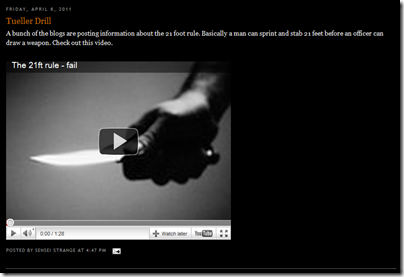
Sensei Strange and Wim DeMeere on the 21-Foot Rule

image
Sensei Strange at Dragons Orb has a great video and some excellent comments in response to my post, “Distance and Awareness-Blade and Gun (Video).”. Click the photo to check it out.

image
Wim responded with this post almost as soon as our original post hit the ‘Net.

Look for a great post tomorrow from TGace of The Things Worth Believing In on the same subject!

Thanks to Patrick from Mokuren Dojo for the heads up about Strange’s post.

Friday, April 08, 2011

Distance and Awareness-Blade and Gun (Video)

Watch the video in full – does it change your awareness of anything?

This begins a guest post series with three of the best writers on martial subject matter in the business: TGace of The Things Worth Believing In, Patrick Parker of Mokuren Dojo, and Adam of Low Tech Combat. Over the next few days they will share their views on the drill and what it means to them in training, or what it can teach the rest of us.


Like this post? Subscribe to our feed or by email and you won’t miss a thing.
Please interact with us at our TDA Training Facebook page!

All original material is copyright of their respective authors.
All rights reserved. Permission must be obtained before use. Copyright 2011

Thursday, November 18, 2010

Marines put new automatic rifle to the test

Per this Military.com article, the Marines are unsure of their new SAW replacement, the M-27.


Ok, maybe it's not a SAW replacement, but they're not sure.
The general in charge of training and equipping Marines for the future fight said Nov. 16 that it is still unclear how infantry units will need to adjust to replace their light machine guns with the service's new automatic rifle.
Lt. Gen. George Flynn, who heads the Marine Corps Combat Development Command in Quantico, told reporters at a Washington, D.C. breakfast that the service plans to finish outfitting five battalions with the new M-27 Infantry Automatic Rifle next month and then will observe how those Marines use it on deployment before changing the organization, training, and tactics of infantry units around the new weapon.
But Flynn pushed back at critics of the M-27, saying the improved accuracy of the Heckler and Koch-made automatic rifle makes up for a lower rate of fire compared to the M-249 Squad Automatic Weapon it's being fielded to replace.
"The initial feedback was that the IAR performed pretty well," Flynn said of early evaluations of the M-27. "Accuracy has a suppressive power all by itself."
The introduction of the M-27 is a return to the roots of the Marine infantry squad, Flynn argued, which featured an "automatic rifleman" that eventually evolved into a light machine gunner with the introduction of the SAW in the 1980s.
The Corps' adoption of the IAR has been fraught with controversy, with critics arguing the limited firepower of an M-27 -- which shoots a 30-round magazine -- would leave Marines vulnerable. The lead-spitting power of the M-249 and its 200-round drum helps keep bad guys in place while grunts maneuver in for the kill, skeptics argued.
In March interview with Military.com, then Commandant Gen. James Conway cast doubt on the utility of the IAR, saying the service had to wait and see whether it should be adopted. But field tests performed in Twentynine Palms, Calif., last summer turned skeptics into converts.
At a recent "town hall" meeting at Quantico, incoming Commandant Gen. Jim Amos raved about the M-27, saying it's in the running to replace all SAWs in the inventory.
"I fired the [IAR] ... and this thing could -- notice I didn't say 'would' -- could replace the SAW," Amos said. "Any of you grunts in here who have not fired that weapon, you need to fire that weapon."
What do you ex and current military readers think of it? Anyone fired it?

For more information:
Wikipedia

Photo: Wikipedia

Wednesday, March 03, 2010

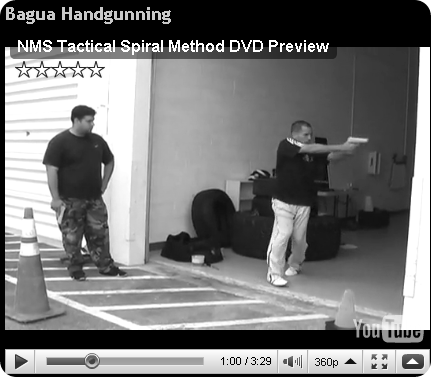
Police Tactical Footwork from Bagua?

Dojo Rat has an interesting post with video of Bagua footwork being used for  handgun drills. I’d love to hear from any law enforcement firearm instructors on this one. Click the picture to watch at Dojo Rat’s site.

Bagua footwork for handguns Bag

Tuesday, February 23, 2010

Thursday, July 30, 2009

Today’s TDA Tip: Carry!

Exurban League makes a great case for carrying. Head over there for a larger view!

image

Also, you may have seen this on the TDA Twitter feed:
More Than A Dozen Shot In Chicago Overnight

‘Nuff said?

Tuesday, November 25, 2008

Inside the Crucible Vol2

New from Paladin Press, an exclusive look at Kelly McCann's first major civilian training program - the Individual Protective Measures Course