Wednesday, March 30, 2011

Blogs You Should Read: Martial Arts Spectrum and The Dragons Orb

During my self-imposed hiatus, I missed the connections I had with some great writing and resources in the martial arts blogging community. I’m determined to help my readers by posting links to great sites, and to help my fellow instructors and martial arts bloggers by public appreciation and recognition of their work.
Two such sites are Martial Arts Spectrum and The Dragon’s Orb.

image
Martial Arts Spectrum is a relatively new blog (started in January of this year), but is off to a great start. I’ve been burned before by featuring and linking new sites, but have a feeling that this one will be with us for a long time. Author Craig Willits runs a school in Fredericksburg, Virginia that features formal instruction in ATA Taekwondo, with an adult program that includes techniques from TKD, Krav Maga, vee arnis jitsu, and defensive tactics. A nice mix.

Mr. Willits writing interests me because his focus is on the practical or self-defense aspects of technique and tactics, while not ignoring the strategies necessary to employ them. He is also not afraid to express his opinions in a blunt manner, and, more importantly, give the reasons for those thoughts.

Some good recent examples of MAS posts are:
Kata Evolution: A Video Comparison
Refractions 3/28/2011: Sumo, McGruff, and Daniel-San – a great weekly collection of links. I hope he adds labels so that we can review or reference past posts that way.
Taekwondo for Self Defense
The Jumping Jack Brain Scramble
Check out Martial Arts Spectrum whenever you can, and look for his latest post the sidebar under “What I Read” for a link.

image
Another recent discovery is The Dragon’s Orb, written by the mysterious Sensei Strange, whose moniker should give you an idea of the flavor of the content: irreverent, fun, but insightful. Strange’s self description is “Martial Magi. Exploring the path through exploration, introspection, a deep love of people and sense of awe.” Love it! I have to admit that I didn’t really discover this site, it was actually there all along, and I saw it linked several times on Pat Parker’s Mokuren Dojo site, and had to check it out.

From what I can see, there is a heavy emphasis on Aikido content and much is filtered through that context, though

I am only beginning to explore The Dragon’s Orb, but to give you an idea of why you should do the same, here are a few posts to whet your appetite:

Training Montage a post which immediate gave me pangs of envy ‘cause I don’t have a montage myself, and as Strange says, “What you don't have a montage? ...And you call yourself a martial artist. Sheesh.”
Interesting Ashi Waza – Sapu contrasting the footwork of a silat instructor’s ideas with ashi waza.
The Definitive Shomen Ate which does what Sensei Strange seems to do best, expound on concepts and ideas using words and video exposition.

A heavy and satisfying dose of instruction is what you’ll get with every post at The Dragon’s Orb. So head over and check it out, or look on the sidebar under “What I Read” for a link to the latest post.
____
Like this post? Subscribe to our feed or by email and you won’t miss a thing.
Please interact with us at our TDA Training Facebook page!

All original material is copyright of their respective authors.
All rights reserved. Permission must be obtained before use. Copyright 2011

Tuesday, March 29, 2011

Review at the Ground Never Misses - "Combat Sambo: Dynamic Entries" by Reilly Bodycomb

I love this review, and if it fit my current training goals, would purchase the material. Check out the review here, and enjoy the Masakazu Imanari highlight video embedded there.


____
Like this post? Subscribe to our feed or by email and you won’t miss a thing.
Please interact with us at our TDA Training Facebook page!
All original material is copyright of their respective authors.
All rights reserved. Permission must be obtained before use. Copyright 2011

Tuesday, March 22, 2011

Is MMA giving Muay Thai a Bad Rap?


Image credit: Wikimedia Commons

Huggy Bear at My Muay Thai thinks so in Is MMA Counterproductive to Muay Thai?.

On one hand they are giving Muay Thai a lot more exposure by constantly talking about it but at the same time they are hurting it because either A. The fighters Muay Thai is garbage or 2. It isn’t even a Muay Thai technique that they are using. So yes, any exposure is good but misrepresenting the sport is counterproductive.
I hate to dismiss this criticism, or minimize it, but here’s my two cents:
Every sport based on a “pure” art is watered down. ALL of them. I’ve posted in the past regarding my feelings on what happens When Arts Become Sports – they change to conform to what the rules emphasize will win. For example, the Judo we see today would hardly resemble the art that was initially focused on self-defense and self-improvement. Pat Parker has posted before on the differences in Judo over time. Boxing itself had to change with the introduction of gloves, and restrictions on the contact area of the fist. The complaints in the My Muay Thai post are correct, in my estimation: in MMA, there is watered down, imperfect Muay Thai, but then, as the author mentions, all of the core arts in MMA are less than perfect when deployed in the MMA setting.
I had the same complaints in the early days of American “kickboxing” ( PKA full-contact karate) – it was bad boxing and bad karate mixed together (I am not capitalizing Karate on purpose). An above average amateur boxer had better technique than some champions in those days. While we’re on the subject of striking, the WKA added the ability to use leg kicks, but what they termed Muay Thai at the time was a poor imitation.
We see the same complaints by wrestlers or boxers watching MMA today: if only so and so used better _________ technique, then he’d do better against ____________. It’s true, but it’s also the nature of compromise in sports, especially combat sports. The more one focuses on a strength, the more opponents focus on the areas of weakness; just basic strategy. For a long while I remember hearing commentary about various world-class wrestlers or BJJ fighters in MMA lamenting the fact that those competitors weren’t using the skills that they possessed, but if they did, an opponent could counter it with another technique or tactic which was only exposed by that style.
Is it hopeless? Will we see good or great technique in a pure form from any of the styles making up MMA? Maybe – we’re getting closer and closer over time as fighters get better trainingin and are more well-rounded, but the days of the specialist winning it all in MMA have been gone for years, so none of us that are accused of being purists will be happy, I suppose.

____
Like this post? Subscribe to our feed, or by email and you won’t miss a thing.
Interact with us at our TDA Training Facebook page!

All original material is copyright of their respective authors.
All rights reserved. Permission must be obtained before use. Copyright 2011

Monday, March 21, 2011

UFC Competitor Fights Crime

We see so many examples of bad press that MMA fighters get, so it’s time to give some well-deserved kudos, too.

Via MMATorch.com:

Jon Jones, trainers halt robber in New Jersey hours before UFC 128 title fight

Hours before the biggest fight in his young mixed martial arts career, Jon "Bones" Jones and his trainers Greg Jackson and Mike Winkeljohn subdued a robber in northern New Jersey.

The three were en route to a waterfall to meditate when they noticed a man breaking into a car and stealing items from the vehicle. They yelled at the man and he took off running, and all three ran after him. Jones caught up to him first, and according to Jackson in comments made to Yahoo! Sports' Kevin Iole, Jones "foot swept" the man to get him to the ground.

A great story of either a bad guy being in the wrong place at the right time, or of some heroics from an unlikely source: the much-maligned MMA fighter! Watch this interview:

Jon Jones, trainers halt robber in New Jersey hours before UFC 128 title fight

Some observations here, in no particular order:

  1. These guys didn’t beat the hell out of the suspect, but used appropriate force to detain him – not your stereotype of MMA.
  2. They had the conditioning to chase down the bad guy, probably far more than the larcenist had.
  3. It could have gone down differently if the guy was armed (always a risk), and we should all consider it when deciding to intervene in a crime in progress. There is always the risk of injury, death, or damages via lawsuit, so be careful. Personally, if there’s a rape or assault and battery in progress, I’m going to probably jump in there and take my chances, but a property crime is less likely to get me in there. You make your own call. That said, we should always be glad that someone’s willing to stick his neck out for others.
  4. What??? “The three were en route to a waterfall to meditate…” Uh, are you sure these were mixed martial arts guys? Breaks the stereotype in half, at least, doesn’t it?
  5. I have participated in debates about MMA, and one of the knocks on it has consistently been that MMA fighters are undisciplined thugs (OK, no one ever went that far, but it’s an exaggeration only by a little), and have no respect for the arts which make up their “mix.” My argument is that, yes, there is a fair amount of dorkish/caddish/loutish behavior in MMA, but I have seen the same in “traditional” martial arts tournaments, and that will definitely take place anytime you are talking about competition at a high level, especially when hundreds of thousand of dollars are at stake. How could we expect MMA to be different? It’s a sport.
  6. We have also discussed (in the martial arts blogging community) the efficacy of MMA in self defense situations, as opposed to traditional arts, and this should be included in those discussions. In the story, all of the skills that a good police officer should use were employed, takedown, nullification of striking, then restraint. Those skills, along with the incredible conditioning that all combat athletes have, plus the striking skills will make any MMA fighter a force to be reckoned with in a self-defense situation. Add to that mix that MMA fighters are used to falling, getting hit, and reversing position from any grappling range, and you have a formidable self-defense package.

Agree? Disagree? Please comment, or join us at our TDA Facebook Page to discuss.

____
Like this post? Subscribe to our feed, or by email and you won’t miss a thing.
Interact with us at our TDA Training Facebook page!

All original material is copyright of their respective authors.
All rights reserved. Permission must be obtained before use. Copyright 2011
Wednesday, March 16, 2011

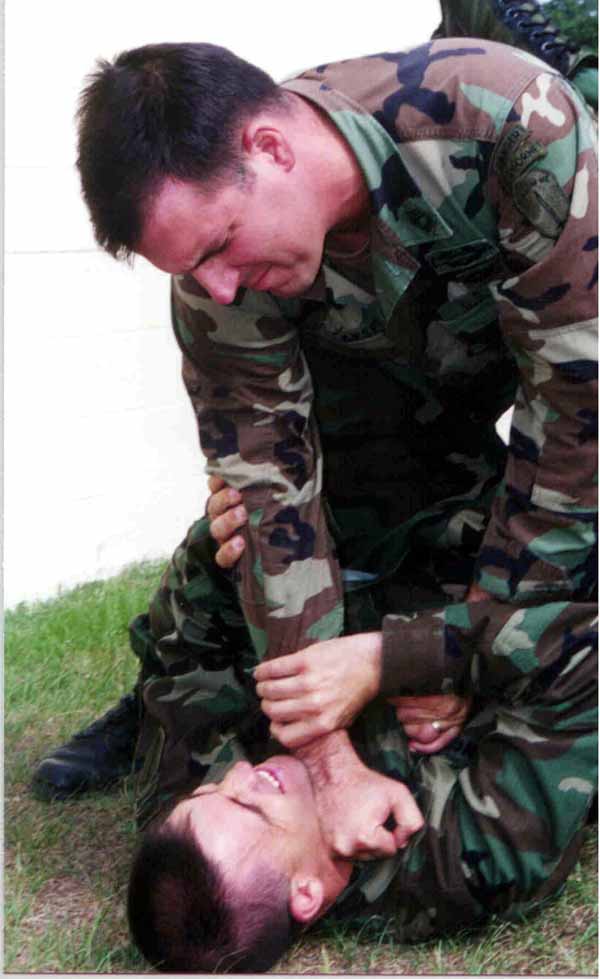
The Basics of Self-Defense Training

[This was built from one of my first serious attempts at passing along practical information from this site, rather than using it as a training diary in 2004. It was originally posted as Practicality in Training. It still encompasses much of my outlook on martial arts training. Comments are appreciated.-Nathan]

I've always looked at martial arts, in general, as an equalizer, much like the Colt 45 in the old west. I believe that you can improve your chances of survival in all self-defense situations if you have some training. For that training to be effective, though, you have to train as if you're in the situation.

This brings to mind something saw last winter at the skating rink near our home. As we were waiting for one of our kids' lessons to begin, I watched as the figure skaters were warming up in the main lobby area. Some of the competitors were just stretching and moving around, but a couple of them were practicing their jumps and spins in the air, then landing on the floor in tennis shoes. I realized that they were not only practicing some of the mechanics of the technique or jump, but from the focus, they were visualizing being on the ice.

That's how we should utilize the components of our training - everything can, and should, have a practical component. How often will we use a technique? Hopefully, never. If we need to, I don't think it's as important as being prepared to usewhatever we have ready. By this, I mean that if I have very heavy boots, restrictive clothing such as jeans and a winter coat on, I probably won't be kicking very high, if at all. But, I should have full use of my hands, and can count on some protection from my clothing as well. If you've ever worn bag gloves, you can attest to the fact that you can hit a lot harder with them on than with them off.

What's more important than what I wear is that I have mental preparation and confidence that I can avoid or handle something. So how can we prepare?

How can you make your self-defense training more practical.

  1. Train with self-defense in mind - How can I actually use this block, kick, punch, or grappling technique to save my life? Every technique, once learned properly, should be filled with intensity and purpose. Take nothing for granted. It could save your life.

  2. Drill scenarios like being attacked as you get in or out of your car; pushed from behind; grabbed from behind; tackled and pinned; in very light or dark conditions. Have you ever started out a grappling or groundfighting session on the ground, lights out or blindfolded? Drill being at an ATM and getting approached from behind. Practice in the parking lot. Read the crime blotter in your local paper and build scenarios from it.

  3. Train outdoors in street clothes. Make your training environment more realistic by wearing what you normally do. If it isn't appropriate, wear something close. As Bob mentioned recently, and I have many times, training wearing footwear is completely different than barefoot. Why on earth would you think that you can pivot, slide, or move the same with street clothes as you do in near-pajamas? Why do you think the military trains combatives in body armor, helmets, etc? Take a lesson and get it in gear!

  4. Train in confined spaces. Use a parking lot area marked off and surrounded (against a car), simulate an elevator or office area (or really use one if you make sure it's OK).

  5. Mentally rehearse. Inconspicuously look someone over so that you could identify them. Go from head to toe: height, build, skin color, facial hair or other distinguishing characteristics, clothing, footwear. Listen to his voice. Accent or anything else that stands out? Could he have a weapon? Think about what you would do versus an initial move or attack by that person.

  6. Think of escape routes. Never a good idea to turn your back, but, can you get away without being exposed to potential danger? One of your first moves when going in to a location is thinking of how you would get out. Much like defensive driving, knowing an escape route is key to being able to avoid dangerous situations.

  7. Practice the dynamics of fighting, not sparring. There is a very big difference between fighting and sparring. As you may know, sparring can be pretty, rhythmic, clean (technique-wise), and can take a while. Sometimes in sparring, you need to pace yourself. Fighting is all-out, vicious, and messy. It doesn't have a discernable rhythm, and there is no referee, or clock, so you don't have rules, and sometimes pacing yourself is going to mean you give your opponent more chances. Fight like you're in a toughman contest with only sixty seconds to win the whole bout. Sparring has it's place, but reserve time for serious fighting drills as well. Contact is critical to training to survive. If you aren't used to getting hit pretty hard, you're probably not going to make it outside the training hall.

  8. Train to survive fighting more than one person. Try to spar, at first, with more than one person until you get pretty competent at it. Then try to fight against a pair of partners that are working together to try to tackle or pin you. If you're really brave, try this against 3. Escalate the intensity and difficulty just a little past what the "defender" is ready for occasionally. Afterward, sit down and discuss what worked, what didn't and why. Learn from your losses and wins. Open up with different objectives, like the attackers are really pissed, or only want your wallet, or are just out to hurt you.

  9. Train to defend and survive an armed attack. Introduce weapons into your training as early as you can. There should be clubs, edged weapons, and handguns in your training. Add them into your skill set, then learn to defend against and use them. Add a club into the mix, or a blade, when sparring. Have someone pull a training pistol or squirt gun during drills and see how you handle it. It will, more than anything else, open up your mind to how your current skills need improvement. Who cares how many guys you can tap if someone else can double-tap you in the chest with a pistol because you aren't looking for it.

  10. Use your environment to survive. Dr. Jerry Beasley said that one of the first things he looks for in every self-defense situation is for something to throw. He wants to make sure he can blind, stun, or injure an attacker so that he can get away. A great approach. Also use objects in your environment to put between yourself and danger, anything that can give you a millisecond more to react if there's a threat. I think it was Hock Hochheim that wrote about some of the subtle things that officers do to maximize reaction time, like standing behind a fire hydrant or up on a curb. Are there any objects in your vicinity that your could improvise with? A broom could make good use of your bo skills. Similarly, I love having a short umbrella in my hand because I know that my Arnis training will let me make short work of most attackers, even a knife-wielding one.

In short, most of us start training with the idea that what we learn will help us in self defense. In many cases, it won't. Unless you train like your life depends on it.

Photo source: Wikipedia Commons

Tuesday, March 15, 2011

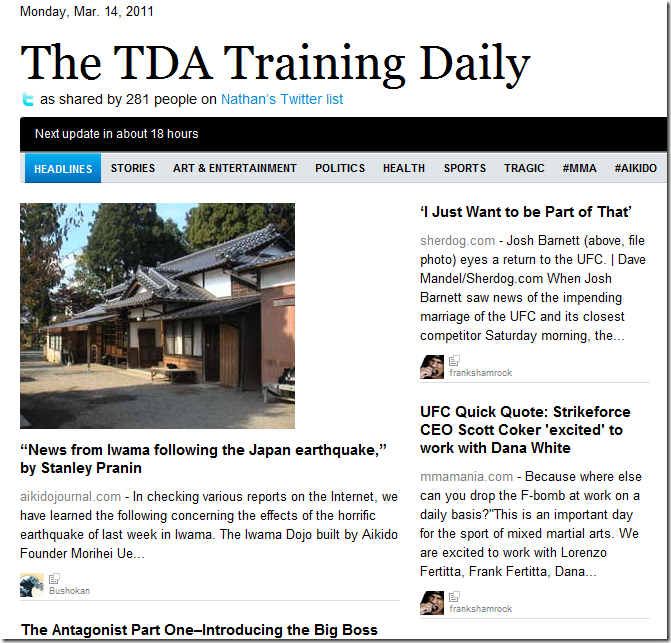
New Feature–The TDA Training Daily

UPDATE: Relaunched as The TDA Training Daily with revised content. Some will be politics, war news, but mostly martial arts and training-related posts by some top people on Twitter. I will be tweaking it as the days go by, so check back from here or just subscribe.
image
We know. We know. Most of your are just happy that we’re actually making your days more bearable by posting here at TDA Training again. We can understand your tears of happiness, but we want to overwhelm you with the value of, not only our TDA Training Facebook Page, but an entirely new feature:
The TDA Training Daily! It’s a big sidebar link thingie, taking up lots of valuable real estate here. But it’s more than that! If you click on said big thingie, you’ll go to The TDA Training Daily, and there you’ll be overwhelmed with joy at all of the great information and posts on all things martial. Far more than even the great TDA Training can bring you.
Go ahead. Try it! We’ll wait for you.
[Faint sound of fingers tapping on the table]
You back? That means you’ve probably spent an hour reading all of the cool posts, so welcome back!
Anyway, it’s a great compilation of tweets and posts by such luminaries as Mokuren Dojo, Ikigai, and others.
Give it a shot, and you can even subscribe via email to the posts.
____
Like this post? Subscribe to our feed, or by email and you won’t miss a thing.
Interact with us at our TDA Training Facebook page!
All original material is copyright of their respective authors.
All rights reserved. Permission must be obtained before use. Copyright 2011

Free PTSD Ebook available

image

If you have, or know someone who has post-traumatic stress disorder, please go to When Our Troops Come Home to read about, then download this free ebook by Ken Jones, PhD, a Vietnam vet who’s still serving his brothers and sisters in arms long after his active service has ended.

Technorati Tags: ,,,,,

Sunday, March 13, 2011

FMA: Pekiti Tirsia Sunday (video)

Filipino Martial Arts: Pekiti Tirsia

Is there something to learn here? A look at traditional Filipino martial art Pekiti Tirsia,

Hat tip to my friend and martial arts mentor Apolo Ladra.

____

Like this post? Subscribe to our feed or by email and you won’t miss a thing.

Please interact with us at our TDA Training Facebook page!

All original material is copyright of their respective authors.
All rights reserved. Permission must be obtained before use. Copyright 2011

Mobile Viewers of Blogs

Ok, geeky Sunday topic for sure, but I was looking at my Google Analytics data and decided to delve into what I could find out about mobile devices viewing TDA Training. To me, interesting stuff. To some of you, probably not, but here goes, anyway.

image

Figure 1, total mobile visits

Clearly there’s a strong upward trend, and this is scaled to a monthly view, but you can see that there’s an average of 17% growth per month. If my math is wrong, it’s still a lot of increase since the end of ‘09 and the beginning of ‘10.


For you soldiers in the Smartphone wars, this one may be more interesting. Which mobile OS has the lead?
Figure 2, % visits by mobile OS
image image

The interesting part about this for me is that the iPod was so high. Didn’t have any idea that many people used those devices for browsing. There has been a change in the stats, which I won’t detail in this post, from the clear dominance of the iPhone to the increase in the Android numbers in the most recent months – about equal. And the iPad has gone from zero to hero in a short period of time. Some of these, I have no idea what they are: Danger Hiptop??? [Extra question marks are for emphasis]

While we’re talking about OS, who are the biggest readers by number of pages per visit?
#1 Sony at 3.11
#2 Android at 2.96
#3 Nokia at 2.89

The stingiest page turners
#10 Blackberry at 2.11
#9 iPhone with 2.18

For us bloggers, how do mobile readers compare to desktop/laptop readers? In other words, how different are their habits? Over this period of time:

Pages/Visit 2.46 (Site Avg: 2.67 (-8.08%))
Avg. Time on Site 00:01:37 (Site Avg: 00:01:25 (+15.32%))
Bounce Rate 19.71% (Site Avg: 23.23% (-15.16%))

What this says is that these mobile readers read a few less pages (8%) than desktop/laptop users, but average 15% more time on the site, and average more than one page 15% more than desktop/laptop readers (bounce rate). Now, these figures are changing fast, and I expect will change faster still as the market evolves with the increasing popularity of the table/iPad, as well as the smartphone advances. Even the ebook readers are now getting into the game.

What impact should this have on bloggers? Should the way we write and market change? Over the whole period, less than 5% of our readers used a mobile device, but over the past three months, that has increased to almost 8% of total visits. Clearly, things are changing.

Friday, March 11, 2011

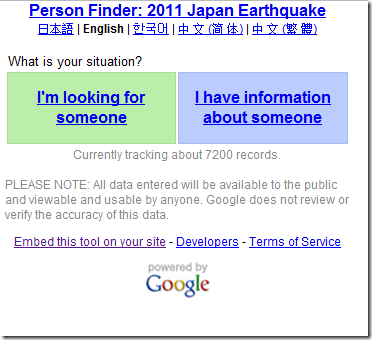
Google People Finder for the Japan Earthquake

TGace posted this at The Things Worth Believing In, and it’s a great use of technology for times like this:

Click the photo to go to the tool. And please post on your own site and spread the word.

image

Taekwondo Competition Rules and Self Defense


Photo credit: Aminoacid91

A nice post by Self Defense Source on the difference between ITF (International Tae Kwon-Do Federation) and WTF (World Taekwondo Federation) rules for sparring in competition. Why post about specific federation rules? Well, it relates to the discussion started by John Zimmer at My Self Defense Blog on what I called Competitive Distortion in Martial Arts Competition, meaning how tweaks to the rules emphasize (or de-emphasize the practicality of certain techniques. Zimmer’s post focused on open tournament rules, and then it started a healthy discussion on MMA in his comments. The Self Defense Source post is a pretty fair comparison of the difference, pros and cons of the two federations’ rules, with the admonition that, “Although both organizations have admirable characteristics and traits, receiving training in WTF vs ITF Tae Kwon Do, can lead the student down different paths.” What are those paths?

The gist of it is that, “Individuals who want to compete in tournaments that may lead to Olympic try-outs will be most interested in the WTF sanctioned schools. When self-defense or the art of movement is the goal, the ITF sanctioned schools will be most appropriate” Absolutely correct. Or is it?

Full disclosure: I hold black belt ranks in both styles of TKD, but favor the ITF. I do recognize, however, that there are distinct advantages to the WTF approach, at least as I understand it (not having taught pure TKD of any flavor since 1996). The two biggest advantages for the self-defense oriented martial artist is that WTF competitive sparring is very physical – heavy contact is the only way to score; in some traditional (ITF) competition, power is de-emphasized over clean technique and control (reducing power while retaining speed and technique). There are other differences, and to make it easy for even someone like me to understand, here is a handy comparison chart:

Comparison Point WTF ITF
Knockouts? Allowed (wins) Not allowed (Disqualification)
Power Level Heavy (to score at all) Controlled (or point deductions)
Body Protection Equipment Yes No
Head Punching Illegal Allowed
# of rounds Three with 1-minute rest periods One 2-minute round
Continuous Action? No Yes
Point Scoring Body (punch or kick)=1
Turning during score+1
Head kick=3
Punch to head or body=1
Kick to body=2
Kick to head=3

Can you pick out the distinct advantages for self-defense oriented practitioner? No? Well, it’s not that clear. Here’s my humble opinion, and I’ll invite our TKD oriented readers to correct and interject as to whatever I may have missed.

  • The WTF sparring style is extremely fast – footwork is unique among martial arts and very deceptive. I’ve found out personally how effective the sport footwork is for controlling range. And I didn’t like it when applied to me! It CAN be applied in self defense, but must be tempered by the conditions (as all styles must), including the room needed, and the footing.
  • ITF sparring’s inclusion of face contact via punches is a big plus. There was nothing I hated more than watching ITF players standing and trading kicks while almost hip to hip, when a elbow or hook punch would have taken so much less effort and been immeasurably more effective. The primary benefit of allowing face punching is that the practitioner learns to defend face punches, which are probably the most common attach there is, besides grabs and shoves.
  • The WTF style is all about kicking HARD. That’s a big plus since the competitors learn to hit a moving, resisting target with power. They also learn to absorb a hit and not get stunned. On the other hand, the ITF emphasis on control is, to me, dangerous for two reasons: 1) you’re expecting a certain level of control, and if it’s not used, you can get hurt very badly, and 2) there is a distinct lack of control in a violent encounter, and you need to be aware of, and ready for that! The continual threat of getting knocked out in WTF sparring adds a sense of gravity to the idea of hitting while not getting hit! I’d thought of mentioning the hogu as a reason to dump on the WTF as unrealistic, but it’s not as much a factor as you’d think, since the emphasis is to heavily on head kicking. And the shots are so powerful that they hurt anyway.
  • WTF conditioning is a nice plus. There are few sports that demand a higher level of conditioning than an elite WTF fighter. I got tired just watching Gordon’s young fighters getting ready for a regional tournament.That training can make the difference in an encounter lasting longer than expected, or even if you just want to put some distance between yourself and the situation.

    To sum up, I think both are unrealistic enough due to the emphasis mentioned in John’s post about open rules: more points for head kicks. That leads to a distortion in that what is being used in competition is one of the last things you want to use in self defense. Sensei Matt Klein’s comment in the Zimmer post was right on: for a sport that can also apply well in self defense, pick MMA.

    For more information:

  • Read the original post at Self Defense Source

  • Wikipedia post on TKD

  • Traditional Taekwondo Techniques

    ____

    Like this post? Subscribe to our feed or by email and you won’t miss a thing.

    Please interact with us at our TDA Training Facebook page!

    All original material is copyright of their respective authors.
    All rights reserved. Permission must be obtained before use. Copyright 2011

  • Thursday, March 10, 2011

    Wim on Old guys

    Wim Demeere has a couple of cool posts in a series, and is working on another per his Facebook page. Check out

    HOW TO TRANSITION FROM COMPETITOR TO COACH

    then

    OLD GUYS IN THE MARTIAL ARTS, PART TWO

    Thoughts?

    Tuesday, March 08, 2011

    Todays Tip: Leave the stall door open!

    IMG_20100820_195045

    Not what you’re thinking! Alternate title: Leave the barn door open, but that’s a different visual.

    Background: we have three equine animals: a small horse, a pony, and a miniature donkey. Until the last few years, I’ve never been around horses, much less owned them, but somehow, I’ve got them now, and my primary job is stable boy. Anyway, that’s where our tip begins.

    The other day I was cleaning the stall of one of the pony, who’s battling laminitis, and is now confined to his stall, and my wife tried to come in, and noticed that the stall was locked. “Never lock yourself in a stall,” she said sternly. She’s the expert.

    How does that apply to self-defense? Have you ever left yourself in a potentially dangerous situation without a way out?

    On several levels, we could say that I assumed I knew the level of danger in a stall with a horse, and assumed I would be able to handle it. I didn’t think about how unpredictable animals can be, even if they know me. If a wasp were to sting him, he could put the through a wall, despite how much he likes me and my treats. In the same manner, do we really always think about our surroundings, and even more importantly, the people in those surroundings? I know I don’t. Don’t get me wrong, I probably have more of an idea of those threats and their threat indicators, but do I really?

    Since my wife and daughter somehow convinced me to invest (hah!) money in large pets that constantly require feed, water, maintenance (hooves, vets), and daily cleaning of their stalls and pasture, I’ve learned a little about how to look for the body language and psychological games that they can play with us, and with each other. With horses, there is a pecking order, and there are constant negotiations and threats that happen as they jockey for the dominant position in the herd (even one as small as three!). I have learned that to turn my back, or be unaware of what’s going on with them could be inadvertently dangerous, as even them quickly turning around is dangerous (700-800 pounds is a lot of mass that can knock even a bulky guy like me over easily). So, I’ve learned that, as much as I love them, watching for a nod of the head, ears turned down, or a snort and turn of the flanks can mean that I need to move, and FAST!

    I try to do the same with these people, even those that I know. Not out of paranoia (OK, maybe a little), but out of caution, or pre-caution. It’s easier to act than react, and faster. If I see someone that may be annoyed or angry, or just agitated, my awareness may let me know before he pulls out the pistol and starts shooting at his unfaithful wife. If I notice a group of young people is sporting the wrong type of clothing or behavior, I have time to clear out. It’s just common sense, and easier than “self-defense.” And potentially less painful.

    Have you unlocked your stall door?

    ____

    Like this post? Subscribe to our feed or by email and you won’t miss a thing.

    Please interact with us at our TDA Training Facebook page!

    All original material is copyright of their respective authors.
    All rights reserved. Permission must be obtained before use. Copyright 2011

    Monday, March 07, 2011

    Home Invasion Survival

    John Vesia has a post on Surviving a Home Invasion prompted by receiving information from an alarm company. He’s asking for comments as to what readers have done to prepare for the possibility, and how to survive.

    Has anyone taken measures to ward off the possibility of a home invasion? Certainly, the very thought of one should be horrifying. But what to do? Keep a bat or some other handy weapon in the closet or drawer? Is owning a gun and keeping it at home a good idea if you have young children?

    We’ve posted before on it, and thought it might be helpful to remind our readers.

    In our post, Anecdotal Information on Home Invasion - Use of Deadly Force we cover the following:

    During my recent time with a retired police officer (see Real-life Pit Bull Encounter) was home invasion, which is defined as, "burglary of a dwelling while the residents are at home." I've had several posts on what type of response you should have, or how you should prepare for the possibility of home invasion.

    As we compared notes on burglary (I don't remember why the subject came up), the gist of our conversation was that true home invasion is actually pretty rare. Most are accidental - burglaries where someone isn't supposed to be home. For example, a home is usually burglarized when the residents are known to be away, or during the day. During those times, if someone is at home, it's likely that the burglar will attempt to flee, because he's after your property, not you, and wants to get away, not hang around.

    The most frequent cases of intentional home invasion may be where the invader is an acquaintance (or relative) or former partner ( or spouse) of the resident, and intends harm to said resident, usually murder, rape, or robbery. In other words, someone breaks into your home because they know you are there, and want to harm or harass you while you are present.

    In any case, depending on the original intention of the home invader (burglary of an unoccupied residence, robbery of the residents, or worse), your response should be appropriate. You don’t know what the intentions are, and can’t trust that it’s not to rape, rob, or murder you and your entire family. You don’t know. Will you risk it?

    Our response in the same post was:

    "weapons should always be your first resort, not the last. My reasoning is that, if faced with an unknown threat, especially an intruder that is so bold as to invade an occupied home, you should assume a deadly threatto your family." My position, after assuming that all other steps are taken to make the home a hard target, and assuming the invaders probably know that you are home and are coming in anyway, you are justified in using a weapon. The commenter is correct that use of deadly force may constitute a crime if not justified. I will clarify my opinion:

    1. If you have a chance (or a choice), make sure that everyone in the home is BEHIND you and in as safe a place as possible. There are many cases in the news of inner-city shootouts that kill residents in their homes because bullets keep going until they stop. That means that you want everyone you care about behind you, if possible.
    2. Call the cops - let them know where you are, meaning your full address and WHERE YOU ARE IN THE HOUSE. Make sure you let the dispatcher know that you are armed, and give a description of your appearance. For example, "My family and I are in the second-floor bedroom furthest back. I am a five foot, nine-inch white male with a beard, and wearing a blue t-shirt and boxer shorts. I am armed with a small semi-automatic pistol." For a good example of why you want to do this, go here.
    3. Let the intruder know that you are there, armed, and that law enforcement has been called. Do this while staying on the phone so that it's recorded by the dispatcher (almost all 911 calls are recorded). Do this in a loud, clear voice.
    4. If you believe the lives of you or your family are in danger, do what you have to do.

    Consult with legal authorities in your state. Is that clear enough?

    There is more good information linked from Weapons first or last?, a post on whether to use weapons or empty-hand self defense skills in a home invasion. Can you guess where we come down on that?

    UPDATE: Wim weighs in on the subject here.

    For more information:

    Be sure to read Martial Views
    Crime Doctor's Home Invasion page
    Equalizer saves the day
    The Armed Citizen

    Sunday, March 06, 2011

    Martial Arts News at Striking Thoughts

    In the early days of martial arts blogging, back when we finished sparring, and wrote the posts in our own blood, then sent it to the Web via a caravan of Mongols who made it to the host only after massive casualties, yeah, in those days, I made some early friends doing this. Several of the early guys, John Vesia at Martial Views, Patrick Parker at Mokuren Dojo, the Dojo Rat, and Bob at Striking Thoughts have kept on keepin’ on even when I slowed the pace to a crawl.

    Here at TDA Training, we did a series of posts called TDA Blitz, which was way cool, but didn’t keep it going. Our successor was the Martial Arts News at Striking Thoughts. If you don't already, please check out his Martial Arts News series. Bob has generously linked and mentioned this blog so many times over the years, that I can’t really give him enough credit, so won’t try. I will recommend you check out his news, and his blog posts. If you ignore his lefty politics, it’s a great blog!

    185 posts on the way?

    image

    Well, no. But since I decided to start doing this writing thing again, I’ve searched all of the places where I put my ideas (mostly dumped into drafts on Windows Live Writer), and was shocked to make a discovery: 185 draft posts. One hundred eighty-five drafts?!!!

    I have been back and forth over the past few years about continuing to write about martial arts, and every time I’d have an idea about something related to martial arts, I’d do one of the following:

    • I’d think, “Wow! That’d make a great post, I’d better write that down!” Then I’d get too busy, not have a pen and paper, and it’s would be gone (about 85% of the time).
    • About 10% of the time, I’d write it down or email myself, or create a draft post. Then do nothing.
    • Maybe 2 or 3% of the time, I’d start a post, and actually build it, and then leave it because I couldn’t justify the time it costs me.
    • A small percentage of the time, I’ve posted these ideas. Thus, the light posting.

    So, that’s why my posts went from over 500 in 2006, to as few as 44 in the last couple of years.

    So, I’m going to post them. Not all, but many. I’ll mix them in as they deserve it, and I’ll schedule some so that it will cover the dry times, but my commitment to myself is to post at least once a week, no matter what, and, if I only posted these drafts, I’d cover the next 3 years! So it should be easy, and take less time than I was committing to this before.

    So, I’ll pick and choose, but post more. Please let me know if you like them, and the comments are appreciated. And, if you use it, please connect with us at the TDA Facebook Page.

    I also plan to ask some of my martial arts friends to write guest posts on occasion, and continue to recommend other blogs, sites, and books that I read. And we’ll see how it goes.

    Thanks for reading TDA Training.

    ____

    Like this post? Subscribe to our feed or by email and you won’t miss a thing.

    Please interact with us at our TDA Training Facebook page!

    All original material is copyright of their respective authors.
    All rights reserved. Permission must be obtained before use. Copyright 2011

    Friday, March 04, 2011

    Top 10 Posts of the Past Week

    I was looking through stats in both Feedburner and Google Analytics, and they return different results for the same time period. I’m no expert on blogging, nor am I especially proficient at interpreting these numbers, so I’ll throw down a both lists for you to check out.

    Ranking Feedburner Google Analytics
    1 Lessons from the DC Metro (video)
    Top Technique: Brachial Stun
    2 Explosiveness Rules!
    Is Boxing Viable for Self-Defense?
    3 The Biggest News of 2011 (so far)
    Lessons from the DC Metro (video)
    4 Competitive Distortion in Martial Arts Competition
    Boxing Punch Numbering System
    5 Should MMA Be Banned?
    The Biggest News of 2011 (so far)
    6 Hoost vs. CroCop = Outstanding!
    Boxing for Self-Defense and MMA
    7 Is an attack imminent? Get a clue!
    Should MMA Be Banned?
    8 Are martial arts good for your joints?
    Explosiveness Rules!
    9 Solo training–key to progress
    Are martial arts good for your joints?
    10 This is amazing
    Is an attack imminent? Get a clue!

    Does this make any sense? I guess I’ll have to actually review what each system uses for compiling their stats. Anyway, any surprises here? I notice that Google Analytics is including some very old posts. Interesting. I think it may be due to inclusion of more search engine results. There seems to a lot of interest in the Brachial Stun as a technique, and we rank very high in searches for boxing content. Interesting.

    If you have a clue about this and want to send me a good link for the lay martial artist on how to read this, I would appreciate it!

    Wednesday, March 02, 2011

    This is amazing

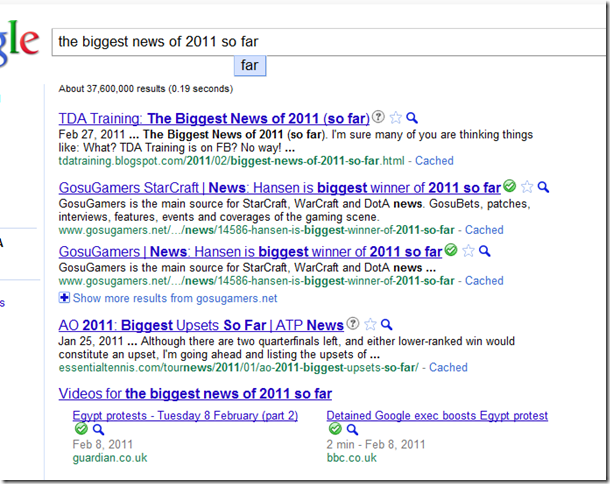
    Blatant self-promotion alert!

    image

    Is that wild? How does that happen? Here’s the post, cus I’m betting this won’t be #1 for that long.

    ____

    Like this post? Subscribe to our feed, or by email and you won’t miss a thing.

    Interact with us at our TDA Training Facebook page!

    All original material is copyright of their respective authors.
    All rights reserved. Permission must be obtained before use. Copyright 2011

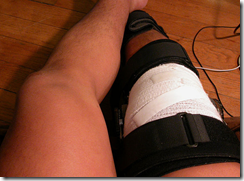
    Are martial arts good for your joints?

    image

    A very interesting post at the Washington Posts’s Health section on a study of some other studies on osteoarthritis of the knee and the relationship to physical activity: The Checkup - Study finds exercise is actually good for your knees. A few of the highlights:

    • “…many of the studies' findings appeared to conflict with one another, some finding that exercise hurt knees, others finding just the opposite or no effect one way or another” No surprises there. It seems to me that many studies are commissioned in order to arrive at a pre-determined conclusion, in a manner similar to polling, thus it’s critical to be able to view the raw data and all information related in order to determine the veracity of the results. In other words, don’t trust without verifying, to quote a wise president.
    • “…exercise does appear to promote the growth of osteophytes, or bony spurs, in the knee joint. But in the absence of accompanying cartilage damage, the researchers suggest, those spurs may simply be the body's healthy response to ongoing mechanical stimulation from physical activity, not evidence of disease.”

    Their conclusion was that what’s been viewed as damage is simply adaptation, in most cases, and that the exercise is actually strengthening the knee and adapting to prevent damage (my interpretation only).

    What relevance does this have for those of us who strike more than the ground with our feet? Perhaps it’s not much. My problem is that I have never seen a study which focused on the effects of martial arts training on the joints. It may be out there, but I’ve not seen it. Have you?

    I will say that, in the 35 or so years (I won’t say how may the “or so” is, I’ve never sustained an injury from the training itself. It was always something like planting a foot incorrectly, poor technique, or an overzealous (or beginning) student or training partner. And my knees are great, even though most of my training has been in striking styles, I have always enjoyed kicking, a so did a lot of it.

    Here’s my reader participation question:
    1) What types of joint injures have you sustained?
    2) Were those injuries preventable?

    Please comment, or join our conversation on Facebook.

    Hat tip: Guy via Twitter

    Photo Credit: D.L. via Flickr

    ____

    Like this post? Subscribe to our feed, or by email and you won’t miss a thing.

    Interact with us at our TDA Training Facebook page!

    All original material is copyright of their respective authors.
    All rights reserved. Permission must be obtained before use. Copyright 2011

    Tuesday, March 01, 2011

    Is an attack imminent? Get a clue!

    A repost of from December, 2008, titled Threat Indicators and Personal Safety. It was a guest-post by tgace, of The Things Worth Believing In. tgace is a friend, whom 'I’ve had the pleasure to meeting in person, and he’s the real deal. By his own definition, he is a "husband, father, police lieutenant, FBINA graduate, fitness buff, martial artist, hunter, reader, gun nut, conservative, internet surfer." Check out his blog after this taste.
    I believe this is one of the best, and most important posts on this site, and I am honored to host and share it. Enjoy.
    Have you ever been in a situation where a person gave you the impression that they could be a threat? Did they gave off some sort of "vibe" that they were ready to start some trouble; something you just couldn't place your finger on? Chances are that there were obvious physical clues that person was giving you that you were only aware of sub-consciously.
    A common topic in law enforcement training circles is the detection of something called "pre-assaultive threat indicators". In any police contact, officers are trained to look for physical cues that serve as "early warning signals" that a person may flee or become combative. These same cues can be useful in the civilian world as well. Being able to identify body language that indicates an imminent attack can give you the opportunity to, at best, "beat feet". Or at worst, allow you to preempt the attack with a defensive measure.
    Avoiding Eye Contact: When a person acts like you are not there and wont look at you it can mean a few different things, or a cluster of them. The person is avoiding engaging because he is mentally processing the situation in an agitated state and cannot multitask. He is trying to decide what to do and when, he could be looking for an escape route or psyching himself up to act. He could also be attempting to distract you for a sucker punch.
    The Chest Puff: "Making the body bigger says 'I am powerful' and is a typical male action. This warns other men not to attack and may indicate that the person is thinking of attacking. It can thus be a response to a threat. If one man expands, then others have the choice of retreating or expanding also ('If you attack, I'll fight back!'). Expansion can thus indicate anger."
    Rocking Motion: When people are going into "fight or flight" mode their bodies are pumping oxygen and adrenaline into their systems and if they are trying to contain that urge to fight or flee (for the moment) they will do some odd things. Pacing, bouncing up and down, rocking back and forth, helps "burn off" some of that extra O2. it is also indicative of a subconscious "warming up" for action.
    Averting the Face: People on the verge of initiating an action often attempt to hide their anxiety by averting or hiding their faces. This will also be seen in facial wipes, slicking back the hair, looking up into the air, etc.
    Boxers Stance: This is a solid indicator that the "fight" half or "fight or flight" is being chosen. Look for a flexing of the knees and a "nose over toes" lean that indicates a preparation to launch.
    Clenching of Fists: Another indicator that "fight" is the choice. Its also another "warming up" gesture.
    Thousand Yard Stare: The subject is looking "through you" instead of at you. He has that "faraway look" on his face. He is putting himself in his "angry place". He is dehumanizing you and hovering over the launch button. Gain distance.
    Target Glance: The opposite of the Thousand Yard Stare. the subject is zeroing in on a target. If he's staring at your chin be ready for the sucker punch. If its your weapon, a gun grab attempt.

    Facial Wipe: see Averting the Face Now, don't go nuts just because some guy wipes his face. The secret to decoding these cues is to take the entire situation into account and look for clusters of behavior. If you are in a profession where you have to deal with people in these situations; when you see these indicators it is time to act! Put some distance between yourselves and start issuing commands for compliance. I would be getting my OC or taser limbered up and/or tightening the laces on my running shoes. If you are a civilian and you see these cues...leave...if possible. If leaving is not an option, get ready.

    The attached video is a clip from a project put together by a close friend who is a martial arts instructor, a local film artist and myself. It's a project in progress. Don't be too critical of the realism of the defensive response at the end. The threat indicators were the focus of the piece and we were not willing to roll around on the hot summer pavement for a more realistic "fight".

    For more articles like these, please visit: The Things Worth Believing In.
    ____
    Like this post? Subscribe to our feed, or by email and you won’t miss a thing.
    Interact with us at our TDA Training Facebook page!

    All original material is copyright of their respective authors.
    All rights reserved. Permission must be obtained before use. Copyright 2011