Or do you do kata in order to get better at some underlying principle (ju oraiki or ran or whatever)? Are kata a vehicle or are they an end goal?
Or do you do kata in order to get better at some underlying principle (ju oraiki or ran or whatever)? Are kata a vehicle or are they an end goal?

Bob from Striking Thoughts has graced us with his insight in an interview of someone who’s the founder of his own martial art.
I think you will find it interesting. Can you guess who the interview subject is?
Look for it after 1600 hours on Wednesday, May 11 (US, Eastern time). Don’t miss it.

This, the second in the series on the “21-foot rule” is written by Patrick Parker, of the venerable Mokuren Dojo blog. Patrick and I have enjoyed several years of banter, debate, and sincere mutual admiration since he started writing online, and I’ve grown to look forward to anytime he expresses an opinion, even if I don’t understand it. Sensei Pat runs a Judo and Aikido school in Mississippi, while, in Clark Kent fashion, appearing to the lay person as a physical therapist and PhD with some kids, living a normal life in the suburbs with a long honey-do list. Several times a week, ,however, in the evenings, the suit comes off, the gi and black belt goes on, and he transforms into a 6th-dan in aikido and 5th-dan in judo, both of which outrank and scare me. To preempt any threats or just looks of intimidation for not allowing him to play, I invited him to share his insights from his own context.
Cross-posted here at his site.
I'm not a law enforcement officer. I don't even play one on TV. In fact, I didn't even stay at the Holiday Inn Express last night. But Nathan at TDA Training did ask me to contribute some ideas to a week-long discussion of the famous Tueller Drill. Check out the video at Nathan's blog, and while you're at it, check out this gruesome example of the 21-foot rule played out in this police reel.
I enjoyed TGace's post about the flaws within the Tueller experiment and I appreciate his assertion that Tueller's results did not validate any sort of claim about the superiority of any particular weapon (a knife) over any other particular weapon (a gun). I intended to write this post on the idea that what Tueller does demonstrate most effectively is that a gun is not a magical talisman that automatically assures victory - but Paul at Tactical Arnis beat me to that point. Kudos to both of y'all for excellent, informative articles.
In my opinion, one of the take-away lessons from Tueller (perhaps unintended by the original author) is that a knife in the hand of a person with the right mindset is the most versatile, effective, gruesome, demoralizing weapon invented in the last several thousand years. Sure, the handgun is (I suppose) the centerpiece of police force projection, but again, the handgun is not a magic talisman. This point is effectively demonstrated by Tueller.
Also, Tueller's results were intended for police consumption. Using it to justify anything in the civilian self-defense context is a stretch - particularly because of the simple fact that most civilians will not have access to a handgun most of the time. But Tueller does illustrate an important point that is one of the centerpieces of our aikido system. That is...
You can never afford to underestimate the potential of your opponent.
Or, put another way, you have to treat every single training encounter as if your opponent is the most dangerous bad guy imaginable, armed with the most awful tactical advantage imaginable. Or, in shorter form, "You can never tell who you're standing beside." To us, that means we try to assume that all opponents are armed with a knife. You have to design your practices around the assumption that your opponent has the potential to kill you if they have the ability to touch you. That's pretty stringent, and it leads to practices like stab-twice randori, starting already stabbed, and progressive chaos.
As we have done knife randori like this over the years, we have come up with a few pretty reliable pieces of information. First, all of aikido (and probably most all of self-defense) is based on a couple of techniques that we call shomenate (A.K.A. the palm jab to the chin) and aigamaeate (A.K.A. iriminage, a palm jab to the chin done from outside the opponent's arm). The tactical idea behind both of these techniques is the same:
All of our randori over the years has verified this basic idea - if you go into a knife encounter with any plan but the above, You're likely to get killed. But the above plan saves you a remarkable percentage of the time.
It turns out that all the other stuff in aikido - all the stuff you think of as aikido - the cool wristlocks and the airy breath throws - those are just backup plans. This basic plan enumerated above makes up easily 80% of aikido, and all the cool stuff fills in around the edges.
And you know what's cool? Tactical guru, Dave Spaulding agrees with me!
So, in summary of this somewhat rambling, stream of consciousness...
[photo courtesy of Jesse Millan]
____________________
Patrick Parker

Mokuren Dojo's post, The aiki gift that keeps on giving, prompted a response post at Colin's Traditional Taekwondo Techniques blog, Aikido Philosophy, Taekwondo Technique ... Is it possible???, as well as mine, Escape as a Strategy in Self-Defense. I'd start in that order to get the full flavor.
I just read Savage Baptist's response to the series of posts at No Blog of Significance. 
One of my favorite blogospheric acquaintances, Dr. Patrick Parker, wrote a thoughtful post on how closely some aikido techniques actually match the art's professed ideals. The ensuing discussion, which has spread over three or four blogs at this point, seems to center around the difference between fighting and self-defense, and which techniques and strategies constitute what.
With that, I think he hit the proverbial nail on it's flat head. It's about the difference between fighting, a voluntary engagement of two or more in violence, and self-defense, which is involuntary by one of said parties.
His thoughts on my post:
Nathan, at TDATraining, wrote:
This provoked several thoughts on my part (Smell smoke? That's probably it...).
Maybe it's just me, but in all my life, I've been in--oh, probably less than ten "confrontations" (I have a hard time thinking of some of them as "fights")--and only one of those involved an ambush. All of them were years ago. I'd say maybe it's just the neighborhoods I've lived in, but most of them haven't exactly been upper-crust, know what I mean? I mean, people do get involved in fights there. Just not me. Why? Who knows?
As an aside, I must also note that I've never had to deal with a complex attack or a skilled attacker. There are times I wonder where the bogeymen that some people write about actually live. All I've ever met are the sucker-punch artists, and not too many of those.
Most of the time, I could smell trouble coming, so to speak. I knew something was going to happen...
I'd agree with that, especially the last statement. If you know something's going to happen, get out, if you can. I'm not so ashamed to admit that, in my younger years, I didn't run either. In fact, if a fight was going to happen, I didn't mind being there at all. That was a choice. Savage Baptist goes on to relate that most of the situations he didn't leave, but could have.
It seems like we're all on the same page, more or less. My post was really related to the fact that 1) I agree with Pat's idea of practicing the evasive technique: no counter, no blend, no grab or throw. Just get into position to escape. I think that was his point (as I saw it). The ideal of nonviolence is just that, an ideal. Where I was heading with my response was that for self-protection, that ideal isn't always the best choice. Indeed, "Immediate engagement can be your best defense - evasion and escape only work if you can outrun or otherwise escape your attacker - if you can't, you could be toast."
Your thoughts?
Pat at Mokuren Dojo has a post (The aiki gift that keeps on giving) which made me think, a lot. And I don't usually like 
I appreciate and agree with the first point (again, as I see it), but the second, to me, is an ideal which is not easily met. I actually object to it (too strong a word?) for the following reasons:
Keep in mind that this only fits with my personal philosophy of self-protection, and may not apply to anyone else. I agree with the sentiment of escape. But when it comes to the evade part, once it's on, it's on.
Please read the post on Mokuren Dojo, then Aikido Philosophy, Taekwondo Technique ... Is it possible??? at Colin's Traditional Taekwondo.
Have a great day, and stay out of trouble!
Those of you who've trained in Filipino martial arts (FMA) may recognize some of the techniques. Ditto for you traditional Ju-Jitsu or Aikido folks. Interesting material. LEOs should also note that their ASP training comes directly from FMA.
Any observations you'd like to share?


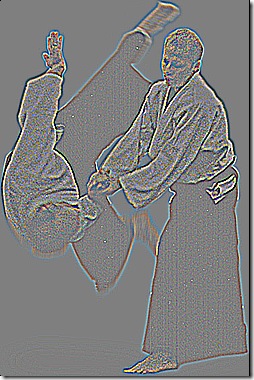 Let's rephrase that: How does the art of Aikido deal with an uncommitted attack of the snappy, balanced flavor? Or, how do you throw, lock, or break a weapon (arm) that isn't there?
I remember experimenting with this during my several years training in Canton Wing Chun. A group of us were training on Pak Sao (an open hand block/parry with the palm) in the basement of our Sifu [instructor], and someone asked, "How would we adapt to deal with a quick boxer?" We huddled up, and started experimenting and discussing, as we usually did. Since I had some (OK, extensive) boxing and kickboxing experience, I served as the sacrificial lamb and did the jabbing. We quickly learned that our traditional techniques had trouble with redirecting an attacking limb that was quickly retracted. Try as we might, the quick, pumping jab was difficult, if not impossible to trap, parry, or drive through.
Months later, one of my si-hing (seniors) came over to train with me, and we went full-contact sparring, pitting his superior WC against my Muay Thai. It was a great day for learning new things! I learned that the high kick is not a good tactic versus a very good WC stylist - it actually hurt my well-conditioned shins when he blocked the kicks. His offense was something I could reasonably handle, but only because I had the WC training, but what was most effective was my jab. The plain, old jab!
Aikido and Judo training also gave me that perspective. I was practicing knife sparring (tanto randori) with a kid no older than twelve, and I was able to handle everything. Except. Except when he "didn't attack me right" and just poked at me with a balanced, uncommitted (his weight was still back and approximately 50-50) stabbing attack. He pumped it, and all of my fancy counters went out the window. And I got stabbed. A lot.
So this isn't focused on the art of Aikido at all, but on anyone who studies a similar style. Chime in via comments - or email (tdatraining at g mail dot com), and let me know if you don't want me to publish your feedback.

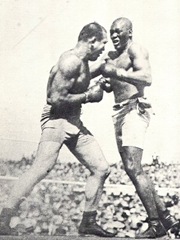

Pat commented to yesterday's post (Boxing Combinations Revisited) by shamelessly plugging his post (Boxing and Aikido), which was inspired by an older post here at TDA, The Three Cs of Sparring: Offense and Defense - repost. Confused? As I reread my own post, then Pat's, I reflected on the nature of fighting, and all combat, as being composed of:
In other words, all conflict is composed of a series of clashes, and he who wins is he who gets in and out safely. It may take different means, but the ends should be the same - stay alive!
Pat properly compares the strikes and movement of boxing with the footwork, techniques, and tactics of Aikido not by contrasting them, but by noting the similarities of the strategies involved.
Look at your fighting or combat system in the same way. How can I get close, damage without absorbing damage, then get back out safely? Adapt your ideas to winning.
Finally, look at how avoiding conflict is the best way to overcome it.
My post, Is Aikido Effective for Self-Defense was a response to Patrick Parker's Mokuren Dojo post (A helpful handful – Aikido for self-defense) about the Aikido techniques he considers universally effective for self defense. In said post, he dropped this gem, "I can honestly say that of the martial arts I have experienced, aikido appears to me to be the best self defense there is." That means a lot to me, as Pat is black belt ranked in several styles and an experienced instructor who's been around the block (sorry Pat!). In my post and comments to him, I requested elaboration on why he considers Aikido the best. Without hesitation, he responded:
With My kung fu is more powerful than yours!, then No, MY kung fu is better than your puny technique!, and I'm betting there'll be more. This is worth reading, then re-reading:
Superiority, equality, or inferiority
What is self-defense? Defense of the self. Not necessarily offence against some other. Sure, sometimes there are people that “need killing,” but that is not self-defense. For example, if you know a given martial art so well, have trained it so long and so rigorously that you know, absolutely KNOW that you are completely superior to some particular enemy, is it self-defense to destroy that enemy? If you know that you absolutely outclass them then it’s not self-defense – it is retribution or punishment or murder or something like that.
It is only self-defense when you are immediately afraid for your life or well-being.
When are you most reasonably afraid? When you’re surprised in the dark on uncertain footing and outclassed and out-gunned and the enemy knows what is going on and is younger and stronger and faster and bigger and better at what he is doing than you. You are most afraid in a situation of weakness and inferiority and lack of knowledge.
Karate, etc… is generally built from an assumption of superiority. All other things being equal, the karateka will use superior technique or training or strength or speed or leverage, etc.. .to prevail.
Pat summarizes his views:
... aikido is based on an initial assumption of inferiority or weakness or slowness. We invest in that weakness and slowness by avoiding the necessary use of strength and speed to make things work. As we invest in that state of weakness, we try to figure out how to work it to our salvation. Thus, aikido, by its definition and its nature, is all about self-defense. Aikido is THE art of self defense. Karate, and even sport judo, are not even about self defense in this sense because they predominantly operate from equality or superiority.
That is, indeed, a different way of looking at things, which reflects well on Pat as a martial artist, instructor, but more as a human being. What do you think? Comments welcomed here, or over at Mokuren Dojo.
In a word, yes. As always, it depends on the type of training provided, and the attitude, determination, and aptitude of the student, but Aikido addresses many aspects of "street" self-defense, while neglecting some others. Pat at Mokuren Dojo posts A helpful handful – Aikido for self-defense:
Over the past 23 or so years I have studied taekwando, karate, judo, aikido, hapkido, and jujitsu and I can honestly say that of the martial arts I have experienced, aikido appears to me to be the best self defense there is [Emphasis mine- Nathan]. The following are a handful of aspects of aikido that I think make it particularly suitable for self-protection purposes.
Ukemi – the art of falling safely – particularly the simple side fall and the forward roll. Proper reflexive falling skills will likely save you from many more hazards during your lifetime than any other martial arts technique or skill. Check here for a collection of good articles on proper falling.
Evasion and the aiki brush-off – the ability to efficiently get out of the way of an incoming force and push the opponent off of you or push yourself off of the opponent. This is the fundamental skill in aikido, practiced in every class as the foundation of every technique. To read more about the aiki brush-off, check out this article.
There's more, much more to this post than meets the eye. In his usual understated way, Pat gives hints and glimpses of what may take you decades to learn in a manner that suggests it's obvious - and to him it may, indeed, be. The post also covers striking, groundwork, and something he calls calibrating the "hyperactive reflexes."
To elaborate on what I said above about Aikido neglecting other aspects of self defense, read my post Its not what's there, it's what's missing for my thoughts - Aikido, like many other systems can form the foundation of an effective style, but has weaknesses in it's strengths.
Please click over to Mokuren for more. I will ask Pat in the comments why he'd characterize it as the "best there is" for him.

This looks like a good test. I like the level of intensity in it, especially the three-on-one.

This is a an AikidoJournal.com video of a 1993 Steven Seagal performance at the 1993 All-Japan Aikido Demonstration.
Not as good as Sam, but he got the job done...
I just read Aikido in the Postwar Years: 1946-1956 on FightingArts.com, and would recommend it to anyone who has more than a passing interest in Aikido. An excerpt:
Since only a relatively small percentage of aikido practitioners have more than a vague acquaintance with the origins of the art, there are a number of common misconceptions about how aikido attained its current status as one of Japan's modern budo. The most glaring misunderstanding is the idea that the founder, Morihei Ueshiba, was the driving force behind the postwar spread of aikido. This is far from true. Rather, his role can more accurately be described as inspirational in terms of his impact on early practitioners. In reality, it is the technical and pedagogicial approaches of other key figures such as Koichi Tohei and Kisshomaru Ueshiba --the founder's son-- within the Aikikai, and Gozo Shioda of Yoshinkan Aikido (an early student of aikido), that became the de facto standards. Even today, the training methods adopted by the majority of aikido organizations and independent schools can be traced back to these figures.
In this article I will attempt to describe the first challenging years of aikido in postwar Japan, the principal figures whose thinking and actions shaped the early development of the art, and the confluence of circumstances that allowed aikido to gain momentum in Japan and flourish internationally.
Read the rest.