Showing posts with label Multiple Attackers. Show all posts

Wednesday, November 02, 2011

The Knockout Game and How We Should Respond

Knockout game
Is the “Knockout Game” real? How can we respond?

“You don’t know them, so why care about hurting them?”

This Gateway Pundit post takes the St. Louis Post-Dispatch to task for equating foreclosures and the opposition to “health care reform” with something called the “knock-out game.” I’ll leave the politics to the Gateway Pundit post, and instead focus on the following:

In April an elderly man was attacked by a mob of black youths playing “the knock out game” while walking home from the grocery store with his wife. They killed him.

In June a group of black youths beat a gay man bloody playing “the knock out game.”

In August black teen mobs targeted St. Louis cyclists in the knock out game.

In September, a 73-year-old man was knocked unconscious just outside of Tower Grove Park.

In October St. Louis Mayor Francis Slay was the first person on the scene on after a local man was beat unconscious by a mob of teens. The youths were “playing” the “knock out” game. The victim’s jaw was shattered and needed to be wired shut. There were several broken bones on his face.

Tuesday, August 23, 2011

Will You Lose to Multiple Attackers?

Karate class

Patrick Parker’s thought-provoking post, The myth of multiple attackers lays it out!

A conflict with any one aggressor is at best a 50-50 proposition - that is, it's an even chance of you winning or losing.  Much of the time the odds are much worse than that because aggressors can be assumed to work the odds in their favor by using surprise, weapons, and whatever other advantage they can come up with.  Martial arts (any martial art) might tip the odds in your favor somewhat, but they are not magic talismans. When two or three or four guys accost you, the smart option is to comply and give them what they want and hope they go away (that's a pretty good option when one guy accosts you too).

Parker is no newbie, he is 6th-Dan Aikido, and 5th-Dan Judo, and is the consummate martial arts student – he rarely says, “I know ,” but seems to say, “let’s see,” and “let’s try to find out.” He details that his training and competitive levels were very high in Karate in the 80s and 90s, but that “I was also a large, athletic guy in the best shape of my life, but I never approached the ability to beat up two attackers at once.”

Tuesday, April 19, 2011

Whoops! Control in Multiple Opponent Sparring

image
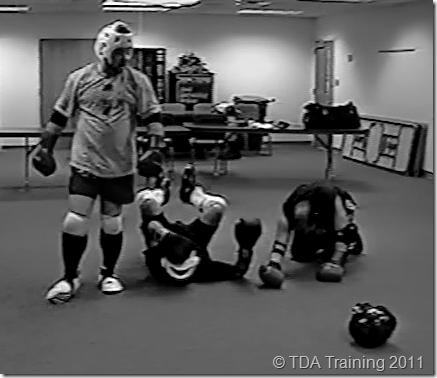
One of the strengths of multiple opponent sparring is that it’s less predictable, but that can, predictably, lead to mistakes, and possibly injuries.

Monday, August 30, 2010

Do not try this at home!

You never know who you’re messing with. So don’t mess!

Old Man Owns Five Dudes In Station - Watch more Funny Videos
The video raises a serious point for those of you who worry about being too small, too old, or too incarcerated to be able to defend yourself.
I'm making a lot of assumptions here, but this guy may not have had many options:
  • Run? Nope. Nowhere to go.
  • Talk his way out of it? May not be able to speak the same language. Or they may all be drunk. Or something.
  • Use an improvised weapon? Hmmm. Don’t they usually search for, and confiscate any weapons before they put you in the slammer? Not an option.
  • Give up? Not this guy. He may be our last, best hope. When the nuclear apocalypse happens, there will be cockroaches and this guy left. Somehow he will have to repopulate. Don’t want to think about it.
  • Fight back? That would imply waiting for the attackers to attack. Which leads to the inevitable defending against five guys. Which is probably just stupid! So…
  • He attacks! The unexpected here is what will work. Or has the best chance of working, however slim that chance may be. Go on the offensive, and have the tools to get the job done. In this case, those tools are some good boxing skills.
What did you take away from this one?

Saturday, March 06, 2010

The Martial Explorer: Don't go to the ground!

Our MA blogging buddy, Jesse Crouch has a nice post with video detailing just why you want to avoid the ground when defending yourself. Especially the bottom position!

You can follow Jesse on Twitter too: http://twitter.com/jessecrouch

For more information:

See our Multiple Attackers category.

Like this post? Subscribe to our feed, or follow us via Twitter

Wednesday, October 29, 2008

Fighting Multiple Opponents, Russian Style!


Great video, and very good training for multiple attackers. Notice the defender's constant lateral movement, keeping everyone in front of him, conservative kicks and strikes, and use of his hands.

Much more on on this subject at TDA Training - see the Multiple Attackers category.

Thursday, October 16, 2008

Knife defense scenario training

Great find by fightclub.team.pro, a great aggregator of interesting martial arts video. This may shock some of you, but it's a pretty good example of the speed and surprise of a serious knife attack.

Teachable moments?

  • There was no squaring off, and little, if any verbal exchange before the attacks. These were the armed equivalent of sucker punches, but deadlier.
  • In every single scenario, the attacker had the advantage: surprise, weapon versus unarmed, action is faster than reaction, superior numbers, you name it. My point is that you are at a serious disadvantage in a surprise attack of any type.
  • Cut or stabbed? In every one of these, again, I believe the defender was cut or stabbed to some degree.
  • In a few of the situations the defender reacted quickly, but stayed engaged (didn't break off and try to run) and risked everything to "win."
  • In almost all of these cases, where the attacker didn't telegraph the attack, he "scored." If the intent were to kill or seriously injure, the attack would nearly always be successful due to the advantage of surprise.
  • The knife could have been a stick or gun, or just a fist, and have a great deal of success. Knives have actually a higher lethality than guns, statistically (See If an attacker pulls a knife...), but even an unarmed attacker could, with the benefit of surprise, knock out or stun a trained fighter or martial artist and then...
  • In these scenarios, how beneficial would it be to have a weapon as the defender? Would it have made a difference to have a gun? Probably not. Once you're in that range, you'd better deal with the knife or get killed while trying to draw. Having your own knife may be marginally better, but, again, you're already at the range where removing a hand to pull out a knife may mean death.
  • Finally, in every case, not resisting the knife attack would have meant near-instant death.

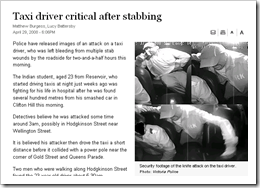
I remember watching footage of a robbery attempt where a single, armed mugger accosted three men in an apartment Knife Attack on Cab Driverdoorway with a drawn handgun. One of the three men made a grab for the knife, and at least two of the victims was shot, with the attacker running away after the shots were fired. He didn't want to shoot them, he wanted their money, and they would've been wise to give it to him. I believe that your life isn't worth the money in your wallet or my wallet, and so, where possible, give it up. If someone wants your life, thought, that's a different story, and you need to resist with everything you've got.

One critique of the video: These are realistic murderous knife attack scenarios, but not realistic armed robbery role-plays - there's a difference. A robber would want the money, and would brandish the weapon, not try to use it. In other words, the threat is more important because he wants to get away quickly and without a lot of trouble. These scenes are scripted as surprise murder attempts, and are thus more difficult to handle. A robber may use the knife if you resist, but you've got more of a chance there.

The first part of this next video is the best. The defense techniques here aren't necessarily the best, but the instructor's talk at the beginning and the scenario at the end are worth watching.

Regardless, however, if you plan on resisting a knife wielding attacker, even an untrained one, you'd better plan on getting cut or stabbed because of the nature of the weapon. The shock from a cut or stab may incapacitate you quickly, and a stab in a critical area may induce immediate shock or death. Serious stuff. In other words, only fight versus a knife attacker if you believe you life is in imminent danger.

For more information:

TDA Bringing a gun to a knife fight?
TDA It could happen anytime - real knife attack
TDA Rush a gun; Run from a knife
TDA Unarmed Knife Defense Video
TDA Reexamining Modern Knife Instruction - WR Mann
TDA If an attacker pulls a knife...
SIMPLE KNIFE DEFENSE
Defend University Disengage Safely from the Fight
Defend University The Most Dangerous Opponent: Dealing with the Sudden Attack

Technorati Tags: ,

Wednesday, April 30, 2008

Best Bar Fight Scene

For my money, Chuck in Code of Silence (1985). Enjoy!

I mentioned that Code of Silence was one of "My Favorite Martial Arts Films" a couple of years ago.

"The fight in the bar scene is probably the most realistic I'd seen, up until that point. Chuck Norris kicked butt for about 30-seconds, when a bunch of bad guys worked as a team. They tackled him, held him, then beat him to near death. The rest of the film is typical, but that scene stands out. Also Chuck works out in the gym and looks pretty sharp!"

Best quote? "When I want your opinion, I'll beat it out of you." That was Norris' character Eddie Cusack.

Got a favorite? Let me know here or at the Convocation of Combat Arts thread! Not a CoCA member yet? Join today and feel good about yourself again!

Wednesday, April 02, 2008

Today's TDA Tip: Drive to survive!

I tend to like to counter in my stand-up fighting, meaning that I wait for an opponent to leave an opening, or create one by drawing (intentionally leaving an opening) an attack. That works well under most circumstances if you know what your opponent can do, or is likely to do, or if you use evasion and distance, coupled with shallow feints to see how your opponent responds. This isn't always wise, however.

In a self-defense situation, once you feel the need to defend yourself, many times it is wiser to quickly overpower an opponent with a ferocious attack that gives you the initiative, and keep firing and driving until that threat is no longer apparent. In other words if you feel an attack is imminent, and that your life may be in danger, blast the attacker and use bumping, checking, striking, and footwork, along with a driving momentum to take down the attacker. An example of this type of attacking style may be seen in this post. I will also try to dig up some video of it.

To drill:

  • Work the scenario of a single opponent who woofs, insults, and crowds the defender.
  • At some point, the attacker should build up to an emotional head of steam and make a conscious decision to attack (but should not signal or telegraph this intention). If it's a beginner to such scenarios, you may allow some telegraphs of intent via body or verbal language, but try to keep it as realistic as the acting skill of the attacker and the ability of the defender allow.
  • Decide, in advance what the attack will be, and execute it, such as a chest grab, overhand, shove, or grab and punch combination. As the student becomes more proficient, do not pre-arrange the attack, but let the attacker freelance.
  • The defender should "feel" the imminent attack and pre-empt it by a stop-hit and continue to attack until the threat is down. Then drill leaving ASAP and watching for other attackers.

Keep in mind that the possibility that an attacker has a weapon is pretty high. A wait and see tactic may result in that weapon being pulled and brandished, worse yet, used. Multiple attackers is always a possibility, but your ferocious attack may defuse that as well, especially if you drop the bad guy then get the heck out of there. I realize that other possibilities exist, and are, in fact, infinite (how about trying to just leave), and would only use this strategy if no other option presented itself.

Stay safe!

Wednesday, February 27, 2008

Multiple Opponents videos

Take a look at this multiple opponent defense drill. What do you think?

Not bad at all, eh?

Some observations:

  • The gear is cool, allowing for close to full power strikes to most of the attackers' bodies, and freeing the defender to concentrate on technique and footwork without worry about hurting his partners.
  • The defenders are, in many cases, obviously new to this, and because the intensity is not too high for them, are able to experiment with a lot of techniques
  • One of the primary problems for groups is getting in each other's way when more than two are attacking. That's not a problem if the defender holds still, but if he moves, you aren't nearly as effective. The lesson is that constant movement can help you survive a mass attack. See the video in our post Is Boxing Viable for Self-Defense? for a good example of this - about 5-10 members of a group are being pummeled by a single man using boxing technique!
  • The attackers are going about half-speed, in some cases attacking one at a time, perhaps unrealistic, but again, gets the defenders into this at a gradient of intensity and difficulty.
  • Notice the male defender with the black "modernwarrior.com shirt goes right at the pack and into the middle - suicide as he would be quickly taken down and stomped in a real attack. Better to attack the periphery. The half-hearted tackles don't really help him realize the mistake of this strategy.
  • There is a vast array of strikes, and mostly open-hand (me likes!) to the head, like palms, knifehands, claws (to the eyes), forearms, and hammers. Plus lots of elbows. This is good!
  • Kicks are low and infrequent - also a good idea!
  • One aspect I didn't like is that the attackers "stayed down." Once the defender hit them he didn't have to worry about them anymore. Not realistic. You'd better count on someone getting back up or you may be unpleasantly surprised.
  • Noticed that some of the defenders are more Wing Chun than others, but didn't notice as much grabbing from the defenders as I'd teach. Perhaps it's not emphasized, or just not in this drill.
  • One of the female defenders used the walls well. Know where escape routes are, but also know where walls are to prevent multiple attackers from getting behind you. In general if one gets behind you, you're going to be taken down.
  • Some of the defenders take a post after completing a successful defense. I'd advise against it. Keep moving!
  • Notice the comments on the YouTube page. Many of them have points, but they are taking this out of context. If this were representative of the totality of this school's training, then it would be valid criticism, but I doubt that it is. A good school may start with something like this, but won't finish with it.
  • Last point is that most of the defenders assume a fighting stance prior to defending. Think about not doing that!

For more information:

TDA Practical Hand Techniques
TDA Against the Fighting Stance
TDA Cung Le video - Great Transition Between Ranges
TDA How One Barroom Encounter Changed One Cop's Views On Fighting
TDA Practicality in Training
TDA If it's against the rules, then it must work!
TDA Is Boxing Viable for Self-Defense?

Monday, February 25, 2008

Is your traditional training going to get you killed?

I'm going to get in some hot water from traditionalists for this, but that's OK, considering the importance of the subject. I think that I'm qualified to state that most traditional training in the US consists of:

  • Kicks and punches only - some have traditional weapons forms, and have added grappling or MMA as a sideline to increase their relevance and revenue
  • Classes of 45 minutes to 90 minutes long, two to three times a week
  • Techniques performed in the air (no contact) or on pads
  • Most schools have students remove their shoes and practice in loose-fitting, comfortable uniforms
  • Forms (poomse or kata) being a large part of the focus and time spent
  • Sparring with light to medium contact, and with restrictive rules for safety

I believe that most modern traditional schools (an intentionally paradoxical statement) do not prepare students for real self-defense, but to get hurt. Where I'm going to get into trouble is with the term "traditional" because that's a wide-open term, with different meanings to different martial artists. I believe it applies, based on how I defined the type of training in the bullet points above.

The question I asked in the title to the post is: "Is your traditional training going to get you killed?" The answer I'm sure to get is, "Well, maybe in other schools, but my tradition is tougher than what you're talking about!" In the example above, a student will spend at least 90% of his time in doing things which don't prepare him for what he's likely to face - an armed, vicious single attacker, or a pair or group of attackers who are similarly vicious and armed.

I was reviewing old comments to a previous post, "Check and move," featuring video of multiple opponent sparring prompted me to make the following comments regarding real fighting:

  1. As was stated so well in the comments, "Real fighting isn't pretty!" The sparring in the video was obviously an exercise, but simulated an "anything goes" fight versus two opponents who were unrestricted in the type of unarmed technique they could use (the only exception being joint strikes). We wore goggles to allow eye jabs and gouges, knee and elbow pads to allow contact with both techniques (strikes with knees and elbows), and the padding also meant we didn't need to use mats for falls. Takedowns were allowed, and even encouraged, and the idea was for the attackers to grab, take down, or otherwise immobilize the defender, then pound him. The only restrictions were on the level of contact - it was medium (to me, that means you'll feel a "pop," but you shouldn't see stars).
  2. Doing a drill like that (or seeing it) makes you realize how "range-centric" most sparring is: from boxing to TKD, to point karate, we all are used to rules which encourage a particular fighting range (like 2 points for kicks, and one for punches), or discourage one (such as the restrictions on clinching in boxing and TKD), and train us to get comfortable in that range. Additionally, in sparring within our style, we automatically assume that range, almost by consensus when sparring. I've read comments from MMA fans watching boxing and screaming at the TV, "He's open! Take him down!" The danger in this is that in real fighting, range is fluid - there's no clear definition of any range (it's the transitions that get you), nor are there any agreements "on the street" to use one range or another. Almost all of the fights I've seen (usually consensual) start just outside of punching range, but end up in a clinch or on the ground. I think the difference in my skill set is primarily that I am better at controlling that range, plus not hurting myself (I can strike, fall, and grapple without accidentally damage to myself more than an untrained person).
  3. To build on the previous point, you need to build the ability to close to, or stay at, the range that you're most effective. My short (5'9"), stocky build (currently around 220#) makes me an effective infighter against most fighters standing (I love hooks, elbows, and knees), and very effective striking versus shorter or similar sized opponents. My shortcomings [intended] have been exposed on occasion when trying to use the same tactics versus taller opponents as I do with my shorter foes.
  4. Another fatal mistake from "traditional" sparring is that we are used to the feeling (and reality) that our opponents have the same intentions that we do - to learn, develop, or to just bang around and have fun. Real encounters of a violent nature nearly always involve some type of disparity. Violent muggers are, by definition, intending you harm. If I were a mugger, I wouldn't want to give my victim a chance to think or react, but put him down and get his stuff before he knew what hit him! In seven years working at a PD (as a civilian), I read countless incident reports, press releases, and heard anecdotal accounts of violent muggings, and in most cases, the victims were taken completely by surprise by either multiple opponents, or multiple opponents brandishing a knife or gun. I don't think we adequately prepare students for that in most dojo (or dojangs). I'll admit, when I ran three commercial schools, we didn't cover that type of material. I hadn't learned it very thoroughly (more of a one-step, unrealistic, pattern-based weapon defense), and thus didn't prepare my students well for the same. Are we really teaching self-defense if more most attacks are more than one-on-one, and are armed encounters? Nope. That's one of the reasons I surveyed some the Convocation of Combat Arts to determine what they're learning or teaching. My impression? It may be a good foundation for one-on-one empty-hand fighting, but is probably giving the students (and even the instructors) a false sense of security regarding their real prospects for surviving a violent encounter.
  5. Real fighting almost never takes place on a padded, level, surface without shoes. I have never seen or heard of a fight or mugging that took place where both opponents (notice how I slipped into the one-on-one mindset?) are barefoot. Why on earth do most schools have you take off your shoes??? A couple of reasons: 1) the styles that we predominantly teach in this county originate in either Korea or Japan, where removing your shoes indoors is a custom, and almost all training is held indoors, 2) it's easier and cheaper to keep your school clean without having to worry about what gets tracked in from outside, and 3) it helps prevent injuries. I am all for both of the last reasons - I like a clean surface to train on, and like to prevent injuries, but I hate the idea that we're teaching our people to ignore the fact that a work boot is more likely to kick us than a bare foot. Have you ever tried to block a work book? How about just cover up? I guarantee that if you have, you'll modify your sparring style! I will admit that I train in soft shoes, but on a realistic surface, whether soft (grass or dirt), or hard (concrete or blacktop). I realize that a lot of this is logistics (hard to create a sloped surface in a storefront school or pour sand on your hardwood), but again, are we trying to save lives, or not?
  6. Uniforms are great, and I understand the idea behind them (uniformity, taking off the old self and putting on your uniform and belt changes your mind set, etc.), but kicking in street clothes is completely different than with a dobok or judogi. Same with grappling. I've tried grappling in tight jeans (not that tight, honest!), and you can't execute a good closed guard or triangle in them. Many "reality-based" or self-defense-oriented schools require shoes and street clothes for good reason. You learn to deal with the limitations of your apparel. Have you trained on concrete in a parka? How about grappling in the grass in shorts and t-shirts? Why not? Strikes in (or against) heavy clothing and grappling without a gi top make a big difference!
  7. Lighting conditions are probably not going to be ideal! I doubt many schools would turn off the lights before practicing one-step sparring, much less free sparring. But chances are, you may be stepping out of a movie theatre (I'm always blinded then), and jumped by the kid you shushed an hour before, or otherwise have to defend yourself when it's brighter or darker than your average MA school. The types of techniques you'd use aren't the same if you don't know your lighting conditions, or if you know you won't be able to see. I have a good amount of video of sparring with my guys in the parking lot of the PD where I'd steer them, check, or "cut off the ring" so that the sun was in their eyes. Only after a few rounds did I fess up, and they tried to use it on each other and me from then on. Makes a difference. Can you do that in the gymnastics school that your groups meets at?\
  8. Finally, if most of your self-defense situations are likely to be versus armed, multiple attackers who are vicious, how much of your training is geared toward that? I'd hazard that most have less than 5% tilted that way. We need to work toward getting at least 50% of your training in that direction, and increase the intensity as soon as your students are ready. My opinion is that we need to do more of what combatives (military martial arts) are doing, with a focus on these mixed weapons and numbers. Do you know how to disarm a gun, to fire one? Do you have any specialized knife or club training? Get some! When we're talking about self-defense, we need to address the totality of combat, not just the least used (single, one-on-one, unarmed) aspects.

Is this an attack on traditional training? Yes. I believe, however, that the older traditions of training in what you've got on, outside, and with mixed weapons are more valid - I'm just advocating getting back to more of that. I've gained so much from traditions, but which are most important - the ones that make it comfortable and orderly, or the ones that save your students lives? Think about it.

UPDATE: There's now a thread at the Convocation of Combat Arts on this subject- HERE. Please head over and put in your $0.02! 


Tuesday, February 05, 2008

Video: Kicks versus Punches handicap

This is another example of the disadvantage a kicker can have, but more than that, how footwork can play such a large part in fighting. Note, this isn't pretty, taken from handicap sparring footage of hands versus feet.

Lessons:

  1. Don't move straight back! As dealt with in a previous post on reasons we get hit, moving straight back prevents a defender from setting up counters, and blocking effectively. Also, any time you cross your legs, especially moving backward, you risk a sweep or just tripping and falling. The puncher in the video didn't really do anything special, except control the range (get close enough to punch but too close to get kicked), and drive forward.
  2. Building on the previous point, move laterally! Lateral movement can stifle almost any offense. If the kicker had focused on movement (as he know well!), he could've avoided punishment.
  3. Don't go down! If the guy with his butt to the camera had joined in when the kicker went down, or if the puncher had a knife instead of a fist, we'd be watching a bloodbath. It would actually be a lot better to just turn around and run as fast as you can, as opposed to putting your back on the pavement (or dirt in this case).
  4. The puncher did a leg-check versus the round kick, got hit on the kneecap, then took a breather, then got hit. Protect yourself at all times! As Rick stated so well, there's a big difference between "sparring" and real self defense. The kicker did the right thing, and tried to capitalize on the injury to his opponent. That's how you should train! It does your partner no good to back off, other than giving him a false sense of security. Boxers tap their cheekbones or temples with their gloves to remind themselves of their hand position - do the same. Remind your partner to protect herself. You may save her life!
  5. Retract your kicks! You may have noticed the takedown at the end caused by the kicker making two mistakes: leaving the leg out there by retracting it slowly and kicking too high. Either mistake can allow a savvy, or just plain mean (obviously it's more of the latter, in this case) opponent to destroy your base and take you down.

See also:
Why Do We Get Hit?
Today's TDA Tip: Avoid Moving Straight Back!
Today's TDA Tip: Protect Yourself at All Times
Integrating Striking, Wrestling & Grappling
Todays TDA Tip: Handicap Sparring Key to Improvement
What if you WANT to high kick on the street?
Marc Animal MacYoung on Grappling
What happens if you go to the ground versus multiple opponents - video

Saturday, December 29, 2007

Integrating Striking, Wrestling & Grappling

Integrate your martial art
Every martial art has it's strengths and weaknesses (see Ain't none of it is real! and some of the referenced links). One obvious aspect of martial arts around the world is the tendency to focus on one area and/or range of unarmed or armed combat. Even among those instructors whose systems have combined the unarmed areas of striking, grappling, or standing clinch, such as Jiu-Jitsu, Hapkido, and Jeet Kune Do, there is a tendency to favor one above the other, depending on the comfort level. For some, it's a range, as in a sport grappler like BJJ or Judo favoring either throws or groundwork, or a TKD player favoring kicking range and striking (despite the fact that all striking ranges are included in TKD). How to you make the transition from one range to the other?

We know that there's a definite need to be able to fight in all ranges. A situation may start with a shove then punch (standing striking), then the attacker may pin the defender against a wall (standing grappling) while trying to pummel him, then the fight may go to the ground (groundfighting, which is a combination of grappling and striking on the ground). It's often said that most fights end up on the ground, but how does one get there? Obviously, the combatants have to transition through the ranges. The questions for a martial artist interested in self defense are, "How do I integrate the ranges and areas of fighting," and, "What's the best way to train for that?"

Stephan Kesting gives his take in his excellent instructional article, The MMA Formula: Striking + Takedowns + Groundwork and his blog post, Integrating Striking, Wrestling & Grappling.

The reason you want to train each area separately (at least some of the time) is so that you can develop skills in that area, without relying on your strengths in the other areas. If you always blend standup and ground, grappling and striking, then your weaknesses in one area might remain hidden for a long time.

The reason you want to combine striking, wrestling and grappling in your training (at least some of the time) is to simulate a real fight as closely as possible and also to find out if you have developed any bad habits in your training. For example, if your wrestling stance is extremely low with your hands on your knees, or if you use your closed guard without breaking your opponent's posture posture or controlling his head and arms, then a brief MMA sparring session will definitely be an eye-opening experience for you.

If there isn't an MMA school near you then combining strikes with your wrestling with your grappling is going to be difficult. The boxers you train with will only want to box, the wrestlers will only want to wrestle.... So you may need to train these areas independently until you can either find an MMA school or some training partners who are willing to to cross train. Even if you are training them separately you are still laying solid foundations for later, so this is NOT wasted effort.

This is one way that sport training can be compatible with Combatives or self-defense-oriented martial arts: MMA builds on this throughout it's skill sets. For self-defense, an ideal way of training for the integration (I strongly agree with Kesting that you have to train and learn the individual skill separately to excel at them) is scenario-based training, and handicap sparring. Build on your strengths, learn the other ranges and areas of skill (including knives, clubs, and firearms), then drill them together. Add in multiple opponents and mixed weapons with multiple opponents. Get outside of your comfort zone.

For more information:

Todays TDA Tip: Handicap Sparring Key to Improvement
Handicap sparring: Striker vs Grappler
The Submission Trap
Cung Le video - Great Transition Between Ranges
Boxing for Self-Defense and MMA
Transition Into All Striking Ranges
THE ILLUSION OF REALITY (PTI)
THE ILLUSION OF REALITY (PT II)
W. Hock Hochheim, the Interview Begins
Air Guns and Self-Defense Training
Components of "reality training" explained
How One Barroom Encounter Changed One Cop's Views On Fighting
Practicality in Training

Thursday, November 29, 2007

Video: Check and move

As a follow up to the posts, "Video: Three Opponent Strategy," and "Video: Checking your way to surviving multiple opponents," I'm posting this video on using the check, strike, and shield strategy mentioned in checking post. Critique, please!

Please notice that, though the defender is taken down, he doesn't let his assailants pin him, and he keeps trying to scramble. As I've mentioned many times, though, regardless of your ground skills, going down is a bad idea. What if there were broken glass or a concrete curb?

Tuesday, November 27, 2007

Video: Checking your way to surviving multiple opponents

In our previous post, Video: Three Opponent Strategy, we showed what can happen when you allow yourself to be taken down, mentioning that you need to utilize checking and striking tactics to keep your opponents stacked in order to face only one opponent at a time. Watch [sorry for the poor audio, due mostly to the mouthpiece I'm wearing]:

Explanation:

  • Check the upper arm or shoulder. Always make sure you do everything above the shoulder or it's easy for the opponent to slip out of the check.
  • Use the opponent's head to move him where you need him to go.
  • DON'T take down or clinch with multiple attackers, or you've trapped yourself and will be defeated. Your goal is to avoid any grip or clinch, but instead use your hands to manipulate the opponent by off-balancing, checking, and shoving to keep one in front as a shield.
  • DON'T strike your shield or knock him out. Use stunning blows to keep him in the way until you are done with him, or you lose your check. Then stick and move or blast him down, then take another attacker as a shield.
  • Constantly move your feet. Laterally, not straight back. More like moving to your 4 or 5, or 7 or 8 O'clock, rather than your six.
  • Watch the feet. Step and slide, don't walk or run backward. If you go down, you're done!

Video: Three Opponent Strategy

Watch as Sam attempts to handle three opponents.

Explanation:

When sparring with multiple opponents, you should isolate specific areas (handicap the attackers) in order to improve in those areas. One of the final stages of multiple opponent training is shown here - multiple opponents including striking and grappling. Later, you can add weapons.

Observations and lessons:

  • If there are more than three attackers, they usually get in the way of one another. The implication is that if you have the proper tactics, you can handle a large number of attackers, until you make a mistake...
  • Avoid being taken down at all costs! As you can observe from the video footage, as soon as you go down, unless you are an unbelievable ground fighter, multiple opponents will quickly overpower and immobilize you. Your primary defense against multiple attackers IS mobility, and when that's gone, you're a goner. The other inherent risks of going to the ground are that the attackers will have a weapon (very likely), or that you may get hurt by objects on the ground, or the surface itself. Not good. Stay up by moving.
  • Sam was surrounded. Don't let that happen. Everyone says that versus multiple attackers you need to "stack" them. What does that mean, and how do you do it? Please refer to more of our instructional video and posts in the Multiple Attackers category for more. In short, grab, check, and strike to move one attacker in the way of the others. Footwork should be short steps and ALWAYS step and slide. Never cross your feet or your balance can be upset and your base of power will be gone (meaning you can't attack or defend effectively because you can't transfer your weight and are easily unbalanced).
  • You can't know who your attackers might be, or what they know. Don't assume (as Daniel pointed out one day) that your opponents are untrained. They may be wrestlers, MMA fighters, or boxers. God forbid, they may even be real martial artists with street experience! Prepare for everything you can.

Friday, October 19, 2007

Fighting multiple opponents from the ground

Can you do it? Perhaps. But Scott Sonnon can! Watch:

All of our regular TDA readers know my personal position on going to the ground: avoid it unless it gives you the advantage. Most of the time, it doesn't - irregular, potentially hazardous surfaces, weapons, reduced mobility, and usually, multiple opponents make the ground somewhere to avoid. I posted this video just to show the possibilities.

Keep training!

Nathan

Thursday, October 18, 2007

The Submission Trap

The popularity of BJJ and MMA has also introduced the general public, and even some martial artists, to the idea of submissions. Per the Wikipedia entry, "A submission (depending on the context also referred to as a "tap out" or "tapping out") is a combat sports term for yielding to the opponent, and hence resulting in an immediate defeat. The submission is commonly performed by clearly tapping the floor or the opponent with the hand or sometimes with the foot, to signal the opponent and possibly the referee of the submission. The submission can also be verbal, during which the fighter verbally informs that he is giving up. In some combative sports where the fighter has cornermen, the corner can also stop the fight by "throwing in the towel", which may count as a submission."

Queries:

  1. Are "submissions" appropriate for self-defense?
  2. What happens if someone won't submit?
  3. What are the best submission techniques for self-defense, if appropriate at all?

Let's examine:Finger lock

Small joint manipulations are basically digital submissions, which doesn't mean sending a PDF file via email! By "digital," I mean that you apply a finger or toe lock (the digits) on someone so that they give up. These techniques may cause your opponent to submit due to the pain.

Issues:
If they don't respond to pain, or are hyper-flexible ("double-jointed"), you could be in a world of trouble because your lock is ineffective, and you've lost the initiative. You may be focused on the lock, expecting the subject to submit, and he/she is not only unphased, but knows something sooner than you - they are still effective in the fight. Not good.

Escalation:
Ankle lockDepending on the type of lock, you can proceed to break the finger or toe, or cause other damage which may  reduce the effectiveness of your opponent. Or not.

Progressing up the chain, wrist and ankle locks are twisting and turning those joints in a direction they aren't meant to twist or turn, or further than they are intended to go. Either way, they can hurt, or fail for the reasons suggested above.

Elbow and knee bars usually cause less pain, but, I feel are more serious, at least when they are applied to me. They're scarier. I hate the feeling of knowing that if I don't submit to a knee bar or leg lock that I may not be walking right for the rest of my life. The arm bar is the same way. I submit out of fear of injury.

Arm locks are applied to the shoulder joint, and include techniques named things like arm lock, Kimura, Americana, Omo  Arm barPlata, etc.

Finally, we get to chokes - including the guillotine, front choke, side chokes, rear choke, chokes utilizing the body only (naked chokes, which can actually be performed with clothes on - I've tried it), and chokes using the clothing you or your victim are wearing. We further break the choke down into "blood" chokes, in which the arteries to the brain are constricted, causing loss of consciousness, and "air" chokes.which restrict the flow of oxygen to the same brain.

Conclusions:

  1. Are "submissions" appropriate for self-defense? Depends. If you know a submission, whether it's a small-joint or arm lock, you must be prepared for the subject to be non-compliant or insensitive to the pain of the manipulation, or just too strong for you to lock it in properly. The other consideration is weapons and multiple opponents. In every case where we've sparred with multiple opponents, including grappling, once you tie yourself up by touching or grappling with an opponent, you will probably be taken down and stomped, unless you are so far superior that you can handle anyone at any range. If weapons are involved, and you never know whether they are until it's too late, then you don't want to try a submission.Multiple opponents
  2. What happens if someone won't submit? You can be in a world of hurt if you tie up one or both hands with trying to submit someone. If you are a BJJ black belt or superior wrestler, you may be in your element, but there's always someone better, as they say. You always need a "plan B," and in a self-defense situation, that means escalating the force (i.e. breaking the joint to disable it, or moving up to a choke), or breaking off if possible. This also means you may need to depend more on your footwork and striking, which have more potential for criminal or civil liability.
  3. What are the best submission techniques for self-defense, if appropriate at all? I'd have to say that they can all work, at the right time, but if you are skilled in choking, that's as sure a fight stopper as there is. Many of us could fight with a dislocated joint or even broken bone, but absolutely no one can go with no oxygen going to the brain!

Final note: Submissions are absolutely appropriate where you have to control the use of force (law enforcement, security, and corrections officers), or where you have superior numbers. Gang-tackling and superior positioning plus skilled submissions means less people get hurt. Unfortunately, many of us don't have a posse with us, so use discretion and don't get trapped into trying submissions when they aren't appropriate!

Stay safe - Nathan

Friday, June 08, 2007

Wednesday, May 02, 2007

Is Boxing Viable for Self-Defense?

In this day of grappling's rise to prominence, some may question whether boxing is a viable tactic or style for self protection. I think that's why Boxing for Self-Defense and MMA has been one of our most popular posts. If you have any doubt as to whether boxing can be used in self-defense, watch this fascinating video.

You'll notice that the man defending himself against the mob in this footage is following the principles of defending against multiple opponents. He's constantly moves, never lets anyone get behind him, keeps his weight forward on the balls of his feet, and actually attacks the mob rather than waiting for them to come to him. What can happen in the case of mob attack is a swarm, where someone is overwhelmed by the clutching mass of his attackers, taken down, and usually stomped or beaten into unconsciousness, if not death. Using footwork and straight punches the defender prevents them from grabbing him, much less taking him down. See the hesitation in the body language of the attackers as the "defender" sticks and moves, taking the fight to them. I especially like how he drops one guy with a stiff jab, and floors someone who attempts a lame kick! Watch it!

See the Multiple Attackers category, and our recent, Grab releases critical versus multiple opponents post with video examples of preventing someone from grabbing you.
Hat tip to AirSoft Canada forum.

____
Like this post? Subscribe to our feed, or by email and you won’t miss a thing.
Interact with us at our TDA Training Facebook page!
 
All original material is copyright of their respective authors.
All rights reserved. Permission must be obtained before use. Copyright 2007