
Or do you do kata in order to get better at some underlying principle (ju oraiki or ran or whatever)? Are kata a vehicle or are they an end goal?

Or do you do kata in order to get better at some underlying principle (ju oraiki or ran or whatever)? Are kata a vehicle or are they an end goal?


Our post, Defend the Thai Clinch, elicited a response in the comments of “They are actually doing it wrong,” with a link to this video:
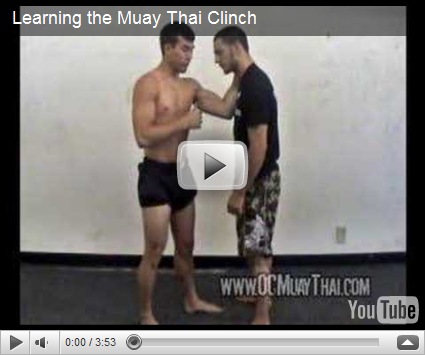
Couple of points:
Great post from Marks on the MT Elbow Strike. Click the video to go there and watch.

I’ve long taught that the elbow and knee techniques of Muay Thai are among the most effective and simple that can be taught or used in self defense, or in the ring. The video showed the effectiveness well. Any thoughts? Ever been hit by an elbow? Still remember it?
Blogging and Convocation buddy BBat50 commented on our post Boxing for Self-Defense and MMA (read it):
“I'm not sure that I agree that the jab is forgotten in MMA. Some fighters, say Chuck Liddell, tend to rely on his deadly right on his left hook. But there are many, especially in the lighter weight classes, whose jabbing is constant.”
It was a thoughtful and critical comment, which I should address, and would ask for your input.
As to the point that the jab is neglected or forgotten in MMA:
At that point (2006), my observation was based on most of the major bouts I saw in the couple of years preceding the post's publication.
If we examine the history of MMA in general, and the UFC in particular, it seems to have had trends:
BJJ early on because of Royce's domination of everyone, large or small. Then the sluggers learned to sprawl and were knocking everyone out with the haymaker variety of power punches - little to no jabbing involved. At the time of my posting there seemed to be more of a balance - grappling and groundwork, and ferocious standup, but the striking was not that good. Punches were used to either knock someone out or create a good takedown opportunity, but seemed to involve little good boxing.
Nowadays, there are superb strikers in MMA, including Anderson Silva, my favorite. They can work the ground, sprawl, or strike like a good boxer and muay Thai fighter. GSP is another great example. Is the jab utilized now? Certainly, by the better fighters and journeymen alike.
So, I actually agree now (referring to the use of the jab), but at that time, no.
Now, what do you MMA fans think? Do you see prevalent use of the boxing jab in MMA at this time (2009)?
For more information:

I don't believe that headgear does much to prevent damage to the brain. For the following reasons:How-to-Box has a nice post addressing the same topic.
Is there any benefit to headgear? Sure. I love it because I train on hard surfaces (floors or pavement) or uneven (grass), and I hate worrying about whether I'm going to smack my skull on something sharp or hard when I go down, even accidentally. Headgear is great to prevent that. Headgear also protects against cuts and abrasions to the skin. That's important when training for a fight because a cut could mean a postponement of cancellation of a bout. For most of us, a little cut just makes us look tougher on Monday when we go back to our geeky jobs.
- A blow to the headgear still does to prevent the rapid acceleration of the brain inside the skull, and nothing to prevent the inevitable impact of the brain, possibly resulting in a concussion.
- Boxing-style headgear, to me, is more of a liability to the user because it ALWAY reduces peripheral vision. That results in more blows taken to the same head. Unintended consequence, to be sure, but a serious one. KOs happen all the time in amateur boxing, don't they?
To be sure there's slight reduction in the impact of a blow. I'd much rather take a Thai kick or overhand right to the headgear than my skull, but if I wear headgear I may never see it coming.
The argument against headgear is that it doesn't protect against knockouts, only cuts and scrapes. While true, the amateur powers that be have made it pretty clear that isn't going to happen anytime soon.What stands out for me is that this is correct, the refs are the ones that protect the fighters, and prevent the injuries. In pro boxing, I’ve seen fighters sustain near-knockout shots for round after round, (sometimes multiple times a round!), and yet fights aren’t stopped because the recipient of those blows is both upright and fighting back. Yet, as any good fight fan knows, a fighter’s instinct, especially a veteran, is to show nothing to the crowd or referee that would indicate he’s hurt, and many have said later that they didn’t know what happened after round X, in other words they were fighting on instinct after a concussion.
There is a perception that headgear prevents brain injuries. While not necessarily true, the perception is beneficial in helping parents get over the initial shock of young jimmy or suzie coming home and saying they want to start boxing. The perception is that headgear somehow makes it safer. In reality it's the rules and attention to safety amateur refs enforce. [Emphasis mine - TDA]
When to use:
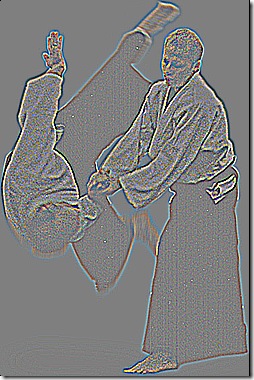 Let's rephrase that: How does the art of Aikido deal with an uncommitted attack of the snappy, balanced flavor? Or, how do you throw, lock, or break a weapon (arm) that isn't there?
I remember experimenting with this during my several years training in Canton Wing Chun. A group of us were training on Pak Sao (an open hand block/parry with the palm) in the basement of our Sifu [instructor], and someone asked, "How would we adapt to deal with a quick boxer?" We huddled up, and started experimenting and discussing, as we usually did. Since I had some (OK, extensive) boxing and kickboxing experience, I served as the sacrificial lamb and did the jabbing. We quickly learned that our traditional techniques had trouble with redirecting an attacking limb that was quickly retracted. Try as we might, the quick, pumping jab was difficult, if not impossible to trap, parry, or drive through.
Months later, one of my si-hing (seniors) came over to train with me, and we went full-contact sparring, pitting his superior WC against my Muay Thai. It was a great day for learning new things! I learned that the high kick is not a good tactic versus a very good WC stylist - it actually hurt my well-conditioned shins when he blocked the kicks. His offense was something I could reasonably handle, but only because I had the WC training, but what was most effective was my jab. The plain, old jab!
Aikido and Judo training also gave me that perspective. I was practicing knife sparring (tanto randori) with a kid no older than twelve, and I was able to handle everything. Except. Except when he "didn't attack me right" and just poked at me with a balanced, uncommitted (his weight was still back and approximately 50-50) stabbing attack. He pumped it, and all of my fancy counters went out the window. And I got stabbed. A lot.
So this isn't focused on the art of Aikido at all, but on anyone who studies a similar style. Chime in via comments - or email (tdatraining at g mail dot com), and let me know if you don't want me to publish your feedback.
I like this video analysis of the Thai kick to the head.
The only thing I'd quibble with is that the counter-rotation of the upper body by swinging the lead arm counter to the direction of the kick is more for balance than torque. My opinion only, but the torque is created by the lead foot stepping out, toes angled out at 45-degrees from the target, and the rotation of the hips into the target.
One other safety point: make sure you pivot on the ball of the supporting foot. If you plant it your knee will blow out a la Jason on the Human Weapon. One of my students did the same thing during a test and it was ugly.

I know the title doesn't make sense, but I couldn't help myself. Heh.
Anyway, the occasion for this post is to inform my dear readers that we've added a new clinch category! Ta da! There are so many posts on the clinch that I thought it deserved it's own grouping, and it's now easy for you to find the posts on:
Learning the clinch
The Thai clinch
Defending the clinch
Drilling the clinch
What to do when you achieve the clinch
It's a cinch, try the Clinch! [Again, my apologies!]
I thought this 2006 oldie was worth reposting, Close to Roundhouse Knee. I've been so busy the past few days I haven't even had a chance to stay caught up on email, much less create posts (I've got about 75-100 drafts, but none ready). So to tie you over, a good blast from the past, the offensive check with a round knee attack. This has utility in sport MA (MMA or Muay Thai), self-defense, Combatives, or defensive tactics (DT).
A few points: the lead technique doesn't always have to do damage, it just has to create or exploit an opening. The lead-off check is a great use of that tactic. It can transition to a trap, pressing to remove the threat of a viable counter (the opponent is off-balanced), and keeps the attention on the upper body, setting up the knee opening. Enjoy. Comments are encouraged!
Offensive (not counter) use of the knee: 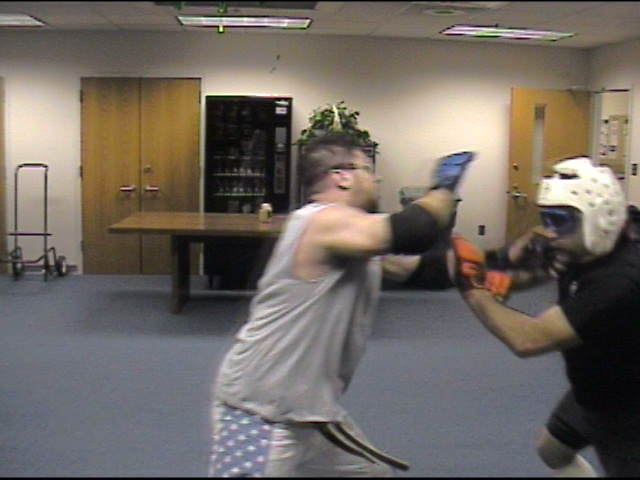 1. Instead of closing the gap with a jab, the lead-off fighter uses a check of the right hand of the counter-fighter.
 2. Inside the guard, and on the flank, the right hand latches behind the neck.
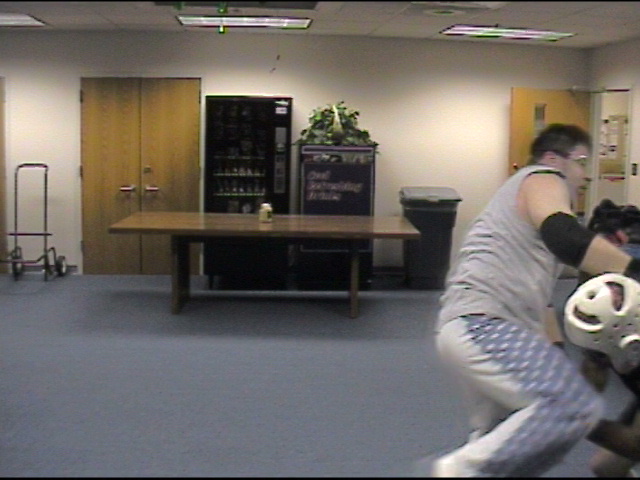 3. The knee to the face is delivered. The important thing to remember is that as long as you close the gap properly, any technique can be used - even a "counter". Why wait for your opponent to lead-he might hit you! Maxim: "It's always faster to act than to react."
For more information:
TDA Check, step-around, and counter
TDA Video: Checking your way to surviving multiple opponents
TDA How Long Do You Press the Attack?
TDA Checking

One of the things I most regret about this age of eclectic technique dominance, a la MMA, is the relegation of pure styles to the background. There are distinct differences and philosophies between the variety of striking and grappling styles that exist. We should celebrate examples of excellent in each. For example, some of the best pure striking you'll ever see comes from Ramon Dekkers, legendary kickboxer from Holland who is probably the most dominant non-Thai fighter to ever fight and win in Thailand, home of Muay Thai. Watching this highlight video of his career, you should take a few things with you [language warning]:
Commitment: Thai boxing is a style that can leave you open to counter-attacks. You are squared up to your opponent more than in most styles of fighting, in order to generate maximum power and use both sides of the body to generate nearly equal power. In order to be effective with that style of fighting, you have to commit so much power as to force your opponent to block or evade, thereby occupying his defenses (creating openings), or completely disrupting his attacking rhythm.
Precision: Dekkers shows unusual accuracy in both hitting open targets, but also perception of the distance needed, and which technique to throw at that time. This include excellent timing, using the right technique, at the exact moment at full extension to maximize damage.
Killer Instinct: Some fighters have incredible skills but don't finish well. Ramon Dekkers demonstrates the ability to pour it on when he sees his opponent is hurt. This can be critical in the ring, but even more so in self-defense. You need to use appropriate force until an opponent is no longer a threat. In the striking arts we have often seen a fighter who is "out on his feet" that wins by knockout. That won't usually happen unless you "punch yourself out" by exhausting yourself by using too much energy without being very effective, or you let up when an opponent is hurt. Dekkers demonstrates neither flaw in his game.
Balanced technique: Dekkers doesn't favor any particular technique over another, and uses the appropriate technique for the range and defensive ability of his opponent. When you are close, elbow, uppercut, hook, clinch, knee. When you are far, punch and kick. Don't try to force a range. Take what your opponent gives you, and don't have weaknesses. If you are a good puncher, work on your kicks. If you are a good striker, work on your clinches and grappling. Great takedowns? Work on your striking and grappling. Be well-rounded.
Toughness: Many fighters can take a shot, but many crumble or defeat themselves when they get behind or take a heavy hit. Dekkers take a licking and keeps on ticking. We should be determined to win in the ring, and survive, no matter what, on the street. Don't take anything for granted. Train as if your life depends on it. It might.
Conditioning: Many of us may have skill, power, and technique. If you lack stamina and endurance, though, you may not be able train, spar, or fight as hard or long as necessary to give you a chance to win. Your survival in a life-or-death encounter may require more cardiovascular or muscular endurance than you currently have. Can you run a mile? How fast? Can you grapple for two minutes? What will it take to win?

 This is the best target, percentage-wise. A leg is almost always open for attack, and it's the quickest of the round kick targets, being level with the beginning of the technique. It's also great for setting up higher attacks, or even takedowns in sport applications. Aim for the spot between the quadriceps and hamstrings (peroneal nerve) when attacking the outside of the thigh, which can result in spasms in the leg, and mentally stun your opponents. To the inside of the thigh (femoral nerve), a round kick can cause severe pain and motor dysfunction for several seconds. The calves and shins are easily attacked as well, with nearly equal effect.
San Diego's sensational rookie linebacker Shawne Merriman uses both boxing and muay Thai to fine tune in the offseason. Makes sense since football's combative intervals closely mimic the type of intense bursts involved in combat sports. Read it.
You have only only two choices offensively when you use a Thai clinch (see this, this, this, and this): knee strikes or throw. There are good reasons for both. As long as you can keep the initiative and land the knee, you should keep doing it. Your opponent will either try to escape, counter, neutralize, or go down from the strikes. If he goes down, great. Counters and escapes have been the subject of other posts (see here, and especially here). Here we will discuss what to do if your opponent tries to escape, or neutralizes your clinch. Watch this series for how Sam handles Daniel's attempt to neutralize his Thai clinch. Daniel has the shorts with a blue stripe.


Tags: Thai boxing, Thai clinch, self-defense, sparring, throw
This video illustrates how to pull someone into a knee strike from the Thai clinch. Watch.


