Sunday, December 28, 2008

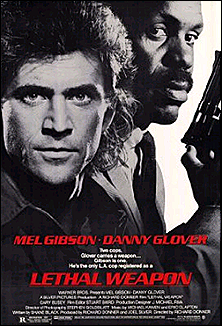
TDA Sunday Cinema: Lethal Weapon I – BJJ on display

Lethal Weapon 

To my knowledge, Lethal Weapon was the first display of Brazilian Jiu-Jitsu in a mainstream film (or any film that I’ve seen). This was prior to the original UFC,  which was a Gracie showcase. Be honest, had you heard of BJJ at the time? I had not, and don’t remember when I started hearing about the Gracie Challenge in Black Belt magazine. Watch this scene.

Trivia and stuff about this film (most via IMDB):

  1. Why has Gary Busey been a villain so often? Per IMDB, “he was hired to play Joshua because they were looking for someone big and menacing enough to be a believable foe for Mel Gibson. Busey also credits the film for reviving his failing movie career.”
  2. And check out the ‘80s hair on Mel Gibson! I’m thinking he’s got a little of the Billy Ray Cyrus thing going on, don’t you?
  3. Gunophile movie mistake: Riggs continually references a "hollow-point" bullet when talking about his suicide plan, yet he is clearly holding a bullet with a full metal jacket both times it is shown.

UPDATE: Per his site, Rorion Gracie choreographed both Lethal Weapon and Lethal Weapon 3.

Technorati Tags: ,,,,,,

Friday, December 26, 2008

When you can't fight back

At TDA Training, we often focus on things like mob attacks (or defending Multiple Attackers), defending against weapons (Knife defense and/or Gun defense). Additionally, many of us see martial arts training as an equalizer.

I've always looked at martial arts, in general, as an equalizer, much like the Colt .45 in the old west. I believe that you can improve your chances of survival in all self-defense situations if you have some training. – from How to Make Your Training More Practical for Self-Defense post

However, I have to make an admission to you that I was speechless when I was asked, at a family gathering, the following question: “You have a lot of training and experience as a martial arts instructor. What could someone like me do to protect himself?” I probably looked (and sounded) like an idiot of the first order as I paused, stammered, and then backtracked in my multiple responses. I think it was evident to my friend that I didn’t believe that there was.

What can you and I do to train someone who has a physical disability such that he or she can’t fight back? You see, my friend had a condition which affected his ability to stand, to say nothing of walking or running. It makes his ability to transfer power a near impossibility.

Nearly all of my life I’ve been either bigger, stronger, or faster than the next guy (or at least I believed I was). When I became skilled in martial arts, it only made the differences starker. In my thousands of rounds sparring against hundreds of opponents, and in all of my years of teaching and training, I’ve only felt out of my depth a few times; like I would definitely lose if it were “for real.” What would it be like to feel that way all of the time? How about to have something happen to you that made you feel that way, and that you could never prevail over someone else?

For me, that would be a nightmare scenario, and yet, for all of us, it’s inevitable? Age, injury, or infirmity will catch up to all of us. Old age is, past a certain point, as inevitable as the Earth turning or the sun rising, and yet most of us go through life training and teaching without that in mind? Why?

This is a serious question for all of you instructors, students, fighters and fans out there. How would you approach teaching someone who realistically couldn’t fight back? Or what would you do if you couldn’t (see how I slipped back into the trap)?

I’d like your feedback on this in the comments. Look for a post to answer shortly.

Thanks.

Technorati Tags: ,,,,,,,,,,,

Wednesday, December 24, 2008

Tuesday, December 16, 2008

Ready for vacation

Forgive me for the light posting. I'll be on leave starting tomorrow, and you know what it's like before taking leave: you work your butt off. Stay tuned!

Sunday, December 14, 2008

TDA Sunday Cinema: Jackie Chan vs Bill Wallace

One of the least-known Jackie Chan films includes American full-contact legend Bill "Superfoot "Wallace as the villain in The Protector. What do you think of the fight scene?

Thursday, December 11, 2008

My tears this morning

... are from reading this.

I've not had time to do almost anything related to blogging in the past couple of weeks, but, of course, heard about the F-18 fighter jet crash in San Diego. The open heart and Christian love that this man has, his capacity for forgiveness, and his gratitude for having had his wife and kids are almost unbearable.

Man who lost family when jet hit house: I don't blame pilot

SAN DIEGO, California (CNN) -- A Korean immigrant who lost his wife, two children and mother-in-law when a Marine Corps jet slammed into the family's house said Tuesday he did not blame the pilot, who ejected and survived.

"Please pray for him not to suffer from this accident," a distraught Dong Yun Yoon told reporters gathered near the site of Monday's crash of an F/A-18D jet in San Diego's University City community.

"He is one of our treasures for the country," Yoon said in accented English punctuated by long pauses while he tried to maintain his composure.

"I don't blame him. I don't have any hard feelings. I know he did everything he could," said Yoon, flanked by members of San Diego's Korean community, relatives and members from the family's church.

Authorities said four people died when the jet crashed into the Yoon family's house while the pilot was trying to reach nearby Marine Corps Air Station Miramar. Another unoccupied house also was destroyed.

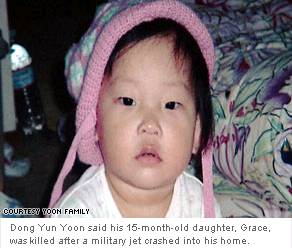
Yoon named the victims as his infant daughter Rachel, who was born less than two months ago; his 15-month-old daughter Grace; his wife, Young Mi Yoon, 36; and her 60-year-old mother, Suk Im Kim, who he said had come to the United States from Korea recently to help take care of the children.

Fighting back tears, he said of his daughters: "I cannot believe that they are not here right now."

"I know there are many people who have experienced more terrible things," Yoon said. "But, please, tell me how to do it. I don't know what to do."

Marine Corps authorities said the pilot, whose name was not released, was hospitalized after he parachuted from the jet, and an investigation into the cause of the crash has been launched.

The jet had just performed landing training on a Navy aircraft carrier before the pilot reported having trouble, according to the Marine Corps. Authorities described the jet as disabled.

Three bodies -- those of two adults and an infant -- were recovered hours after the crash on Monday. The fourth body -- that of a child -- was recovered Tuesday, as firefighters sifted through the rubble of the Yoon house.

Authorities said they did not expect to find any other victims of the crash.

Technorati Tags: ,

Monday, December 08, 2008

Threat Indicators and Personal Safety

This is a guest post by Thomas Gerace, someone for whom I have a lot of respect. Thomas is author of The Things Worth Believing In blog, a newer site with an early and continuing emphasis on the concept of "warriorship." By his own definition, he is a "husband, father, police lieutenant, FBINA graduate, fitness buff, martial artist, hunter, reader, gun nut, conservative, internet surfer." Check out his blog after this taste.


Have you ever been in a situation where a person gave you the impression that they could be a threat? Did they gave off some sort of "vibe" that they were ready to start some trouble; something you just couldn't place your finger on? Chances are that there were obvious physical clues that person was giving you that you were only aware of sub-consciously.

A common topic in law enforcement training circles is the detection of something called "pre-assaultive threat indicators". In any police contact, officers are trained to look for physical cues that serve as "early warning signals" that a person may flee or become combative. These same cues can be useful in the civilian world as well. Being able to identify body language that indicates an imminent attack can give you the opportunity to, at best, "beat feet". Or at worst, allow you to preempt the attack with a defensive measure.

Avoiding Eye Contact: When a person acts like you are not there and wont look at you it can mean a few different things, or a cluster of them. The person is avoiding engaging because he is mentally processing the situation in an agitated state and cannot multitask. He is trying to decide what to do and when, he could be looking for an escape route or psyching himself up to act. He could also be attempting to distract you for a sucker punch.

The Chest Puff: "Making the body bigger says 'I am powerful' and is a typical male action. This warns other men not to attack and may indicate that the person is thinking of attacking. It can thus be a response to a threat. If one man expands, then others have the choice of retreating or expanding also ('If you attack, I'll fight back!'). Expansion can thus indicate anger."

Rocking Motion: When people are going into "fight or flight" mode their bodies are pumping oxygen and adrenaline into their systems and if they are trying to contain that urge to fight or flee (for the moment) they will do some odd things. Pacing, bouncing up and down, rocking back and forth, helps "burn off" some of that extra O2. it is also indicative of a subconscious "warming up" for action.

Averting the Face: People on the verge of initiating an action often attempt to hide their anxiety by averting or hiding their faces. This will also be seen in facial wipes, slicking back the hair, looking up into the air, etc.

Boxers Stance: This is a solid indicator that the "fight" half or "fight or flight" is being chosen. Look for a flexing of the knees and a "nose over toes" lean that indicates a preparation to launch.

Clenching of Fists: Another indicator that "fight" is the choice. Its also another "warming up" gesture.

Thousand Yard Stare: The subject is looking "through you" instead of at you. He has that "faraway look" on his face. He is putting himself in his "angry place". He is dehumanizing you and hovering over the launch button. Gain distance.

Target Glance: The opposite of the Thousand Yard Stare. the subject is zeroing in on a target. If he's staring at your chin be ready for the sucker punch. If its your weapon, a gun grab attempt.

Facial Wipe: see Averting the Face

Now, don't go nuts just because some guy wipes his face. The secret to decoding these cues is to take the entire situation into account and look for clusters of behavior. If you are in a profession where you have to deal with people in these situations; when you see these indicators it is time to act! Put some distance between yourselves and start issuing commands for compliance. I would be getting my OC or taser limbered up and/or tightening the laces on my running shoes. If you are a civilian and you see these cues...leave...if possible. If leaving is not an option, get ready.

The attached video is a clip from a project put together by a close friend who is a martial arts instructor, a local film artist and myself. It's a project in progress. Don't be too critical of the realism of the defensive response at the end. The threat indicators were the focus of the piece and we were not willing to roll around on the hot summer pavement for a more realistic "fight".

For more articles like these, please visit my blog: The Things Worth Believing In.

Sunday, December 07, 2008

Read Striking Thoughts Martial Arts News

Martial Arts News at Striking Thoughts

At first I thought, "Ah, another copycat of the world-famous TDA Blitz (after all, who wouldn't want to copy it?), but ol Bob Patterson (a Convocation Partner) really puts together a great (and original) summary of interesting martial arts-related news and links. Read his Martial Arts News posts every week at Striking Thoughts.


View my page on The Convocation of Combat Arts

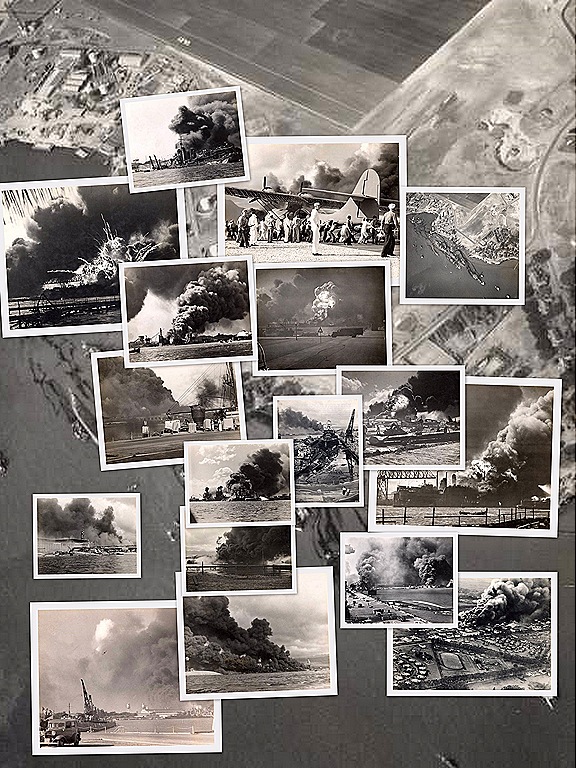
A Day Which Will Live Forever

Pearl Harbor

Technorati Tags:

Saturday, December 06, 2008

Is the elbow the best infighting weapon?

From the archives. The only editorial comment I'd make is that a good knife might be better.

[Note: this was originally posted in January of 2006]


Friday, December 05, 2008

TDA Blitz 2008.12.05

Holiday Rush Edition: I've decided to start naming the Blitz with a theme, just 'cause. This is a bonus 15 bullet Blitz because we weren't able to get one out last Friday.

We're through with Thanksgiving now, the aptly named Black Friday has come and gone, and we're in a rush to complete our Christmas shopping. I'm fortunate to be able to have negotiated the amount of leave that I did, and will be off from mid-month through the New Year's Day holiday.

Without further ado, and after much research and painstaking vetting, here's the TDA Blitz!

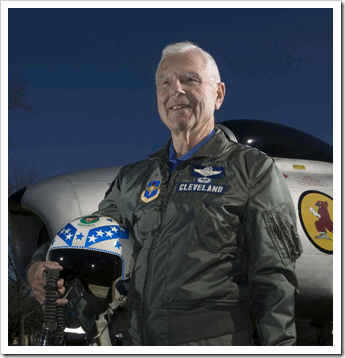
  1. Well done! Via Military Times.LTG Charles Cleveland

    Newly confirmed Korea ace receives Silver Star

    Fifty-five years after he flew F-86 Sabres over Korea, retired Lt. Gen. Charles Cleveland will receive a Silver Star for his aerial dog fights on Monday.

    Cleveland qualified for the Silver Star earlier this year when the Air Force Board for Correction of Military Records recognized a MiG 15 he shot down in 1952 as an official kill. The board’s decision made him an ace, a pilot with five confirmed kills.

    Cleveland did not record the dog fight as a confirmed shoot down in 1952 because he had not seen the plane crash, flames coming from the plane or the pilot bail out.

    More than 50 years later, a West Point classmate of Cleveland’s, Dolph Overton, found Soviet records of flight operations in Korea that included a shoot-down matching Cleveland’s encounter. Evidence from those records helped convince the records board that Cleveland brought down the MiG-15.

  2. One of the best video posts in a while, Striking Thoughts compares how different martial arts handle street fights. Head over and watch!
  3. How is Britain's strict gun control, and now "knife control" policy working out? As this, and many other stories reveal, not well. The focus "across the pond" has been on criminalizing any means that honest citizens have from defending themselves, and those who choose not to obey those laws can run rampant. If handguns were legal and available, do you think that the incidence of knife crimes would be as high?

    One teenager killed on Britain's streets every five days

    One teenager has been killed on the streets of Britain every five days this year as the number of fatal stabbings soars, The Daily Telegraph can disclose.

    Official figures from each police force in the UK reveal a grim tally of 65 teenagers who have met a violent death since January 1 - almost two-thirds of whom were stabbed to death.

    The record level of teen killings, which has doubled in five years in London alone, has alarmed senior officers and led to being named as the top national priority at a recent meeting of police chiefs.

    The figures show that the problem is acute in the capital, which has six times the rate of teenage murders of any other city.

  4. EagleSpeak reveals Mumbai attack parallels failed New York attack plan. Do we still need to remain vigilant? The terrorist murderers in India reveal what a disarmed populace, and under-trained and poorly armed police force can't do: stop a determined band of attackers willing to die. I think we all hope that our civilian law enforcement would do better...

    Stratfor posts an interesting comparison between the Mumbai attack of last week with a failed plan to attack New York City several years ago in From the New York Landmarks Plot to the Mumbai Attack. From the last piece by and :

    A third similarity exists in the geography of the two cities. In both plots, the use of watercraft is a distinctive tactical similarity. Watercraft gave militants access at unconventional locations where security would be more lax. Both Mumbai (a peninsula) and Manhattan (an island) offer plenty of points where militants can mount assaults from watercraft. Such an attack would not have worked in New Delhi or Bangalore; these are landlocked cities where militants would have had to enter by road, a route much more likely to encounter police patrols. Being centers of trade and surrounded by water, both Mumbai and New York have high levels of maritime traffic. This means infiltrating the area from the water would raise minimal suspicions, especially if the craft were registered locally (as was the case in the Mumbai attack). Such out-of-the box tactics take advantage of security services, which often tend to focus on established threats.
  5. Low Tech Combat has a great post on Helio Gracie - Training into Old Age. Inspiring!A Roadmap for Brazilian Jiu-Jitsu
  6. BJJ luminary Stephan Kesting has a free e-book for you! Go here at Beginning BJJ to get it. I did, and look at me now. Ok, don't look at me, but imagine that I'm really good at BJJ now. If you had done the same a few minutes ago, you'd be good at it, too. Really.
  7. Jiu-Jitsu Sensei Lori O'Connell has an interesting post on Why Small People Have More Trouble When Starting a Martial Art, stating that, "When starting out, bigger people usually have less trouble because what they lack in technique, they make up for using strength. Then, with practice and good instruction, they will make adjustments to eventually do it without relying on their strength (in theory)." I'd actually disagree with that, and say that, perhaps only in grappling arts does strength confer an advantage in the beginning stages of training. In many traditional striking arts, techniques are done in the air, or at best, on a striking posts or bag, where strength doesn't make any difference. When it comes time to applying such striking arts, many of the tactics and techniques were actually designed by smaller instructors for use on someone of the same or larger stature. So, larger size and strength can make it harder sometimes. Where bigness really shines is competitive sport styles like BJJ, Judo, boxing, Sumo, or any other style where weight classes don't make a height distinction, and rampant weight-cutting can lead to great strength disparities. Is she right? Yes, and no.
  8. John Zimmer's post Fighting with Self-Defense! addresses his dinner conversation with a "formal" (as opposed to sport) stylist in karate who said that,
    The formal stylist made the following points:
    • you fight the way you train

    • if you put on hand and foot pads, you drastically reduce the possible targets

    • if you spar using self-defense, you will end up maiming or killing your sparring partner

    • if you have to defend yourself, you will end up making mistakes if you are used to fighting for sport

    I made the following points:

    • you fight the way you train

    • high-kicks would work against most attackers as I was already used to them

    • I would not be surprised if I got hit hard (used to contact)

    • I was used to hitting and winning fights (from sparring)

    So you can see how the conversation went and I came away knowing that I was right because I had been in over 100 (my estimate) real fights in the bar while I was bouncing and never had too much of a problem. But he got me thinking and today I now think I agree with allot of his positions.

    It's a very interesting post, and while I agree with Zimmer on many points, the reason he's able to use his "sport karate" style of fighting in self defense Why Shodan?was because he modified it for the street. He admits to using some basic techniques, but aimed at "illegal" areas, and had a lot of experience (100+ violent encounters) due to his encounters with unruly patrons as a bouncer. He's clearly a fighter, not just a sport player. The delusion of a lot of no-contact "formal" stylists persists, though, in that some still believe that deadly techniques which they've never practices full-speed/full-power, or who don't make contact or spar, are still going to prevail against some untrained street ruffians. Sigh... More on this in a full post.

  9. On the subject of self defense, this encounter makes it clear that you'd better make sure you're opponent is really finished before you let down your  guard!
  10. Fascinating post by our friend Patrick at Mokuren: why first degree black belt is called "Shodan," and not, "Ichidan." I learned a lot there, Pat!
  11. Cops now using Twitter? Makes sense. Read it!
  12. Good advice on generating more striking power at Traditional TKD.
  13. Excellent advice on data security to protect your identity and finances.
  14. Congratulations to Kyoshi Steve Lavalle on earning 8th dan!
  15. Brave New World. A genetics company is offering a $149 test that aims to predict a child’s natural athletic strengths. Christopher Littlefair at Diary of a Martial Artist has a great video post named, appropriately, Hilarious. Click the link or the photo to watch!
    Hilarious but sad attempt to break boards


Thursday, December 04, 2008

US Special Forces develop "functional combatives program for operators, support elements"

1ST Special Forces Group (Airborne) develops functional combatives program for operators, support elements

SOC combatives technique

A 1st Special Forces Group (Airborne) Soldier (top) executes a move called the “S position” during a “Defanging the Serpent” combatives-training session in the Group’s combatives pit at Fort Lewis, Wash. Feb. 1. “Defanging the Serpent” is the unit’s internally-developed, combat-tested combatives program. (U.S. Army photo by Staff Sgt. Andrew Kosterman/1st SFG (A) PAO)

FORT LEWIS, Wash. (Courtesy of 1st Special Forces Group (Airborne) Public Affairs Office, Feb. 8, 2008) – For Special Forces Soldiers, there are a few things that are just part of everyday life: shooting, airborne operations, studying foreign languages and cultures, teaching foreign soldiers and combat-focused combatives training.
The techniques of the current Modern Army Combatives Program are essentially mixed-martial arts techniques that are certainly effective in individual cagefights and tournaments.  However, these techniques may not be the best available for actual combat situations where Soldiers wear full battle kit.   A full kit usually includes a helmet, body armor, weapons and tools. 

It was with this in mind that leaders within the unit began using their own experiences and knowledge to develop a fighting program called “Defanging the Serpent.”

“About 6 years ago (at 1st SFG’s 1st Battalion in Okinawa), then-Lt. Col. Wendt came to me about developing a combatives program,” said Chief Warrant Officer Maurice K. Duclos, co-founder of the program.   “Together, in 2002, we came up with 30 standard moves that were learned by the entire 1st battalion.”

After developing the initial program with Wendt, Duclos set out to continue to improve the system.

“I was thinking, ‘what did we miss, what could we have done better,’” Duclos said.  “Based on operational experiences and feedback, I started to come up with a plan to make what we have better.”

“We started out with 30 good moves, but they were “martial arty” and didn’t necessarily pertain to our job,” Duclos said. 
In 2006, Duclos was tasked again by Wendt to develop another system that could be used by all the Soldiers of the 1st SFG.  By this time, Wendt had been promoted to colonel and is the current commander of the Group.

The current program has a much better developed strategy and does not require students to learn a lengthy series of moves, said Duclos.

“In developing this program, we wanted to stick to ‘most likely to happen’ scenarios and moves that are high-percentage payoff,” Duclos explained.

Wendt agreed, saying the moves in the updated program are more likely to be used by Soldiers conducting operations.

“We want Soldiers trained in combatives techniques that work in confusing combat situations,” said Wendt.  “Cage fighters are very tough individuals with great techniques for that venue, but we are not training our Soldiers to be cage fighters in a one-on-one match or tournament.”

He further explained that 1st SFG Soldiers work “through, by and with” the populations of countries when deployed.

“Because we operate in these situations, it is important to know highly effective techniques in a system designed specifically for these combat
situations,” Wendt explained.  “’Defanging the Serpent’ is a system that can be used by Soldiers who are wearing their full battle kit in situations that require different levels of lethality against single or multiple opponents.  In other words, it is a system designed precisely for what our Soldiers face when deployed.”

His thoughts were shared by more junior members of the unit.

“I love the command emphasis on combatives in Special Forces,” said Pfc. Shawn M. Carson, a support Solider in the Group, and one of the graduates of the first-ever 1st Special Forces Group combatives instructor course.  “I feel much more confident.”

Carson, who wrestles in a Seattle-based club during his off time, compared the current Army program to the unit’s.

“The Modern Army Combatives program pales in comparison to what we got here (in 1st SFG),” Carson said.  “This system is all about preparing Soldiers for real combat situations instead of cagefighting.  There is no comparison.”

Wendt added his own thoughts, saying that he is very pleased with the ‘Defanging the Serpent’ program. 

“Our Soldiers are further developing the ability to either diffuse an operational situation with a small amount of force, or escalate the amount of force to be used as required, up to and including how to close with and subdue or destroy the enemy,” said Wendt.  “Fully combat-functional combatives training of this type is time well spent.”