Monday, February 28, 2011

Should MMA Be Banned?

3367150744_7c73c408d4
Photo credit: David Kuhn

That’s the question posed by Mr. Vesia at Martial Views. He brings up part of the timeline of MMA’s history in the US.

Getting MMA on legally equal footing with boxing, kickboxing, etc., has been no easy task for its proponents, thanks to propaganda and bad press. Politicians such as John McCain railed against MMA in the 90s. Still, in spite of what appears to be gratuitous violence, MMA is no more dangerous to its competitors than other contact sports.

and then,

I don't think MMA should be banned, though. What do you think?

I planned to respond in the comments, but it got to wordy, so here are my thoughts in reply form to the original post.

John,

I just reread your "Boxing vs. MMA" post because of this one, and I wonder how many of the commenter's views on MMA have changed.

McCain was probably right, in that his original statements and proposed legislation was during the very early days, before Zuffa took over the UFC, and before there were uniform rules governing the sport. The early "rules" allowed a lot. This Wikipedia summary of UFC 1 rules state, “no biting, no eye-gouging, and no small joint manipulation. Fights ended only in the event of a knockout, a submission, usually signaled by tapping the hand three times on the mat or opponent, or by the corner throwing in the towel.” Obviously, there was a real danger of permanent injury or death if the officiating were not good enough.

MMA definitely is a sport, with superbly trained and conditioned athletes. Per Dictionary.com, sport is defined as “an athletic activity requiring skill or physical prowess and often of a competitive nature, as racing, baseball, tennis, golf, bowling, wrestling, boxing, hunting, fishing, etc. It would be hard to argue that bowling or fishing are sports, while MMA does not require skill, physical prowess or competition.

MMA has undeniably changed over the years, and improved in quality. When compared to other combat sports, I had the same complaints about it in the early days, even through 2-3 years ago - sloppy technique, poor tactics, and, to answer your post's title, the spectacle approach that was similar to pro wrestling. Interestingly, until the heyday of K-1, I hated watching kickboxing due to the poor technique and sloppy tactics.

I think that has changed, and, from what I understand, MMA has eclipsed traditional martial arts for the young adult demographic - it has some appeal for those who want something more "realistic," but most parents seem to want what a good traditional school and art can offer: life skills development through achievement.

As to your final question, banning MMA? I think we'd have more luck trying to bad ice hockey. Without researching the numbers, I think the passion and viewership numbers for MMA are probably as good as the NBA, and better than anything but the NFL and NASCAR. It should exist if high school football, cheerleading, or boxing should exist. Or back yard trampolines.

What do you think? Please comment here, at the Martial Views post, or join us at the TDA Training Facebook Page for a discussion.

Sunday, February 27, 2011

The Biggest News of 2011 (so far)

I’m sure many of you are thinking things like:What? TDA Training is on FB? No way!!!!
Nope! None of those things. Something which will rock the world is that TDA Training is now on Facebook!

We’ve decided to take the plunge and get back into the martial arts blogging business, and will now emulate the other great sites by going over to this newfangled (see, I’m oldfangled, so it’s new to me!) Facebook thing!

We plan to develop posts there by linking to things we read, discuss, debate, argue, and make up about them in the discussion forum, and be friends with other pages, too. It’s a whole new world, people, let’s adapt and get used to it.

How did this come about? Well, I don’t really know. I’ve been thinking about dumping the whole blogging thing, or going back into it with full commitment. And, seeing as to how I don’t want to have a commitment problem, I decided to do this thing right.

If any of you are on FB, please “Like” our page. If you run a martial arts page or site, please let me know. We will put our “Like” button at the top of the sidebar for a few weeks, and promote it in an annoyingly constant manner, so join up so that quit!

Thanks!

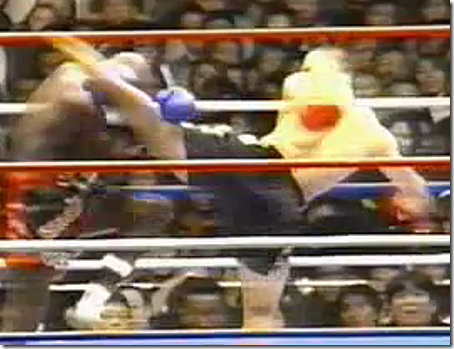
Hoost vs. CroCop = Outstanding!

Via The Angry Sensei. Click the pic to watch.

image

Saturday, February 26, 2011

Explosiveness Rules!

BXP135660
Image by tableatny 

After sparring hundreds of other martial artists over the years as a competitor and instructor, I finally made the connection: the reason I was better was not just technique – it was speed (that’s physical, not mental speed, obviously!). I could react quicker and move faster, and, after enjoying some success as a purely offensive, attacking fighter, learned to take advantage of my quickness by become a sadistic counter-fighter. I’d leave something open (a draw), then stop-hit or counter after making my opponent miss. What I had was EXPLOSIVENESS!

I have always been relatively strong and quick, and definitely not a distance-running kind of guy. I knew I was quick around the playground, but didn’t know to what degree until I was went into 6th grade. We lived in Germany in the 70s and attended schools run by the DOD, and to save costs, we were bussed a long distance to large, consolidated schools. Mine had over 600 kids per grade, and I can imagine it could be a bit intimidating. Anyway, I got an objective measurement of my attribute when they had us all race against everyone in our grades in heats. I remember winning heat after heat until I was in the last one, and then they had all the winners of the grades race together. I came in 3rd, which disappointed me to no end, but that was that – I was a 6th grader racing 7th and 8th, and was amazed and surprised.

How can we increase the explosiveness that we’re born with, or develop what we can? Several ways:

  • Sprinting – what I was unconsciously doing as a kid by racing as much as I did was develop the fast-twitch muscle fibers in my body. As anyone who’s watched a race can tell, sprinting is a whole-body sport, not just the legs. You tense and contract everything from the core to the hips, thighs, and drive off your calves and are flexing even the muscles in your feet and toes. A big reason that some are faster than others is that they utilize that drive and increase it with their core and upper body assisting in the weight transfer and momentum. Olympic sprinters look like the bodybuilders of 20 years ago (uh, let’s not discuss any drugs at this time).
  • Weight training – squats, cleans, and almost any weightlifting (not bodybuilding) movement that utilizes the whole body will increase and develop explosiveness. I am not an expert in that type of training, but there are many out there. Enlist the aid of someone who’s involved in sports-specific or conditioning. ALL successful sports programs use this type of training now.
  • Plyometrics – dynamic training such as rope skipping, depth jumping, lateral jumps, clapping pushups, and medicine ball training are all examples of this.

The common denominator in all of this training is explosiveness, and whole body involvement.

I strongly suggest you check three sites for techniques, suggestions, and even instructional video, and they’re all FREE!

RossTraining.com – the author of one of my favorite sites is a well-respected trainer of elite combat athletes, and not only knows what he’s teaching, he’s an amazing physical specimen because he practices what he preaches. Many of his videos and articles include his demonstrations, and they are great! This is probably the most motivational site for physical conditioning, too, as he constantly features people who are in their 70s and older who put me to shame!

Combat Trainer – my friend Rob is fast becoming one of  the best bloggers on martial arts training, with an emphasis on training MMA and other combat athletes. Don’t discriminate if you’re a traditional martial artist, though, ‘cause what he’s teaching and demonstrating will work for all of us. His latest example is a video of Jon Fitch doing jump squats.

Straight to the Bar – this is a great collection of articles, links, and posts of all types of strength training, and also features strongman training techniques. It’ll spice up any routine, and you could browse it for hours.

Any other suggestions or links you would share? Comment!

____

Like this post? Subscribe to our feed, or by email and you won’t miss a thing.

Interact with us at our TDA Training Facebook page!

All original material is copyright of their respective authors.
All rights reserved. Permission must be obtained before use. Copyright 2011
Competitive Distortion in Martial Arts Competition

Why do the rules favor certain techniques? Mr. John Zimmer stirs things up at My Self-Defense Blog with a post about how the rules have changed in open martial arts tournament sparring. See Karate Tournament Rules; How Many Points for a Kick?! for a very nice discussion in the comments with Zimmer, myself, and Sensei Matt Klein.

The gist of the matter is that there is a distortion in competition so that there either a purity of style, or a desired outcome. In the case of style, TKD tourneys favor high kicking above all else, and de-emphasize punching, especially to the face, while (as I mentioned in the comments at the post) the UFC started giving financial incentives to the fighters to finish a fight with a KO, as opposed to a decision or submission. Why?

Check out My Self-Defense Blog to find out!

Thursday, February 24, 2011

Lessons from the DC Metro (video)

[Content warning: violence, language]

UPDATED: Adding comments and other feedback.

Watch.

Attack at DC Metro station

The video posted here is likely from a bystander witnessing an attack at a Washington, DC Metro station. According to the story (posted here), it was in public, and no one assisted the victim. My summary:

  1. Victim is minding his own business.
  2. He is also distracted, not paying attention.
  3. He is cornered, and then distracted again.
  4. Unable to defend himself effectively, he tries to enlist aid in a busy public place.
  5. No one comes to his aid.
  6. Law enforcement takes a report.

Does that seem accurate?

Several thoughts, all my opinion as to what happened, and what we should all take away as lessons:

First, there are bad people in this world, who love to hurt others because they either don’t see them as human (and worthy of respect), or don’t care. My opinion, but justified in the newspapers and television every day. The beginning of awareness is knowledge that there is a potential threat and that may change your behavior.

Second, awareness of possible danger is fundamental to avoiding it. My friend tgace wrote an excellent, profound post early in his blogging career, Self-defense “magic formula”, wherein he shares this nugget:

As a LEO I believe I can give you the “magic formula” to avoid 99% of “street attacks”:

Don’t participate in illegal activity. Don’t hang out with people who attract trouble (need I clarify that?). Don’t hang out in places that attract trouble. Don’t get drunk or high. Don’t tolerate domestic violence, call the police and/or leave the abuser. Be alert to your surroundings and if something “feels” wrong…leave. Many people stick around thinking that they are being needlessly paranoid.

The point is that survival is almost always our choice. Our victim made a choice, probably out of ignorance, but chose to pay more attention to his book than the people (potential threats) around him. He was struck from one side, then the other, even while we was responding to the first. He had lost the initiative, which is always key to winning. The reason that most criminals continue to be criminals is that they get away with it. That’s because they act, rather than react. By knowing that you are already a step behind, you should be encouraged to at least be aware to give yourself some kind of chance.

Additionally, if something does happen, you’d better believe it. One of the most common responses by victims of violent crime is “I can’t believe this happened to me.” But that’s after the fact. The real problem is that many of us have that outlook during an attack, or while it’s developing. This is an extension of the first two points: 1) no conception of the predatory nature of others, and, consequently, 2) being unaware of what’s developing or happening, as in, “Someone’s approaching me with a closed fist and a scowl.” Another aspect of this attach was that the attackers were “kids.” If you have any ideas that kids, women, or smaller people won’t attack someone else, let this scenario be your education.

His reaction of asking for the attackers to stop had the same effect it almost always does – encouraging the attack to continue. As someone who’s taught dozens of women’s self-defense courses, it’s important to understand that one of the last responses that works is begging the attacker to stop. Additionally, the presence of others, adds the mob mentality to the situation, which makes extreme violence more likely regardless of the age and sex of the attackers.

So enough Monday-morning quarterbacking here. What is the proper response to an attack like this? First of all, let me say that these are my opinions only, as stated before, and should not be considered advice. That said, I would:

  1. Be aware of possible danger – even in public places. Look around, make brief eye contact with everyone around you to let them know that you are aware of them, and that you’re not afraid.
  2. Have an out – an exit strategy is more important in self-defense than anything else. How can you extricate yourself? Where are the exits? Is there anything in the way of your escape (especially threats)? Make a note of where, and how far they are, and make sure you don’t get disoriented.
  3. Arm yourself. That may mean whatever is appropriate for your environment and potential threats. It may, or may not be permissible to carry a weapon, so consult with your attorney or state and local codes. My intention is to say that we should do what is necessary and legal to protect ourselves. In this guy’s case, it may be beneficial, in hindsight, to take some courses on effective self-defense. In other words, be armed with knowledge and ability to defend yourself and your loved ones.
  4. Don’t count on help. The reason that the bystanders did nothing to help is probably more the rule than the exception, and is well-documented. In other words, you have to rely on yourself first, and if someone helps, all the better. This includes assistance from, or protection by, law enforcement. How many crimes in progress are interrupted by police officers, as opposed to solved after the fact? I’d hazard that most arrests are for suspects to crimes not witnessed by officers, meaning you’ve got little chance. In the case of our Metro patron, the fact that the attackers were so brazen as to do this with witnesses all around them means that they weren’t very afraid of getting caught.
  5. I’m going to stop here - I’d suggest you read this, then comment. I’d love to get your feedback as to whether there are any other lessons here. I will update the post and add your suggestions with credit.

UPDATES from comments and other feedback:

  • Rick, don't be stupid (you can’t put a price on wisdom, AKA common sense- Nathan)
  • Elias The only thing I disagree with, is the part where you said that asking the attackers to stop is useless. It is probably useless as far as stopping the attackers goes, but it might be necessary from a legal point of view. (Excellent point, and great advice- Nathan)
  • Via Facebook:
    FB User Good tips... now what would master pak do if (for the sake of argument) a little girl started wailing on u? How would u get them to back off, without looking like a grown man beating a little girl (..bitch...) it would be hard for me to run away, but having an angry mop push me on the tracks doesn't sound good either...

    Master Pak- Ignore the little girl and take out the biggest one and be sure to drop him. I'm pretty sure I can push her hard enough to fall or sweep her to be out of the picture if I can't be scary enough yelling at her. I yell pretty damn loud. if she comes back, I can whip her jacket over her head a la hockey fight style to temporarily subdue

Remember, the nature of self-defense is proactive.

For more information:

See the original post Man attacked by kids at L'Enfant Metro
Self-defense
Multiple Attackers

Hat tip to my friend and peer Jhon Pak, whom I’m betting would not respond in the same way!

____

Like this post? Subscribe to our feed, or by email and you won’t miss a thing.

Interact with us at our TDA Training Facebook page!

All original material is copyright of their respective authors.
All rights reserved. Permission must be obtained before use. Copyright 2011

Tuesday, February 01, 2011

Solo training–key to progress

This post at Just at Thought (a very nice Karate Blog by our old friend and Karate instructor Michelle, highlights one of the greatest opportunities missed by many: Solo training.

As I commented on the post, most progress is made on your own, especially when you are first learning, in my opinion and experience. The students who wait for class before breaking out the gi are those that make slower, more incremental progress, and often get frustrated. I often saw students leap ahead and out of stagnant periods when they made a little time and analyze their own techniques at home.